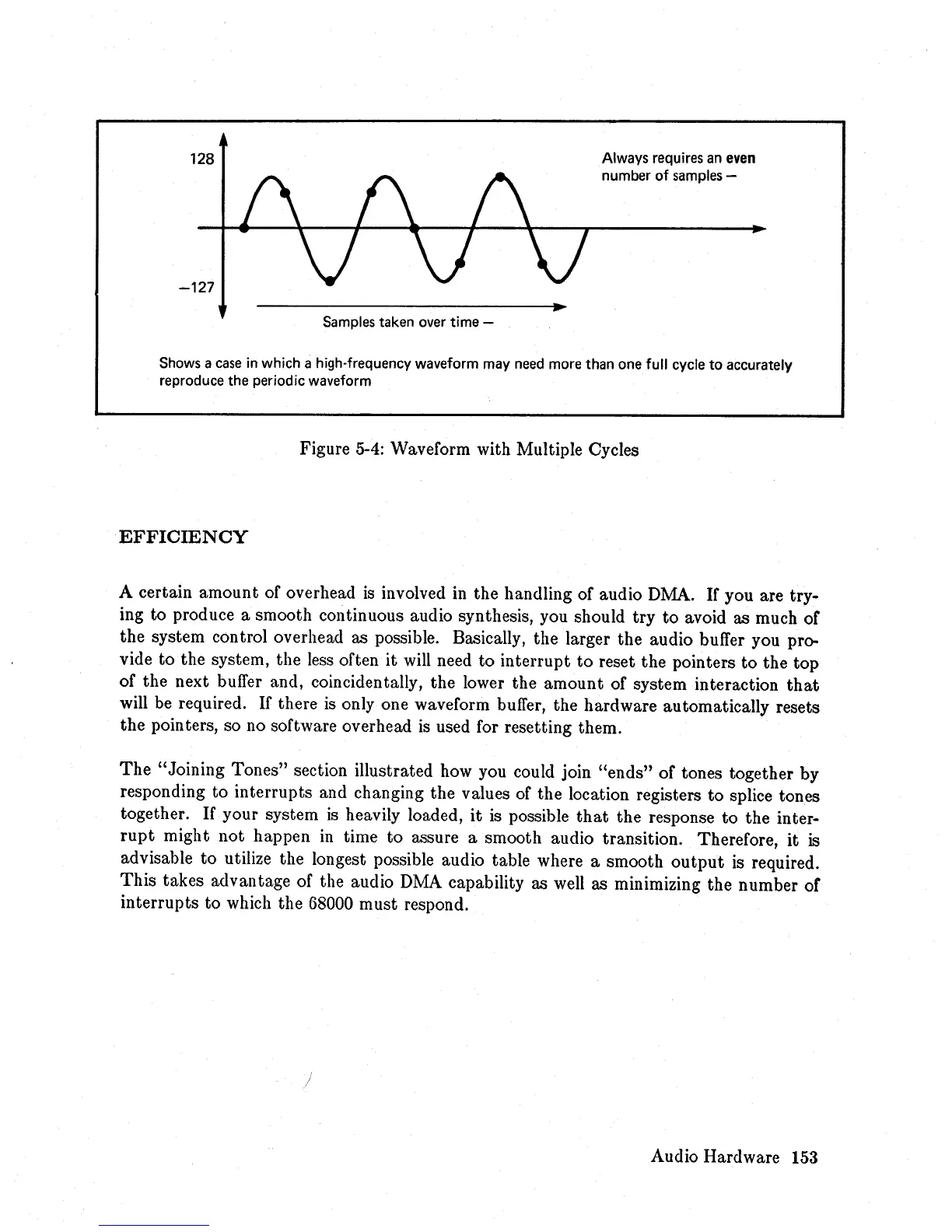
128
-127
Samples taken over
time
-
Always requires
an
even
number
of
samples -
Shows a
case
in
which
a high-frequency waveform may
need
more than one
full
cycle
to
accurately
reproduce the periodic waveform
Figure
5-4:
Waveform with Multiple Cycles
EFFICIENCY
A certain amount of overhead
is
involved
in
the handling of audio DMA. If you are try-
ing to produce a smooth continuous audio synthesis, you should
try
to
avoid as much of
the system control overhead as possible. Basically, the larger the audio buffer you pro-
vide to the system, the less often
it
will need
to
interrupt
to
reset the pointers
to
the top
of the next buffer and, coincidentally, the lower the amount of system interaction
that
will
be
required. If there
is
only one waveform buffer, the hardware automatically resets
the pointers, so no software overhead
is
used for resetting them.
The
"Joining Tones" section illustrated how you could join
"ends"
of tones together by
responding to interrupts and changing the values of the location registers
to
splice tones
together.
If
your system
is
heavily loaded,
it
is
possible
that
the response
to
the inter-
rupt
might not happen
in
time
to
assure a smooth audio transition. Therefore,
it
is
advisable
to
utilize the longest possible audio table where a smooth
output
is required.
This takes advantage of the audio
DMA
capability as well as minimizing the number
of
interrupts to which the 68000 must respond.
/
Audio Hardware 153






 To Next Page