20
21
22
23 24
24
26
27
28
29
30
31
32
33
34
35 36
37
38
39
40
41
42
43 44
45
46
47
48
49
50
51
52 53
54
55
56
57
58
59
60
61
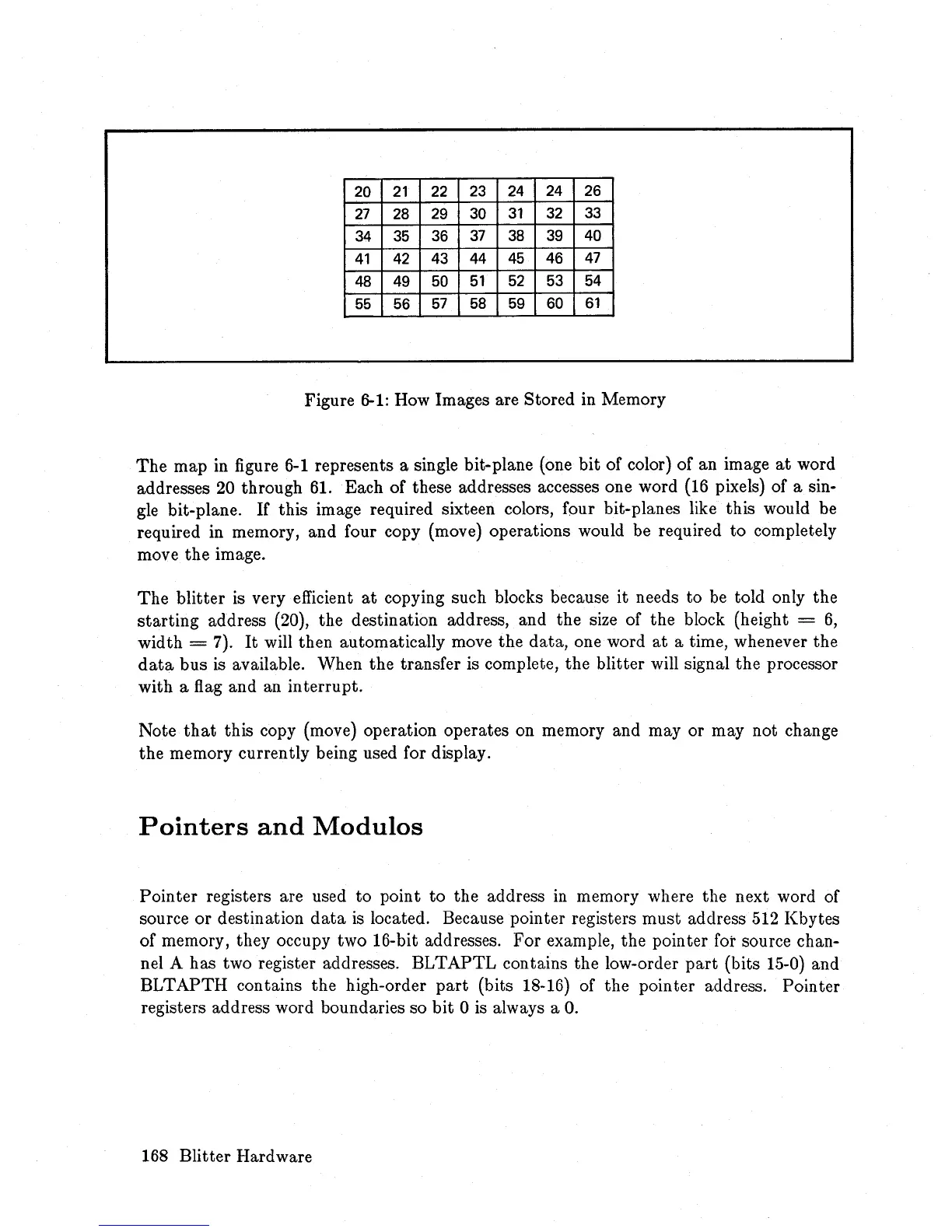
Figure
6-1:
How Images are Stored in Memory
The
map in figure
6-1
represents a single bit-plane (one
bit
of
color) of an image
at
word
addresses 20 through
61.
Each
of
these addresses accesses one word (16 pixels) of a sin-
gle bit-plane.
If
this image required sixteen colors, four bit-planes like this would be
required in memory, and four copy (move) operations would be required
to
completely
move
the
image.
The
blitter is very efficient
at
copying such blocks because
it
needs to be told only the
starting
address (20), the destination address, and the size of the block (height =
6,
width = 7).
It
will then automatically move
the
data, one word
at
a time, whenever the
data
bus is available. When the transfer is complete, the blitter will signal
the
processor
with a flag and an interrupt.
Note
that
this copy (move) operation operates on memory and
mayor
may not change
the memory currently being used for display.
Pointers
and
Modulos
Pointer registers are used
to
point
to
the address
in
memory where the next word of
source
or
destination
data
is
located. Because pointer registers
must
address 512 Kbytes
of
memory, they occupy two 16-bit addresses.
For
example,
the
pointer for source chan-
nel A has two register addresses. BLTAPTL contains the low-order
part
(bits 15-0) and
BLTAPTH contains the high-order
part
(bits 18-16) of
the
pointer address. Pointer
registers address word boundaries so
bit
0 is always a
o.
168 Blitter Hardware






 To Next Page