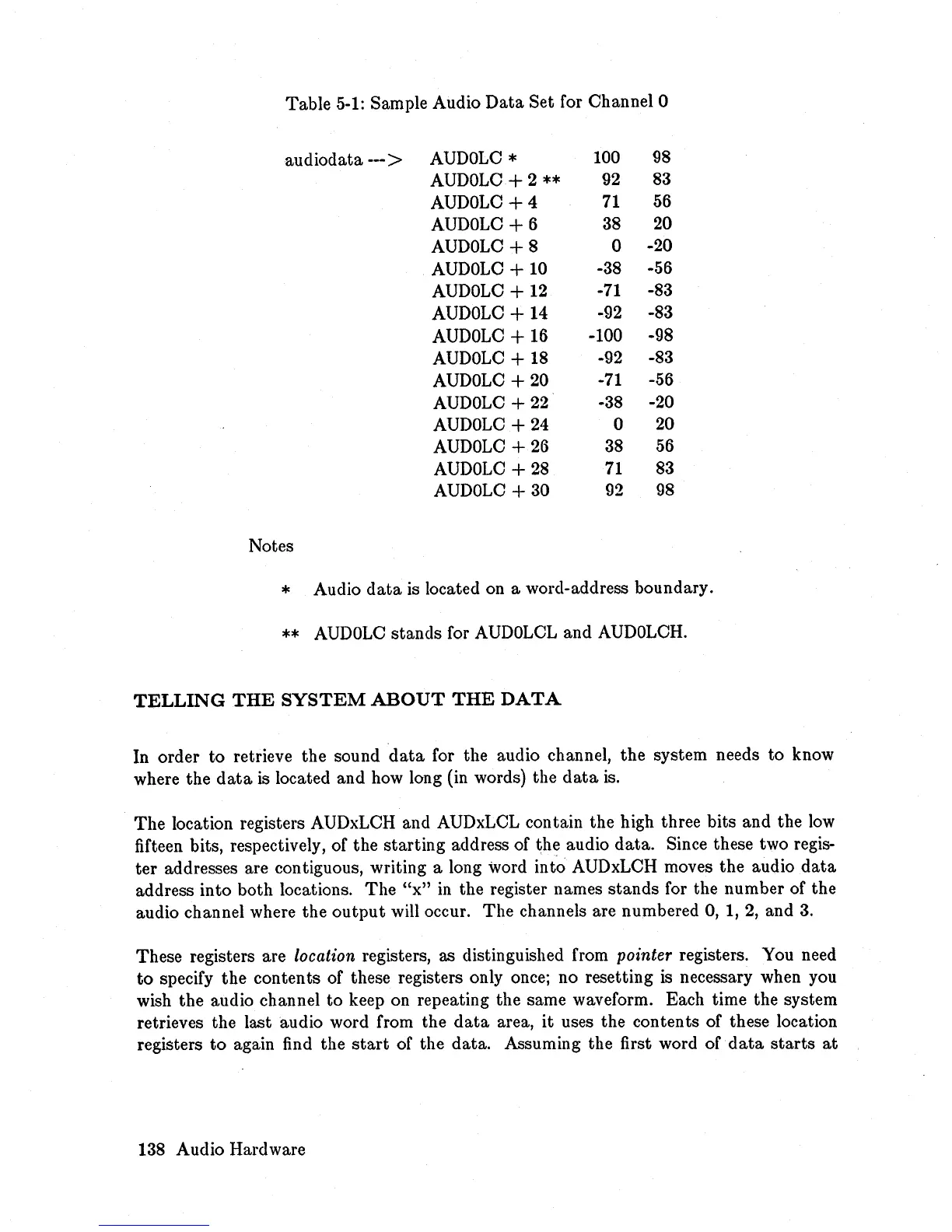
Table
5-1:
Sample Audio
Data
Set for Channel 0
audiodata
---
>
AUDOLC
*
100
98
AUDOLC
+ 2
**
92
83
AUDOLC
+4
71
56
AUDOLC
+ 6
38
20
AUDOLC
+8
0
-20
AUDOLC
+
10
-38 -56
AUDOLC
+
12
-71
-83
AUDOLC
+ 14
-92 -83
AUDOLC
+
16
-100
-98
AUDOLC
+ 18
-92
-83
AUDOLC
+ 20
-71
-56
AUDOLC
+
22
-38
-20
AUDOLC
+
24
0
20
AUDOLC
+
26
38
56
AUDOLC
+
28
71
83
AUDOLC
+ 30
92
98
Notes
*
Audio
data
is located on a word-address boundary.
**
AUDOLC
stands for
AUDOLCL
and
AUDOLCH.
TELLING
THE
SYSTEM
ABOUT
THE
DATA
In order to retrieve the sound
data
for the audio channel, the system needs to know
where the
data
is located and
how
long (in words) the
data
is.
The
location registers AUDxLCH and AUDxLCL contain the high three bits and the
low
fifteen bits, respectively, of the starting address of the audio data. Since these two regis-
ter addresses are contiguous, writing a long word into AUDxLCH moves the audio
data
address into both locations.
The
"x"
in
the register names stands for the number of the
audio channel where the
output
will occur.
The
channels are numbered 0,
I,
2, and
3.
These registers are location registers, as distinguished from pointer registers. You need
to
specify the contents of these registers only once; no resetting
is
necessary when you
wish the audio channel to keep on repeating the same waveform. Each time the system
retrieves the last audio word from the
data
area,
it
uses the contents of these location
registers
to
again find the
start
of the data. Assuming the first word of
data
starts
at
138 Audio Hardware





 To Next Page