Use e Maintenance ENGLISH
4.7.11 Parking the machine
The machine must be cleaned of any fertiliser residues
before parking.
Fertilisers mixed with the humidity in the air are
extremely corrosive. Keeping the machine clean
means prolonging its duration over time.
Do not park the fertiliser spreader in direct contact with
the ground. If possible, park the machine on a wooden
pallet.
Always park the machine on even, compact ground.
Only park the machine if the hopper is empty.
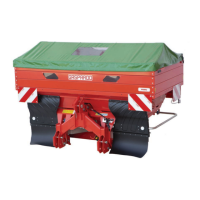
Using the storage wheels (optional)
The storage wheels allow you to easily move the machine
once unhooked from the tractor.
To assemble the storage wheels, proceed as follows.
DANGER!
All operations must be done exclusively with the
tractor off, P.T.O. disengaged, parked with
parking brake and with the key removed.
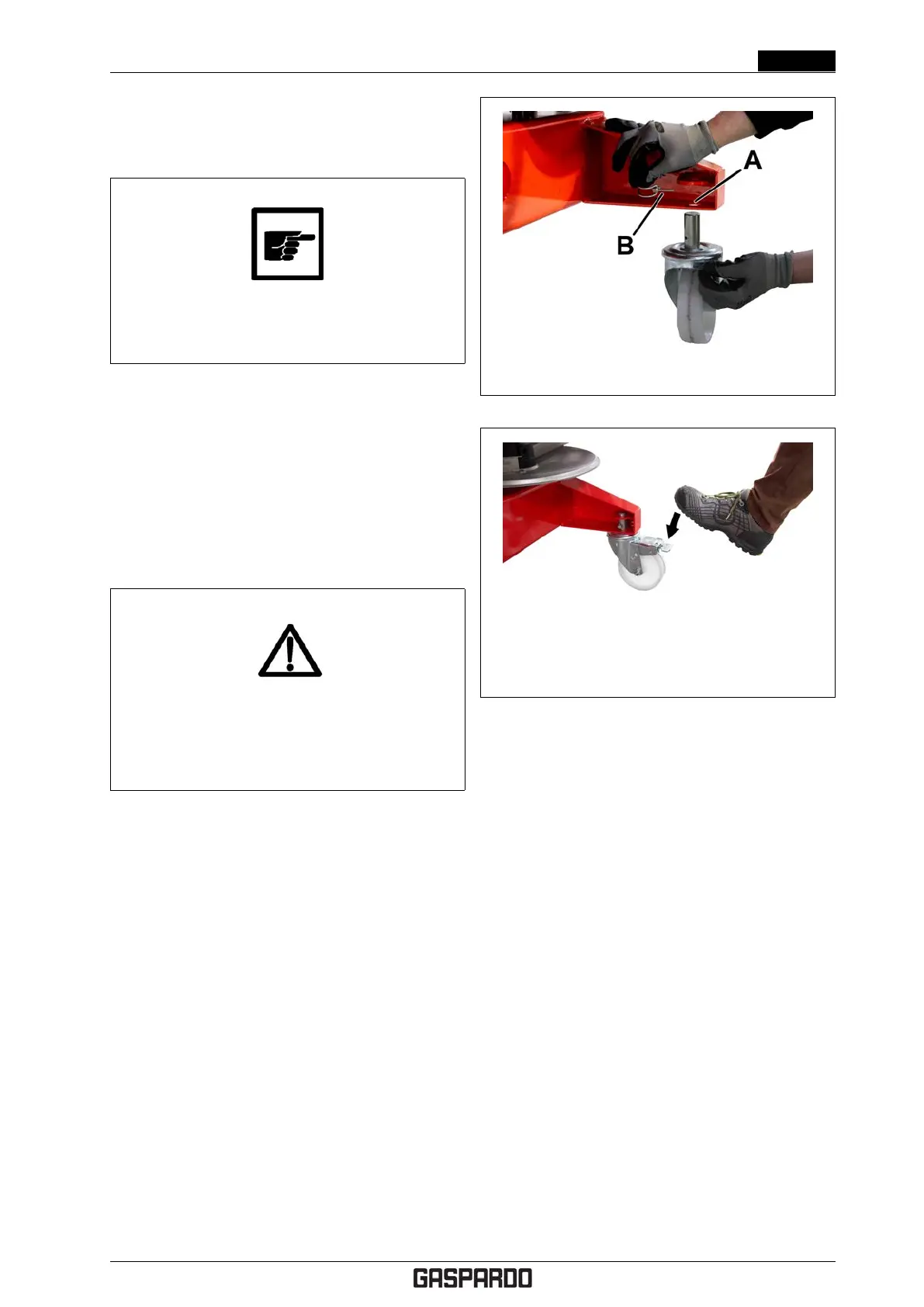
1. With the machine lifted, insert the 4 wheels in their
housing (A) see fig. 4.29 and lock the wheels with
the specific elastic pin (B).
2. Lower the machine to the ground and unhook it from
the tractor (see § 4.1.2 on page 21).
3. Push the machine to the storage area. Make sure the
ground is even and compact.
4. Frenare le ruote di rimessaggio premendo
sull’apposito pedale di frenatura (vedi fig. 4.30).
4.8 HOW TO WORK
The PRIMO centrifugal fertiliser spreader was designed
exclusively for normal use in agricultural work and is suit-
able to spread dry, granulated, pellet and crystal fertilisers,
seeds and snail and slug bait.
All the adjustments for proper fertiliser spreading are
made according to spreading tables created based on
tests done at specialised laboratories. Despite everything,
even following the instructions to adjust the machine ex-
actly, we cannot exclude variations in spreading compared
Figure 4.29: Storage wheels
Figure 4.30: Storage wheels - wheel brake
to the expected results. Before starting to spread a new
fertiliser, it is essential to proceed with the machine cali-
bration operations as shown in § 4.7.8, 4.7.9 and 4.7.10.
Below is a list of the main causes that lead to variations
in spreading quality.
• Variations in the physical features of the fertilisers or
seeds. In particular, fertilisers have physical features
(granule size and shape, specific weight, degree of
humidity, etc.) that can vary for the same fertiliser
even based on the production batch (same type and
brand).
• Weather variations that change how well the fertiliser
slides.
• Storage conditions that may make it easier for lumps
to form in the product to be spread.
• Uneven or not flattened soil.
• Excessive wear in the spreading parts (vanes, discs,
agitator).
• Excessive wind.
• Incorrect rpm and drive speed.
• Machine not adjusted properly.
• Adjustment tests not run.
• Poor machine cleanliness.
Cod. F07011577 EN - 37


 To Next Page