ENGLISH Use e Maintenance
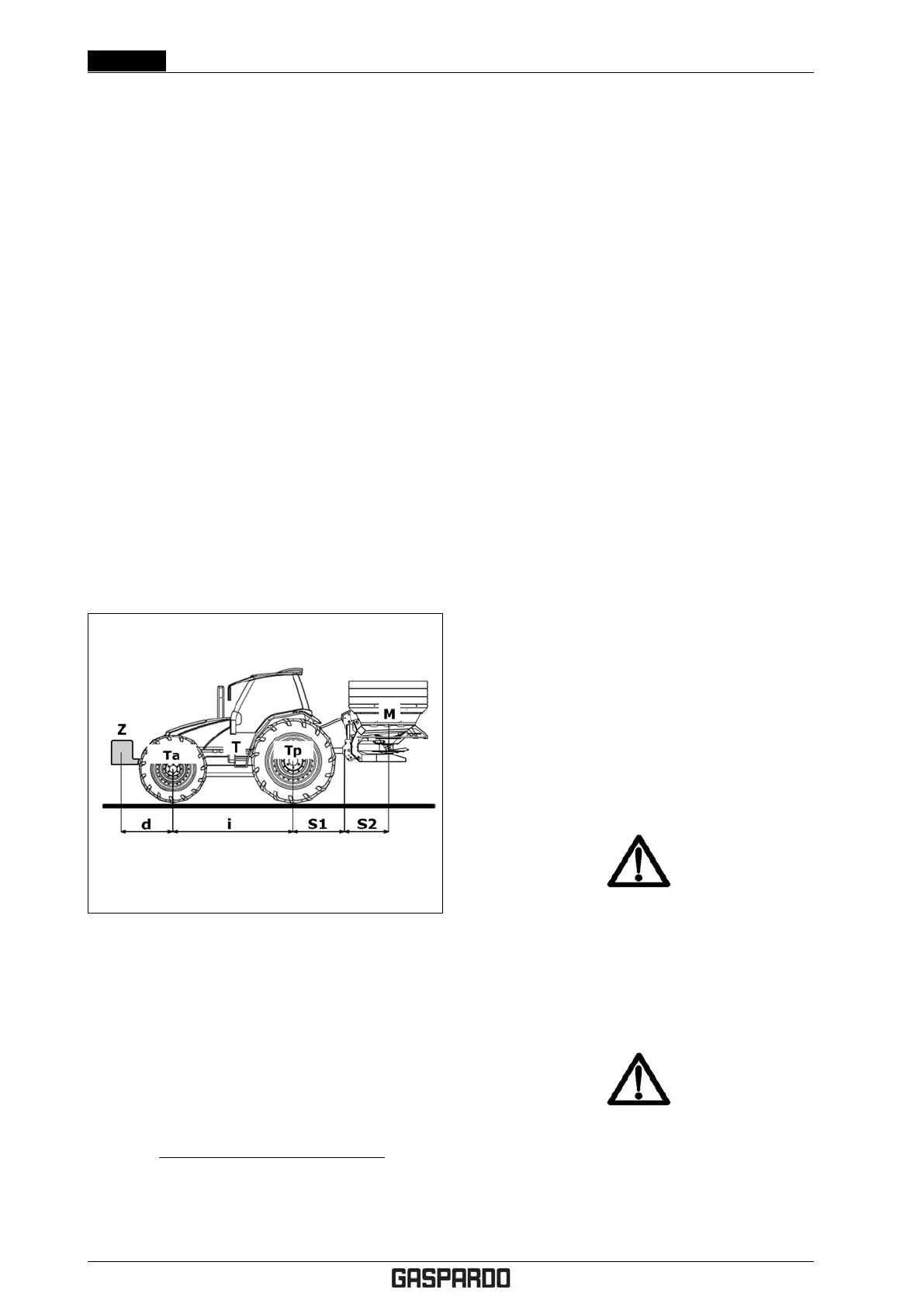
• T a (kg) Mass when empty on the front tractor axle.
• T p (kg) Mass when empty on the rear tractor axle.
• Z (kg) Total mass of ballast.
• i (m) Tractor wheelbase, that is, the horizontal dis-
tance between the tractor axles.
• d (m) Horizontal distance between the centre of grav-
ity of the ballast and the front axle of the tractor.
• S1 (m) Horizontal distance between the inferior point
of attachment of the equipment and the posterior axle
of the tractor (equipment supported to the ground).
• S2 (m) Horizontal distance between the barycentre of
the equipment and the inferior point of attachment of
the equipment (equipment supported to the ground).
See tab. ?? pag. ??.
The amount of ballast that should be applied according
to the formula is the minimum required for circulation on
the road. If for reasons of tractor performance or to im-
prove the set-up of the planting unit during operation it is
thought necessary to raise these values, please refer to
the registration document of the tractor to check its limits.
When the formula (4.1) for calculating the ballast gives a
negative result it will not be necessary to add any weight.
In any case, as long as the limits of the tractor are re-
spected, a suitable quantity of weights may be applied in
order to ensure greater stability during travel. Check that
the tractor tyres are suitable for the load.
Figure 4.5: Attaching the ballast
4.3.1 Check the suitability of the tractor
Below are the formulas to check tractor suitability.
It is important to compare the data obtained with what
is shown in the tractor registration.
Calculation of actual tractor front axle load
T a
T OT
T a
T OT
=
[Z · (d + i)] + T a · i − M · (S1 + S2)
i
[kg]
(4.2)
Check the registration to make sure that:
• T a
T OT
: Is less than the maximum load value allowed
on the front axle.
• T a
T OT
: Is less than double the maximum capacity of
the front tyres.
Calculation of the actual overall combined trac-
tor and machine weight T
T OT
T
T OT
= T + Z + M [kg] (4.3)
Check the registration to make sure that:
• T
T OT
: is less than the total maximum allowed mass
Calculation of the actual tractor rear axle load
T p
T OT
T p
T OT
= T
T OT
− T a
T OT
[kg] (4.4)
Check the registration to make sure that:
• T p
T OT
: is less than the maximum load value allowed
on the rear axle.
• T p
T OT
: is less than double the maximum capacity
of the rear tyres.
4.4 TRANSPORT
If it becomes necessary to transport the machine for a long
distance, it can be loaded onto a railway wagon or a truck.
For this purpose, consult «Technical Data» on pag. 16, for
weight and specific dimensions. The latter are very useful
to check the possibility of driving along all types of roads.
The machine is generally supplied in a horizontal po-
sition with no packing material. It is therefore necessary
to use a system of hoisting with a crane and cables, or
chains of adequate capacity, hooking onto the machine at
the hoisting points marked with the «hook» symbol (10,
Fig. 2.1).
CAUTION!
Before proceeding to the hoisting operations, make
sure that any any mo- bile elements of the machine
are blocked. Make sure to use a crane with an ade-
quate hoisting capacity to lift the machine. Hoist the
machine with extreme caution and transfer it slowly,
without jerks or abrupt movements.
DANGER!
The operations of hoisting and transport can be
very dangerous if not carried out with the maxi-
mum caution; persons not directly involved should be
moved away. Clean, evacuate the area and delimit the
24- EN Cod. F07011577


 To Next Page