VLT
®
5000 Series
■ Use of EMC-correctcables
Braided screened/armoured cables are recom-
mended to optimise EMC immunity of the control
cables and the EMC emission from the motor cables.
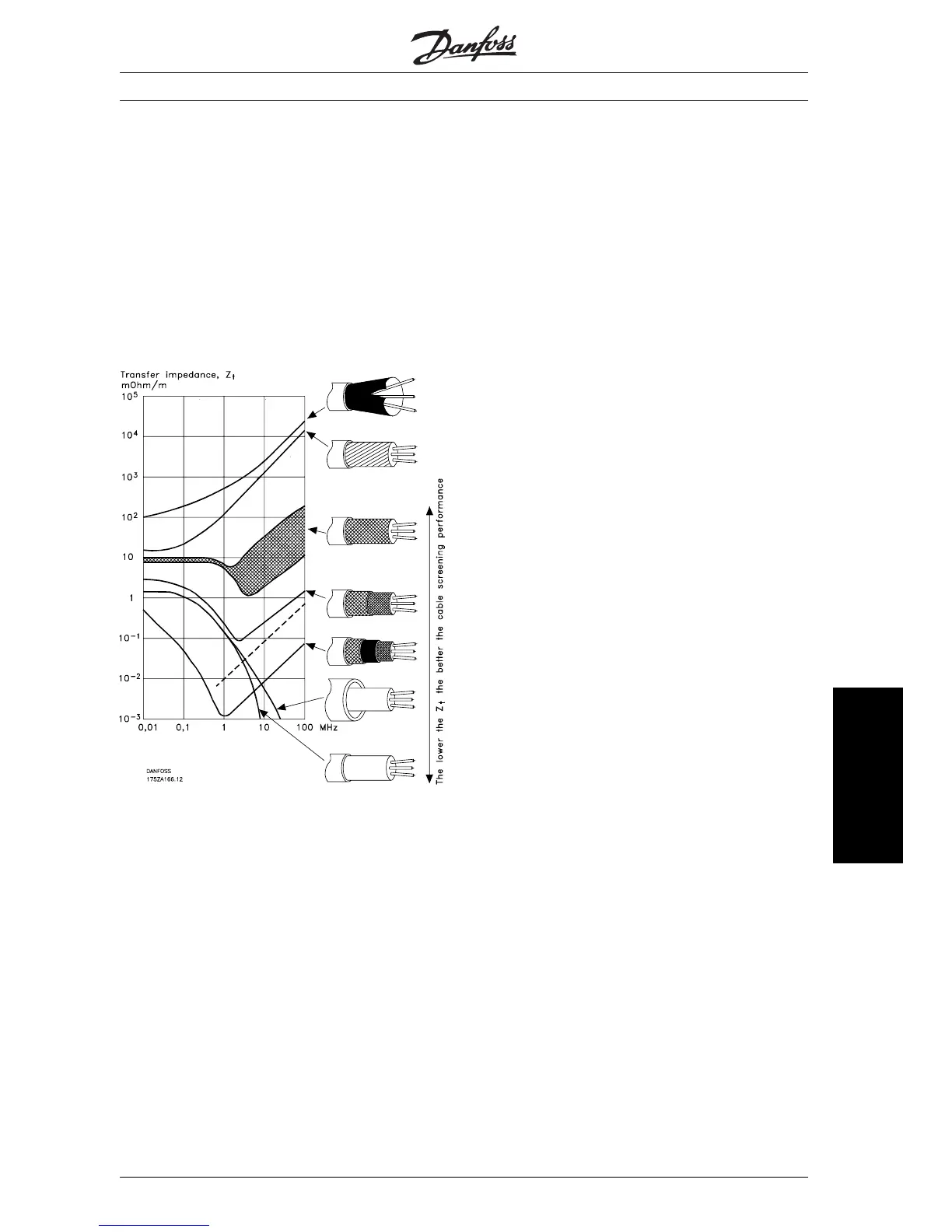
The ability of a cable to reduce the in- and outgoing
radiation of electric noise depends on the transfer
impedance (Z
T
). The screen of a cable is normally
designed to reduce the transfer of electric noise;
however, a screen with a lower transfer impedance
(Z
T
) value is more effective than a screen with a
higher transfer impedance (Z
T
).
Transfer impedance (Z
T
) is rarely stated by cable
manufacturers, but it is often possible to estimate
transfer impedance (Z
T
) by assessing the physical
design of the cable.
Transfer impedance (Z
T
) can be assessed on the
basis of the following factors:
- The conductibility of the screen material.
- The contact resistance between the individual
screen conductors.
- The screen coverage, i.e. the physical area of the
cable covered by the screen - often stated as a
percentage value.
- Screen type, i.e. braided or twisted pattern.
Aluminium-clad with copper wire.
Twisted copper wire or armoured steel wire cable.
Single-layer braided copper wire with varying per-
centage screen coverage.
This is the typical Danfoss reference cable.
Double-layer braided copper wire.
Twin layer of braided copper wire with a magnetic,
screened/armoured intermediate layer.
Cable that runs in copper tube or steel tube.
Lead cable with 1.1 mm wall thickness.
MG.51.A1.02 - VLT is a registered Danfoss trade mark
57
Installation








 To Next Page