SpectroEye™36
2
The tolerances are defined separately for densitometric and
spectral measurements as follows:
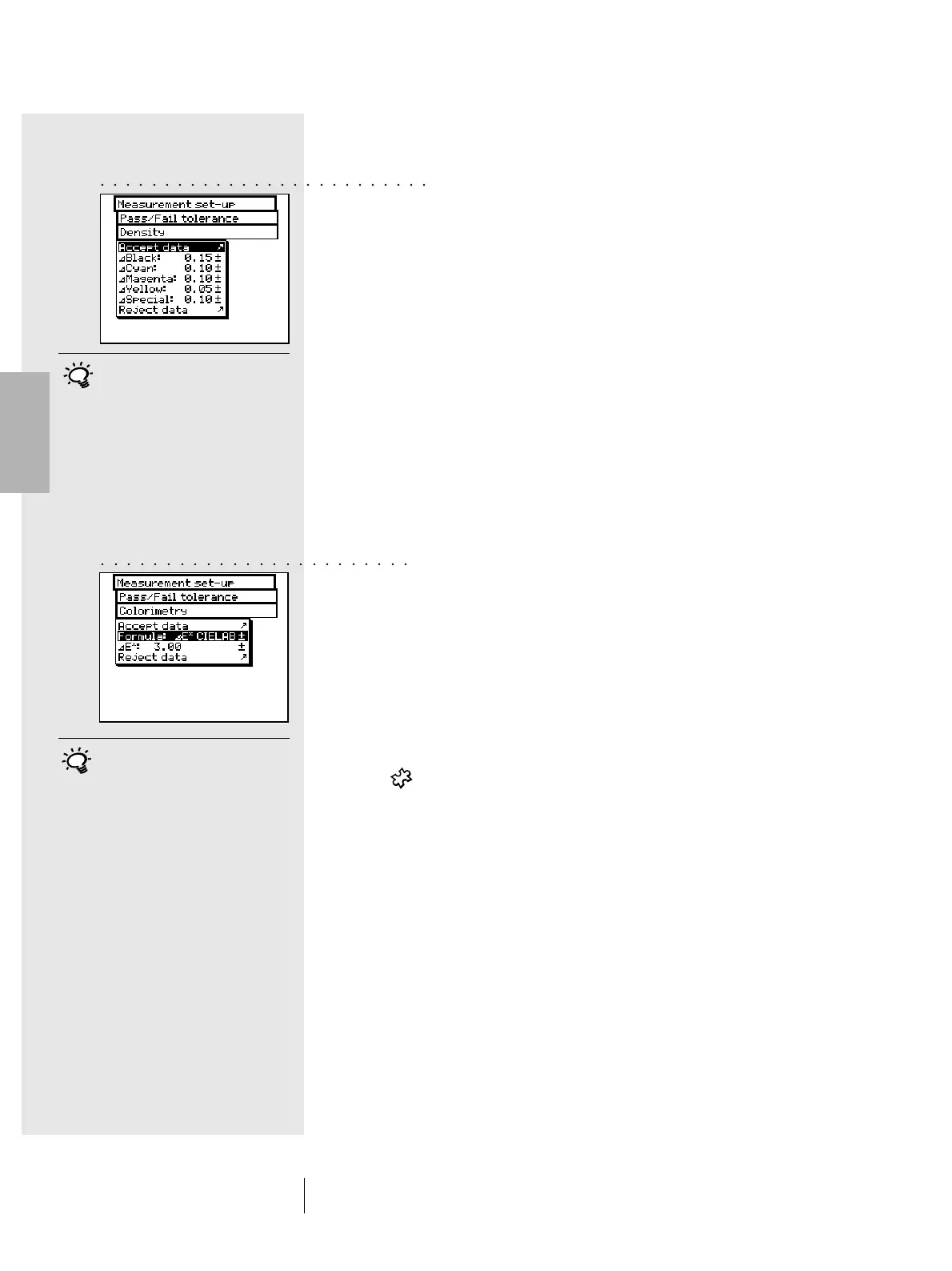
Starting from the Measurement set-up menu, select
Pass/Fail tolerance > Density
Enter the sequence of tolerances corresponding to the
maximum densities of the process colors. The tolerance
values indicate how much the solid density value of a
measured sample can shift from the solid density of the
reference.
Example:
The reference for cyan has been measured with a solid
density of 1.55. The tolerance value was set-up to +/- 0.10.
All the measured samples are within the density range
of 1.45 and 1.65 i.e. within the allowed tolerance. Therefore,
in the measurement window Pass will be displayed.
If the solid density is higher or lower than such limits,
Fail will be displayed.
Next, starting from the Measurement set-up menu, select
Pass/Fail tolerance > Colorimetry
In the Formula: menu line select the formula you want to use
to define the tolerance.
The following formulas and tolerance settings are available:
Supplied with the base - L*a*b*
instrument: - E* CIELAB
Options: - E CMC, E FMCII, E*94
- E* CIELUV
-E mg
- E Hunter Lab
As soon as you have chosen one of the above formula, the
corresponding parameters are displayed in one or more menu
lines. When the data entry procedure is completed, save the
tolerance values using Accept data.
All the subsequent Pass/Fail evaluations will refer to this formula
and to the tolerances defined here. The Pass/Fail evaluation is
displayed only if the corresponding measurement function has
been selected.
2 • Use
The tolerances set-up in this menu
must be considered only as a first
recommendation. In general, it is
advisable to choose tolerance limits
based on customer needs and
product requirements.
The tolerances set-up here must
be considered only as a first
recommendation. It is advisable
to tune tolerance limits based
on customer needs and product
requirements.
○○○○○○○○○○○○○○○○○○○○○○○○○○
○○○○○○○○○○○○○○○○○○○○○○○○


 To Next Page