Installation Manual Liebert Hipulse E Chapter 1 - Installation Procedure
Single or '1+N' UPS System Installation (Mechanical)
(07/04) Page 1-3
1.3 Mechanical Considerations
1.3.1 System composition
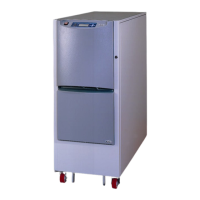
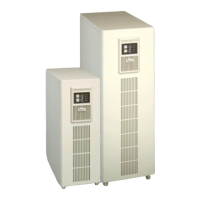
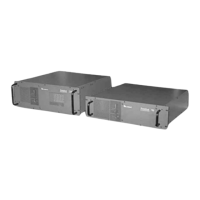
A UPS system can comprise a number of equipment cabinets, depending on the individual system design requirements
- e.g. UPS cabinet, External Bypass cabinet. In general, all the cabinets used in a particular installation are of the same
height and designed to be positioned side-by-side to form an aesthetically appealing equipment suite.
Refer to the drawings provided in Chapter 6 for the positioning of the cabinets described below.
1.3.2 Frame and enclosure
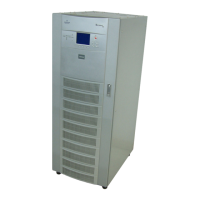
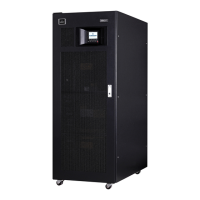
The UPS is housed in an IP20 enclosure, designed for floor mounting. The top and side removable panels are secured
to the chassis by screws. The door can be opened to give access to the power connections bars, auxiliary terminal
blocks and power isolators. Front door can be opened at 180° for better Service and more flexibility in installations.
The UPS comes with an operator control panel, which provides basic operational status and alarm information. The
cabinet houses the power components, control boards and fuses. The cabinet is structurally designed to handle lifting
from the base. Cooling is by internal removable fans.
1.3.3 300 kVA UPS with rectifier 6 pulses
The 300 kVA UPS consists of a single cabinet.
1.3.4 300 kVA UPS with rectifier 12 pulses
While the 6 pulse 300 kVA UPS consists of a single cabinet, the 12 pulse 300 kVA UPS is divided into two cabinets
for easier transport and positioning at the installation site; one cabinet contains the standard UPS sections, while the
other contains the section including the second rectifier bridge, the magnetic components and the control circuits.
Once the equipment is in position, and before it is anchored in place permanently
, make the electrical power and
auxiliary connections and mechanically join the two cabinets of the UPS.
1.3.5 400 kVA UPS with rectifier 6 pulses
The 400 kVA UPS is split into two cabinets to allow easier transportation and positioning, one houses the Inverter and
the other houses the Rectifier/Static Bypass. Once the equipment is positioned and prior to fixing the equipment in
place, the two cabinet have to be bolted together and the interlinking power and control cable connections made.
1.3.6 400 kVA UPS with rectifier 12 pulses
The 12 pulse 400 kVA UPS also consists of two cabinets, but while it has the same overall length as the 6 pulse
version, it incorporates the 12 pulse section in the Rectifier/ Static Bypass cabinet.
1.3.7 Moving the cabinets
The route to be travelled between the point of arrival and the unit’s position must be planned to make sure that all
passages are wide enough for the unit and that floors are capable of supporting its weight (for instance, check that
doorways, lifts, ramps, etc. are adequate and that there are no impassable corners or changes in the level of corridors).
WARNING
Ensure any lifting equipment used in moving the UPS cabinet has sufficient lifting capacity.
EXERCISE EXTREME CARE WHEN HANDLING UPS CABINETS TO AVOID EQUIPMENT
DAMAGE OR INJURY TO PERSONNEL.
Ensure that the UPS weight is within the designated surface weight loading (Kg/cm
2
) of any handling equipment. See
the UPS specification for weight details - see Table 5-3.
UPS and optional cabinets (battery cabinets, top cable entry cabinets, etc.) can be handled by means of a fork lift or
similar equipment. For operations with a fork lift, it is necessary to remove either the lower protection panel located at
the base of the cabinet and rear panels (or both side panels). Be aware of the location of the load supporting feet so as
not to damage them, refer to installation drawings in Chapter 6.
In the eventuality that the equipment cannot be moved by fork lift, then rollers should be used.
Because the weight distribution in the cabinet is uneven, use extreme care during handling and transporting.
When moving the unit by forklift, lift the unit from the rear so as to protect the front panel. Do not exceed a 15 degrees
tilt with the forklift. Bottom structure will support the unit only if the forks are completely beneath the unit.
The handling with straps is not authorised.
Note: Do not move the battery cabinet with the batteries fitted.





 To Next Page