LM 287 User Manual – 30.10.2023
74
If you inspect the engine in operation, always use the proper inspection procedure to avoid a fluid penetration hazard.
Visually inspect the high-pressure fuel lines for damage or signs of fuel leakage. Replace any damaged high-pressure
fuel lines or high-pressure fuel lines that have leaked.
Ensure that all clips on the high-pressure fuel lines are in place and that the clips are not loose.
• Inspect the rest of the fuel system for leaks. Look for loose fuel line clamps.
• Drain the water and the sediment from the fuel tank daily.
• Inspect the wiring and the wiring harnesses for loose connections and for worn wires or frayed wires. Check for any
loose cable straps or missing cable straps.
• Disconnect any battery chargers that are not protected against the current drain of the starting motor. Check the
condition and the electrolyte level of the batteries, unless the engine is equipped with a maintenance free battery.
• Check the condition of the gauges. Replace any gauges that are cracked. Replace any gauge that cannot be
calibrated.
Inspect the Engine Aftertreatment System for leaks and for loose connections.
Check that all clamps, clips, and cable straps are secure and in good condition.
6.10 Maintenance every 50 operating hours
Also carry out maintenance items 1–10.
6.10.1 Lubrication (11)
Lubricate all grease nipples with a grease gun.
► Clean the grease nipples and the tip of the grease gun.
► Press the tip of the grease gun perpendicular to the grease nipple, and apply a suitable amount of lubricant. The
articulated shaft universal joints should be lubricated until the lubricant is visible underneath all the joint cup seals.
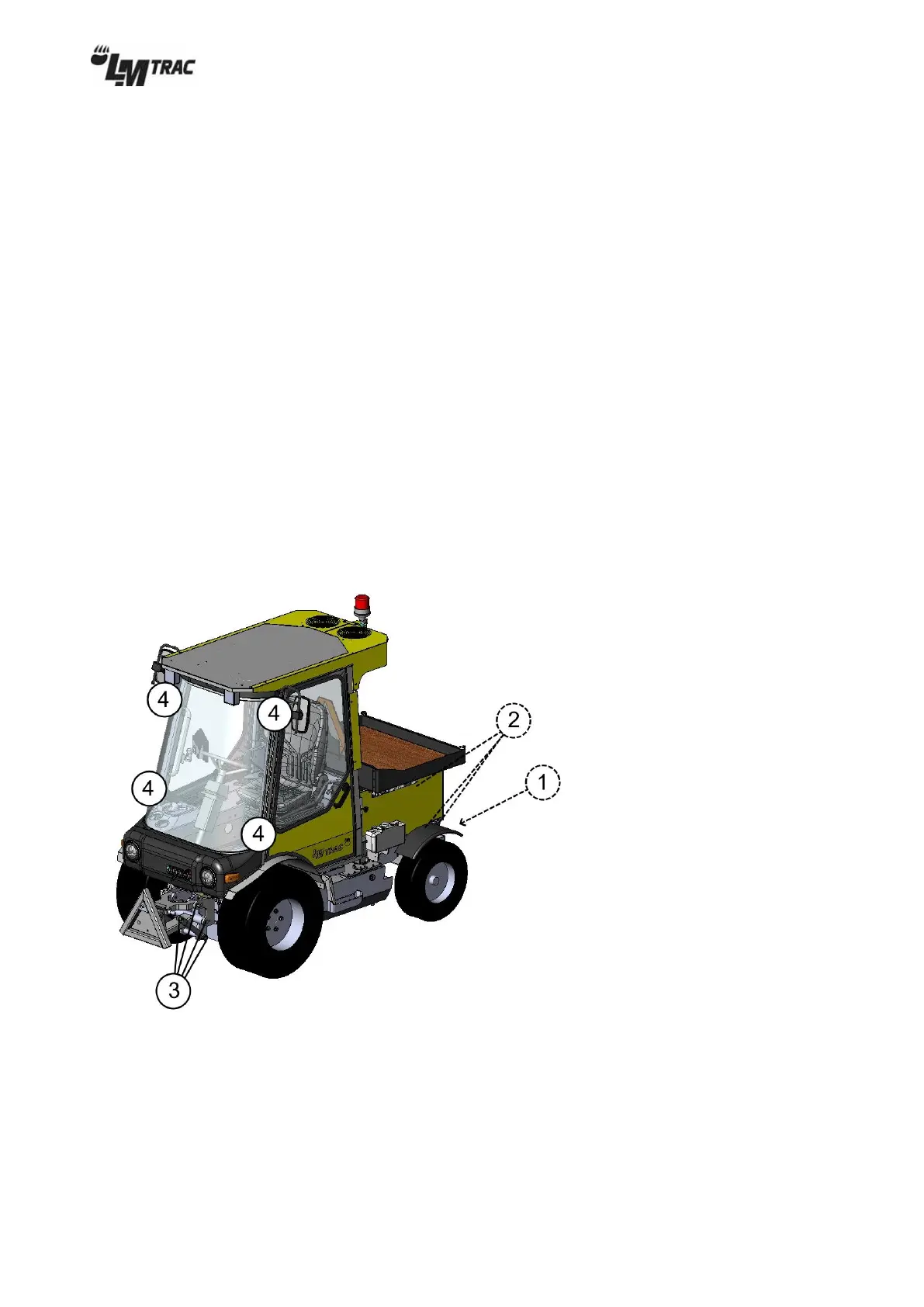
Figure 89
Lubricate all lubrication points:
►1. Ball joints for the steering cylinder.
►2. Joints for the bonnet lifting cylinders and tipping pins.
►3. All of the joints on lifting equipment that require lubrication.
►4. Lubricate the hinges/hinge pins on cabin doors, all of the sliding surfaces etc. For hinges, use a high‐quality spray
lubricant with high penetration; for sliding surfaces, use a graphite‐based lubricant.


 To Next Page