214683 179 Revision A
Adjusting the Header Raise/Lower Rate (Gleaner R65/R66/R75/R76 and Pre-2016 S Series)
NOTE:
Changes may have been made to the combine controls or display since this document was published. Refer to the
combine operator’s manual for updates.
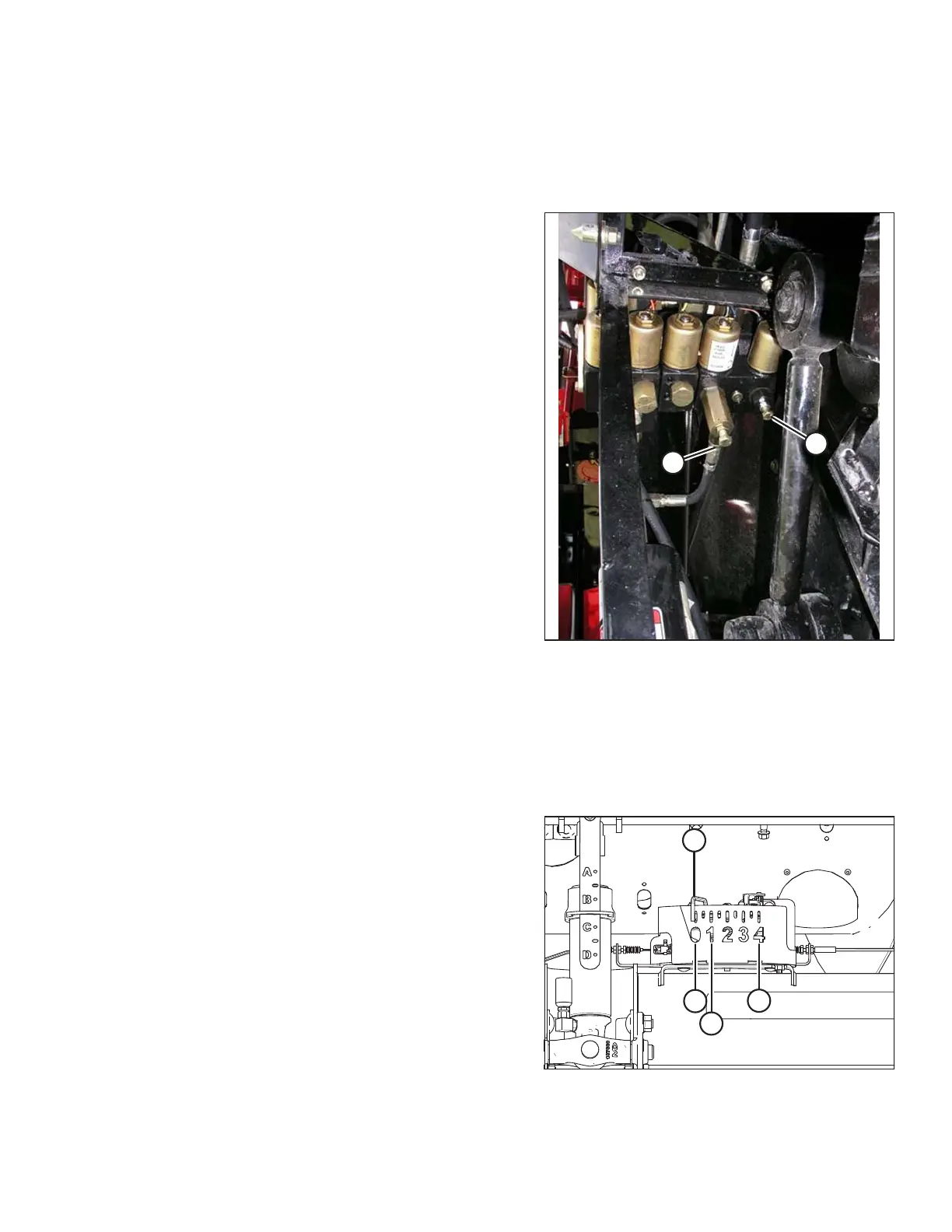
Figure 3.273: Header Raise and Lower
Adjustable Restrictors
The auto header height control (AHHC) system’s stability is
affected by hydraulic flow rates. Ensure that the header
raise (A) and header lower (B) adjustable restrictors in the
hydraulic manifold are adjusted so that it takes
approximately 6 seconds to raise the header from ground
level to maximum height (hydraulic cylinders fully
extended), and approximately 6 seconds to lower the
header from maximum height to ground level.
If there is too much header movement (for example,
hunting) when the header is on the ground, adjust the lower
rate to a slower rate of drop: 7 or 8 seconds.
NOTE:
Make this adjustment with the hydraulic system at normal
operating temperature (54.4°C [130°F]) and the engine
running at full throttle.
Adjusting Ground Pressure (Gleaner R65/R66/R75/R76 and Pre-2016 S Series)
NOTE:
Changes may have been made to the combine controls or display since this document was published. Refer to the
combine operator’s manual for updates.
Figure 3.274: Float Indicator Box
NOTE:
The indicator (A) should be at position 0 (B) with the header
152 mm (6 in.) off the ground. If not, the float sensor output
voltage should be checked. Refer to Step 4, page 128.
When the header is on the ground, the indicator should be
at position 1 (C) for low ground pressure, and at position
4 (D) for high ground pressure. Crop and soil conditions
determine the amount of float to use. The ideal setting is as
light as possible without header bouncing or missing crop.
Operating with heavy settings prematurely wears the
cutterbar wearplates.
OPERATION



 To Next Page