
 Need help?
Do you have a question about the Motorola solutions APX 8000XE and is the answer not in the manual?
Details compliance with FCC Rules and Industry Canada license-exempt RSS standards.
Explains compliance with national and international regulations for portable two-way radios.
Provides awareness and control information for occupational use of the radio.
Guidelines for controlling RF exposure and ensuring compliance with RF limits.
Instructions for safe operation regarding RF exposure, distance, and accessory use.
Precautions to protect hearing from loud noises and radio volume.
Guidance for users with medical devices regarding RF energy exposure.
Warnings for vehicle use with airbags and potentially explosive atmospheres.
Instructions for safe charging, use, and disposal of the radio's battery.
Information on authorized repair locations and contacting Motorola Solutions for service.
Warning against substituting approved intrinsically safe options or accessories.
Information on proper disposal of electronic equipment according to EU WEEE directive.
Compliance notice for FCC and Industry Canada rules regarding device operation.
Information on Motorola's copyrighted computer programs and usage restrictions.
Restrictions on duplication and distribution of the manual.
Statement on reliability, responsibility, and Motorola's right to make changes.
Details audio samples recorded under varying conditions for analog and digital audio.
Describes the purpose and scope of the IEUTK for basic radio operation.
Explanation of WARNING, Caution, and Note notations for safety hazards.
Explains special notations used to identify items like buttons, menus, and features.
Details features enhancing security, quality, and efficiency of the radios.
Optimizes handling of message sizes and update rates for improved data efficiency.
Ensures seamless switching to backup master site during system failure for redundancy.
Prevents crosstalk by adjusting Trident Transmitting SSI clock rate from Receiving Frequency.
Provides security encryption and authentication for IV & D data communication.
Allows secured communications on Analog or MDC channels, including OTAR.
Improves Scan feature operation with multiple agencies and Selective Squelch.
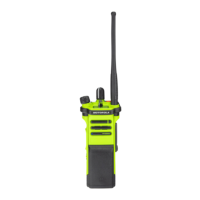
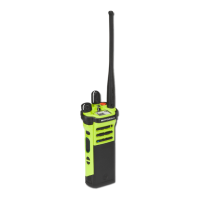
Diagrams identifying key parts and controls on Model 2 and Model 3 radios.
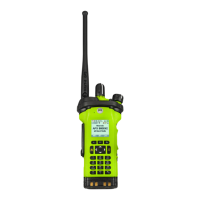
Diagram identifying key parts of the APX 8000XE radio, including buttons and ports.
Diagram of the top view of the radio, showing knobs, switches, and buttons.
Table showing Z1-Z6 and C1-C16 for fleet mapping.
Procedure for charging the Motorola-approved battery to ensure optimum capacity.
Instructions for correctly attaching and removing the battery from the radio.
Procedure for attaching and removing the radio antenna securely.
Steps to attach and remove the accessory connector cover for protection and submersion specification.
Instructions on how to properly place and remove the radio from its carry holder.
Procedure for powering the radio on and off using the control knob, including power-up test messages.
Instructions on how to adjust the radio's volume using the control knob for clear audio.
Explanation of how programmable buttons are assigned and activated via press durations.
Details various assignable functions related to Bluetooth connectivity and operation.
Enables or disables Bluetooth visibility for pairing and connection.
Allows radio to function as a pager or verify system activity.
Allows the user to answer a private call.
Function to select a specific radio channel.
Accesses the radio's contacts list for managing call information.
Allows editing of radio's ASTRO Individual ID and/or MDC Primary ID.
Temporarily replaces a Priority-Two channel with any channel in a scan list.
Initiates or cancels an emergency alarm or call based on programming.
Displays general information about the radio's status and settings.
Displays the radio's IP address, device name, and network status.
Determines current location or controls GPS functionality for location services.
Clears the Man Down mode alarm triggered by tilt or motion.
Enters the current message list for viewing or managing.
Saves current zone/channel to a programmable button or soft-key for quick access.
Monitors a selected channel for all radio traffic until disabled.
Allows selection from Multiple Private Line lists for channel access.
Temporarily removes unwanted channels from a scan list.
Launches specific features using single button presses, up to four programmable buttons.
Allows making and receiving calls similar to standard phone calls.
Allows calls between individual radios in a trunked system.
Overrides preprogrammed coded squelch (DPL or PL) on a channel.
Launches a list of predefined short text messages after successful Two-Factor Authentication.
Provides easy access to preprogrammed visual and audio settings of the radio.
Allows easy access to the list of recently received or made calls.
Notifies the dispatcher to request new encryption keys.
Allows manual sending of a repeater access codeword.
Notifies dispatcher for a new dynamic regrouping assignment.
Notifies dispatcher to send a voice call.
Toggles scan functionality on or off.
Selects the scan list for editing via a long press on the Scan button.
Toggles Secure/Clear Transmission On/Off for capable radios and channels.
Initiates a call to an assigned radio.
Displays site ID, RSSI value, and performs site search for AMSS or SmartZone.
Locks or unlocks the radio onto a specific site.
Sends data calls to the dispatcher about a predefined status.
Toggles between repeater and direct communication with other radios.
Allows calls from an individual radio to a group of radios.
Selects the text messaging menu for sending and receiving messages.
Selects a predefined message for quick text communication.
Automatically registers the user with the server for data services.
Allows selection from a list of radio zones.
Provides access to up to 6 zones by toggling between 2 banks of 3 zones.
Provides access to up to 75 zones by toggling through 25 banks of 3 zones.
Toggles Wi-Fi connectivity on or off.
Details functions that can be assigned to buttons or accessed via menus.
Locks or unlocks the keypad, programmable buttons, and rotary knob.
Toggles display backlight on/off or reverses top display content.
Toggles transmit power level between high and low settings.
Audibly indicates current feature mode, Zone, or Channel assignment.
Toggles voice mute on or off.
Sets the audible tone for volume changes.
Explains methods to access radio functions via programmable buttons or menu selections.
Details how to use Menu Select buttons to navigate features and select options.
Explains the use of Home, Data Feature, and 4-Way Navigation buttons for radio control.
Returns to the Home screen and can save settings or information.
Accesses data-related features like Text Messaging Service (TMS).
Used to scroll through menus and lists by pressing or holding the directional buttons.
Explains how to input characters in uppercase mode using the radio's keypad.
Details character mapping for uppercase input on the keypad.
Explains how to input characters in lowercase mode using the radio's keypad.
Details character mapping for lowercase input on the keypad.
Explains how to input numbers using the radio's keypad.
Details character mapping for numeric input on the keypad.
Explains how to input hexadecimal characters using the radio's keypad.
Details character mapping for hexadecimal input on the keypad.
Explains the two basic purposes of the PTT button: transmitting and making new calls.
Describes icons on the LCD and monochrome displays indicating radio status and conditions.
Indicates received signal strength via bars, stronger signal with more stripes.
Indicates when the radio has roamed and is registered to a foreign system.
Indicates radio configuration for direct or repeater communication.
Shows when a selected channel is being monitored in conventional operation.
Indicates enabled/disabled status of voice muting for talkgroups or channels.
Indicates if the radio is set at Low (L) or High (H) power.
Indicates when the radio is actively scanning a scan list.
Shows activity on Priority-One (rapid blink) or Priority-Two (steady blink) channels.
Shows if the radio is in View mode (steady) or Program mode (blinking).
Indicates that the vote scan feature is currently enabled.
Shows which zone (1, 2, or 3) the radio is currently in for Bank 1.
Shows which zone (4, 5, or 6) the radio is currently in for Bank 2.
Indicates zone assignments within Enhanced Zone Banks (A-Y, 1-75 zones).
Shows secure (On), clear (Off), or receiving encrypted call (Blinking).
Shows AES secure (On), clear (Off), or receiving encrypted call (Blinking).
Indicates if location feature is enabled (On), disabled (Off), or signal available (Blinking).
Shows user association status: associated (On), not associated (Off), or registration failed (Blinking).
Indicates when data activity is currently present on the radio.
Indicates that the text entry is currently in hexadecimal mode.
Shows Bluetooth is on and ready for connection.
Indicates current connection to an external Bluetooth device.
Shows Wi-Fi network connection status and signal strength.
Icons displayed for TMS features such as Inbox Full, Message Sent, and Unread Message.
Indicates that the radio's message inbox is full.
Confirms that a text message has been sent successfully.
Indicates that a text message could not be sent.
Shows when a new message has been received or a selected message is unread.
Confirms that a selected text message in the inbox has been read.
Indicates a message composed with normal priority and no reply request.
Shows the index of the current message being viewed within the inbox.
Indicates if the 'Priority' feature is toggled on for the message.
Indicates if the 'Request Reply' feature is toggled on for the message.
Shows when a message has both priority status and a request for reply.
Indicates that the text entry is currently in numeric mode.
Indicates that the first character of text entry is capitalized.
Indicates text entry is in normal text mode.
Indicates text entry is currently in uppercase mode.
Indicates text entry is currently in lowercase mode.
Indicates lowercase entry with predicted words shown on screen.
Indicates mixed-case entry with predicted words shown on screen.
Indicates uppercase entry with predicted words shown on screen.
Lists and describes menu options for TMS, such as Back, Clr, Del, Edit, Exit, etc.
Provides descriptions for TMS menu options like Back, Clr, Del, Edit, Exit, No, Optn, Rply, Sel, Send, Yes.
Icons indicating different call types for aliases or IDs, such as radio number or mobile number.
Icon indicating a landline phone number added to a Call List.
Arrow icon indicating an incoming call or data transmission.
Arrow icon indicating an outgoing call or data transmission.
Warning triangle icon indicating an incoming emergency call.
Shows the operational status of the radio via the LED light.
Details the meaning of solid red, blinking red, double blinking red, yellow, and green LED indications.
Temporary changes to display backlight and alert text color for radio events.
Lists notifications for Orange (Emergency), Red (Critical Alerts), and Green (Call Alerts).
Visual summary of Orange (Emergency Alerts), Red (Critical Alerts), and Green (Call Alerts).
Lists alert tones and when they occur to inform of radio condition.
Describes tones for Radio Self Test Fail, Reject, Time-Out Timer Warning, etc.
Describes tones for Time-Out Timer Timed Out, Talk Prohibit/PTT Inhibit, etc.
Describes tones for Busy system status.
Describes tones for Valid Key-Press, Radio Self Test Pass, Clear Voice, etc.
Describes tones for Volume Set and Emergency Exit.
Describes tones for Failsoft, Automatic Call Back, Keyfail, etc.
Describes tones for Over-the-Air Programming request.
Describes tones for Low-Battery Chirp.
Describes tones for GPS Fails, Fast Ringing, Enhanced Call Sent, Phone Call Received.
Describes tones for Dynamic Regrouping and Talk Permit.
Indicates when a new message is received.
Indicates when a priority message is received.
Indicates Bluetooth pairing or connection status.
Indicates Bluetooth unpaired or disconnected status.
Alert tones for Man Down Continuous Tone and Critical Man Down Continuous Tone.
Indicates when scrolling Enhanced Zone Bank Up.
Indicates when scrolling Enhanced Zone Bank Down.
Shows display indicators and alert tones for phone calls, including busy or unacknowledged calls.
Procedure to select a zone using the 3-Position A/B/C switch or menu.
Procedure to select a channel using the 16-Position Select Knob or menu.
Allows searching for channels by alias, matching found channels.
Saves current zone/channel to a programmable button or soft-key for quick access.
Saves current zone and channel to one of five available soft-keys.
Saves current zone and channel to a programmable button or keypad digit.
Explains how to receive and respond to radio calls, including LED indications.
Procedure for receiving and responding to calls from a group of users.
Procedure for receiving and responding to one-to-one calls in a trunked system.
How to receive calls similar to standard phone calls from a landline.
Overview of selecting a zone, channel, ID, or talkgroup to initiate a call.
Procedure for making a call to a group of users.
Procedure for making one-to-one calls in a trunked system.
Procedure to send an individual Call Alert Page if there is no answer.
Procedure for making calls similar to standard phone calls to mobile or landline phones.
Explains REPEATER operation for range and DIRECT operation for bypassing repeaters.
Information on digital technology and monitoring channels for clarity before transmitting.
Procedure to monitor a channel using the Monitor button or menu.
Details how to operate the radio in conventional mode, including Private-Line (PL) calls.
Covers features for selective calls, talkgroup calls, and status calls.
Allows receiving or making calls to specific individuals for privacy.
Procedure to initiate a selective call using a preprogrammed button or menu.
Defines groups of users for conventional system sharing of a channel.
Procedure to select and manage talkgroups for conventional channels.
Procedure to send status data calls using preprogrammed button or menu.
Temporarily reassigns radios to a channel for communication during special operations.
Explains how the radio behaves when dynamically regrouped by the dispatcher.
Notifies dispatcher for a new dynamic regrouping assignment.
Procedure to send a reprogram request to the dispatcher.
Explains Select Enabled vs. Select Disabled classifications for regrouped radios.
Provides Dynamic Zones to store frequent channels for conventional or trunking use.
Procedure to enter a Dynamic Zone and select a dynamic channel.
Procedure to save a channel in Dynamic Zone from a list selection.
Procedure to save a channel in Dynamic Zone using its name.
Procedure to delete a channel from the Dynamic Zone.
Provides 'address-book' capabilities for initiating calls with aliases or IDs.
Procedure to view all associated numbers and information for a selected contact entry.
Procedure to make a private call from contacts using subscriber alias or ID.
Procedure to add a new contact entry with name, number, and call type.
Procedure to delete a contact entry from the radio's contacts list.
Procedure to add an existing contact entry to a call list.
Procedure to remove a contact entry from a call list.
Procedure to edit a contact's alias and entry ID, including name and system IDs.
Procedure to edit the call type associated with a contact entry.
Explains scan list creation, assignment, and types supported by the radio.
Procedure to view the members on a selected scan list.
Procedure to change scan list members and priorities, add/delete channels.
Explains how to view/change channel priority status (non-priority, P2, P1) and corresponding LED indications.
Procedure to enable or disable the radio's scanning feature via button or menu.
Temporarily change a channel in a scan list to Priority-Two while scanning.
Temporarily remove unwanted channels (nuisance channels) from a scan list.
Procedure to restore a deleted nuisance channel by restarting the scan or changing channels.
Allows radio to function as a pager for sending individual pages to users.
Procedure to send a page to a preprogrammed ID using a button or menu.
Broadcasts distinct tones before voice transmission to dispatcher or radio.
Overview of supported emergency modes: Alarm, Call (Trunking), Alarm with Call, Silent Alarm.
Procedure to send a data transmission identifying the radio sending the emergency to the dispatcher.
Gives radio priority access to a talkgroup for emergency calls in trunking systems.
Procedure to send an emergency alarm and make an emergency call simultaneously.
Sends an emergency alarm without triggering audio or visual indicators.
How to change channels during an emergency transmission if the new channel is preprogrammed for emergency.
Prevents the radio from being turned off via the On/Off knob while in Emergency state.
Describes the Fireground Communications System components and its data exchange.
Procedure for powering up and listening for transmissions in a Fireground Zone Channel.
How the radio sounds an Evacuation Tone and displays EVACUATE when an evacuation signal is triggered.
Enables users to identify transmission start/end by displaying caller's name or ID.
Describes Emergency Beacon and Emergency Call De-Key Sidetone during TPS emergency transmission.
Explains Man Down condition detection and automatic activation of Emergency Alarm or Call.
Details the three phases of Man Down: sensing, pre-alert, and post-alert timers.
Explains how PTT button, other buttons, repositioning, or Clear button affect Man Down timers.
Sets time for Man Down warning before emergency alarm is transmitted.
Sets time for radio to remain in Man Down condition before emergency alarm transmission.
Ensures Man Down alert tone volume is loud enough; notes on Silent Emergency and Surveillance Mode.
Describes how Emergency Alarm or Call is triggered if Man Down condition is not cleared.
Explains Critical Man Down Continuous alert tone and responses to channel changes during Man Down.
Procedure to exit Man Down feature and prevent accidental emergency activation.
Procedure to reinitiate Man Down feature after exiting emergency operation.
Procedure to test Man Down feature functionality, including enabling and checking alerts.
Step-by-step guide for performing a functional test of the Man Down feature.
Provides automated data application registration for the radio with the server.
Procedure to select or change the ARS mode (Server or Non-Server) using preprogrammed button or menu.
Allows user association with the radio for data applications using a friendly username.
Procedure to log in as a user using preprogrammed button or menu, entering username and PIN.
Procedure to log out and optionally clear private data from the radio.
Allows sending and receiving text messages with a maximum length of 200 characters.
Procedure to access TMS features like Inbox, Compose, Drafts, and Sent folders.
Procedure to compose and send a new text message, including address entry.
Procedure to send a predefined quick text message, including selecting message and address.
Allows appending priority status and/or request reply to outgoing messages.
Procedures for deleting a single text message or all messages in a folder.
Enables quick message sending and database queries from Motorola radios with Two Factor Authentication.
Details user account provisioning in PremierOne™ and session restoration after interruptions.
Extends ARS and TMS operation for user authentication via username, ID, password, and passcode.
Procedure to log out and optionally clear private data from the radio.
Procedure for sending a query using Quick Text with a flag, available after Two-Factor Authentication login.
Procedure for receiving query information in TMS format, indicated by a high-pitched chirp.
Allows selection between secure and clear transmission modes for voice security.
Procedure to attach the Key-Variable Loader (KVL) and load encryption keys into the radio.
Explains Conventional and Trunked Multi-key encryption, supporting DES-OFB.
Procedure to select and save an encryption key, with notes on key erasure or invalid keys.
Allows selection of one or more groups of encryption keys (keysets) for automatic switching.
Procedure to erase all or selected encryption keys from the radio.
Allows remote reprogramming of encryption keys via dispatcher request (OTAR).
View or define MDC OTAR features for secure conventional communications.
Enables permanent storage of Unique Key Encryption Key (UKEK) even after erasure.
Reduces channel noise using Companding and Random FM Noise Canceller.
Changes radio to a robust security system protecting encryption keys; shows 'Radio locked' if enabled.
Procedure to unlock the radio by entering the numeric password, with important notes on deadlock and forgotten passwords.
Procedure to change the radio's password by entering old and new passwords.
Procedure to change the Tactical Inhibit Encode Password.
Procedure to stun another radio via over-air command, requiring password for reactivation.
Procedure to render a radio inoperable if misplaced or lost, requiring a special device for recovery.
Procedure to make your own radio inoperable by pressing Top Side and Orange buttons.
Explains how GPS/GLONASS integrates for geographical location determination.
Explains how GPS technology works and factors affecting performance and accuracy.
Tips for improving GPS fix success, such as holding radio in face position and staying in the open.
Allows determining current location, distance, and bearing to other locations; stores waypoints.
Explains MGRS coordinate display enablement via CPS configuration for GPS locations.
Procedure to toggle the Outdoor Location feature on/off and obtain a location fix.
Procedure to save current location as a waypoint, Home, or Destination, and edit its name.
Procedure to view the location information of saved waypoints.
Procedure to edit the alias (name) of a saved waypoint.
Procedure to edit the location coordinates (latitude, longitude) of a saved waypoint.
Procedure to delete a specific waypoint from the saved list.
Procedure to delete all saved waypoints from the radio.
Procedure to measure distance and bearing from current location to selected waypoint coordinates.
Behavior of Location feature when Emergency is activated; saving emergency and last known locations.
Shows peer location coordinates for radio-to-radio transmissions in conventional ASTRO systems.
Defines Geofence as a virtual perimeter based on GPS to identify geographical areas.
Procedure when radio enters Geofence area, including Dynamic Regroup and notifications.
Ensures continuous radio communications during trunked system failures.
Procedure for communicating in failsoft mode during trunked system failure.
Describes radio behavior when out of system range, locking onto control or failsoft channels.
Explains site reversion to trunking when zone controller loses site communication.
Allows radio to lock onto a specific site, inhibiting roaming to other sites.
Allows viewing current site name or forcing radio to change to a new site.
Extends radio functionality by connecting to proprietary Motorola accessories.
Procedure to turn Bluetooth on, including status indications and potential failures.
Procedure to access Bluetooth settings via menu for status checks.
Procedure to turn Bluetooth off, including status indications and potential failures.
Defines pairing types (Immediate, Infinite) and scenarios for retaining pairing information.
Explains Drop Timer settings for Bluetooth connection buffer and accessory 'stay alive' time.
Instructions for pairing with LF-MPP feature, ensuring Bluetooth is on and tones enabled.
Details successful/failed pairing and connection processes, including audio and display feedback.
Describes radio indications (icon blinking, tones, display messages) when Bluetooth connection is interrupted.
Enables radio to search for and pair with other Bluetooth devices using PIN authentication.
Procedure to search for, select, and connect to Bluetooth devices.
Procedure to enable or disable Bluetooth search feature via preprogrammed button or menu.
Enables other Bluetooth devices to search for your radio by turning visibility on.
Procedure to accept or refuse a pairing request from another Bluetooth device.
Disables Bluetooth visibility to prevent other devices from searching for your radio.
Ensures correct device pairing by verifying the correct device using an authentic PIN.
Procedure for pairing using a generated numeric PIN for authentication.
Procedure for pairing using a manually keyed-in PIN for authentication.
Routes audio between radio and headset or routes audio from headset to radio.
Explains how to adjust volume for MCW/OCW devices and independent volumes for other Bluetooth devices.
Procedure to view a list of currently active Bluetooth devices and their status.
Procedures to clear all active Bluetooth device information from the radio.
Procedure to edit the Bluetooth friendly name for the radio.
Enables configuration data and firmware upgrades over-the-air without interrupting communication.
Procedure for accepting, delaying, or rejecting radio upgrade notifications.
Notifies users of special situations with Intelligent Lighting and audio alerts.
Procedure to send SSA notification to a single site, with request status feedback.
Procedure to stop SSA notification to a single site, with request status feedback.
Procedure to send SSA notification to a single site using manual Site ID entry.
Procedure to stop SSA notification to a single site using manual Site ID entry.
Procedure to send SSA notification to all sites, with request status feedback.
Procedure to stop SSA notification to all sites, with request status feedback.
Procedure to send SSA notification to all available sites, with request status feedback.
Procedure to stop SSA notification to all available sites, with request status feedback.
Enables radio to audibly indicate feature mode, Zone, or Channel assignment.
Explains how voice announcements occur for various radio events and operations.
Allows turning Wi-Fi on or off for wireless programming with the Radio Management tool.
Shows current Wi-Fi status, connected network, and signal strength.
Allows viewing recent incoming and outgoing call information for various call types.
Allows flipping the top display content upside down for easier reading while in carry holder.
Allows accessing twice as many zones via a switch, doubling switch positions.
Allows users to communicate in more zones, navigating up to 75 zones in 25 EZBs.
Enables reducing transmit power level for specific cases or conserving power.
Allows manual switching of visual and audio settings based on preprogrammed radio profiles.
Allows displaying or hiding the radio alias (name) on the home screen.
Allows selection of audio route from main or secondary speaker via radio profile settings.
Enables or disables radio's display backlight as needed for visibility.
Configures radio display for NVG compatibility, emitting low illumination backlight.
Locks keypad, buttons, knobs, and switches to avoid inadvertent entry.
Enables or disables keypad tones for user preference.
Enables or disables voice transmission mute.
Prevents radio transmitter from transmitting longer than preset timer setting.
Allows setting the radio's time and date.
Filters unwanted calls with low signal strength or high background noise.
Overrides any coded squelch (DPL or PL) and unmutes to digital activity.
Allows viewing radio ID of the transmitting radio and automatically sends radio's ID on PTT press.
Prevents users from talking over other conversations by inhibiting transmission on active channels.
Stops all transmission (voice and data) when enabled, allowing receive only.
Procedures for enabling and disabling the Transmit Inhibit feature via switch or menu.
Allows saving the last received call and playback of recorded calls.
Displays current battery capacity and charge cycles when using an IMPRES Battery.
Provides access to various radio information like Host Version, Secure Version, Model Number, etc.
 General
| IP Rating | IP68 |
|---|---|
| Operating Temperature | -30°C to +60°C |
| GPS | Yes |
| Bluetooth | Yes |
| Wi-Fi | Yes |
| P25 Phase 1 & 2 | Yes |
| Frequency Range | 700/800 MHz |
| Channel Capacity | 1000 |
| Display | Color display |
| Intrinsically Safe | Yes |






 To Next Page
