MTC-22
LUBRICANT
Revision: January 2005 2004 Quest
LUBRICANT PFP:KLG00
Maintenance of Lubricant Quantity in Compressor EJS001S0
The lubricant in the compressor circulates through the system with the refrigerant. Add lubricant to compres-
sor when replacing any component or after a large refrigerant leakage has occurred. It is important to maintain
the specified amount.
If lubricant quantity is not maintained properly, the following malfunctions may result:
● Lack of lubricant: May lead to a seized compressor
● Excessive lubricant: Inadequate cooling (thermal exchange interference)
LUBRICANT
Name: Nissan A/C System Lubricant Type (DH-PS)
Part number: KLH00-PAGS0
CHECKING AND ADJUSTING
CAUTION:
If excessive lubricant leakage is noted, do not perform the lubricant return operation.
Start the engine and set the following conditions:
test condition
● Engine speed: Idling to 1,200 rpm
● A/C switch: On
● Blower speed: Max. position
● Temp. control: Optional [Set so that intake air temperature is 25° to 30° C (77° to 86°F).]
● Intake position: Recirculation ( )
● Perform lubricant return operation for about ten minutes
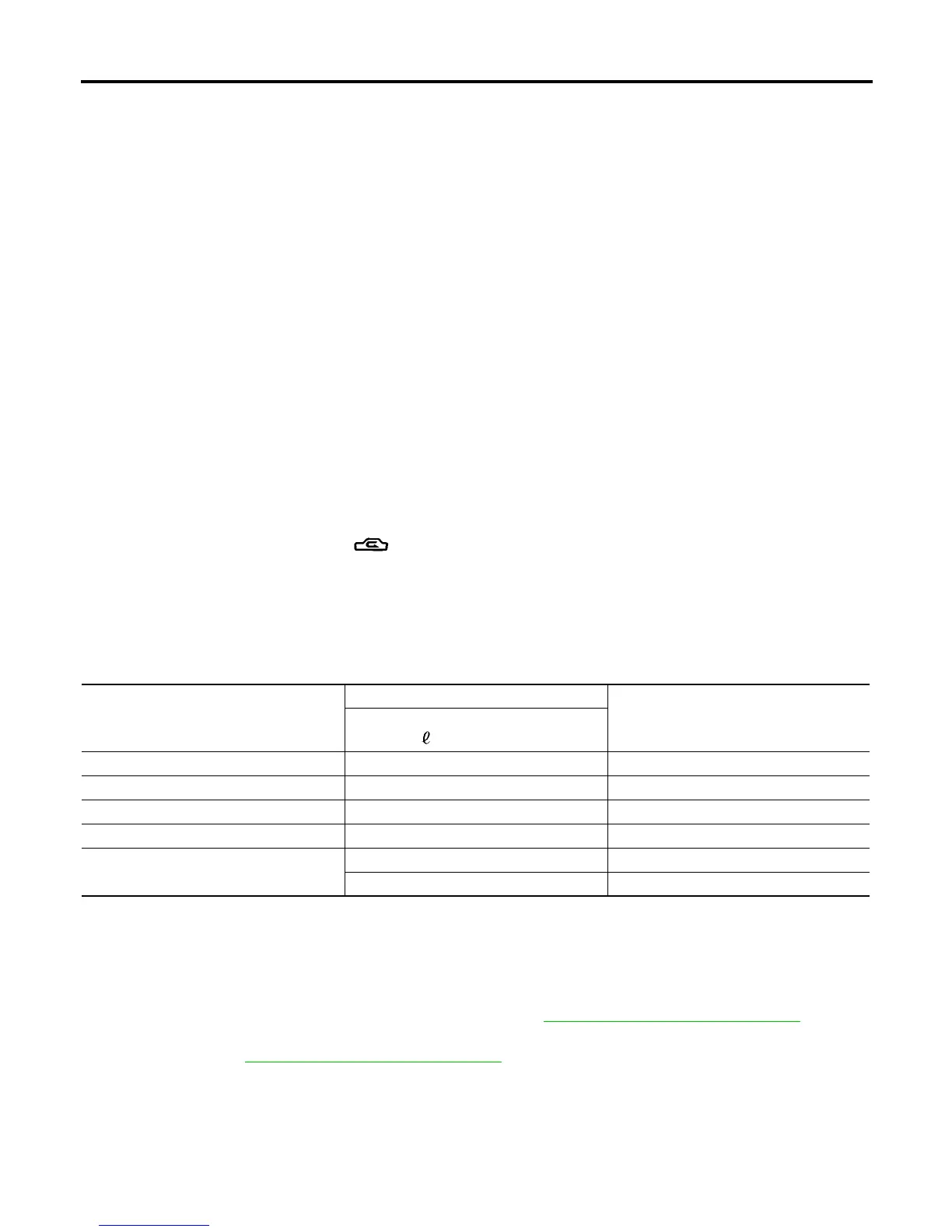
Adjust the lubricant quantity according to the following table.
Lubricant Adjusting Procedure for Components Replacement Except Compressor
After replacing any of the following major components, add the correct amount of lubricant to the system.
Amount of Lubricant to be Added
*1: If refrigerant leak is small, no addition of lubricant is needed.
Lubricant Adjustment Procedure for Compressor Replacement
1. Before connecting recovery/recycling equipment to vehicle, check recovery/recycling equipment gauges.
No refrigerant pressure should be displayed. If NG, recover refrigerant from equipment lines.
2. Connect recovery/recycling equipment to vehicle. Confirm refrigerant purity in supply tank using recovery/
recycling equipment and refrigerant identifier. If NG, refer to MTC-5, "
Contaminated Refrigerant" .
3. Confirm refrigerant purity in vehicle A/C system using recovery/recycling equipment and refrigerant identi-
fier. If NG, refer to MTC-5, "
Contaminated Refrigerant" .
4. Discharge refrigerant into the recovery/recycling equipment. Measure lubricant discharged into the recov-
ery/recycling equipment.
5. Drain the lubricant from the “old” (removed) compressor into a graduated container and recover the
amount of lubricant drained.
6. Drain the lubricant from the “new” compressor into a separate, clean container.
Part replaced
Lubricant to be added to system
Remarks
Amount of lubricant
m (US fl oz, Imp fl oz)
Front evaporator 75 (2.5, 2.6) —
Rear evaporator 75 (2.5, 2.6) —
Condenser 75 (2.5, 2.6) —
Liquid tank 5 (0.2, 0.2) Add if compressor is not replaced.
In case of refrigerant leak
30 (1.0, 1.1) Large leak
— Small leak *1



 To Next Page