Chapter 7. Performing Measurements
119
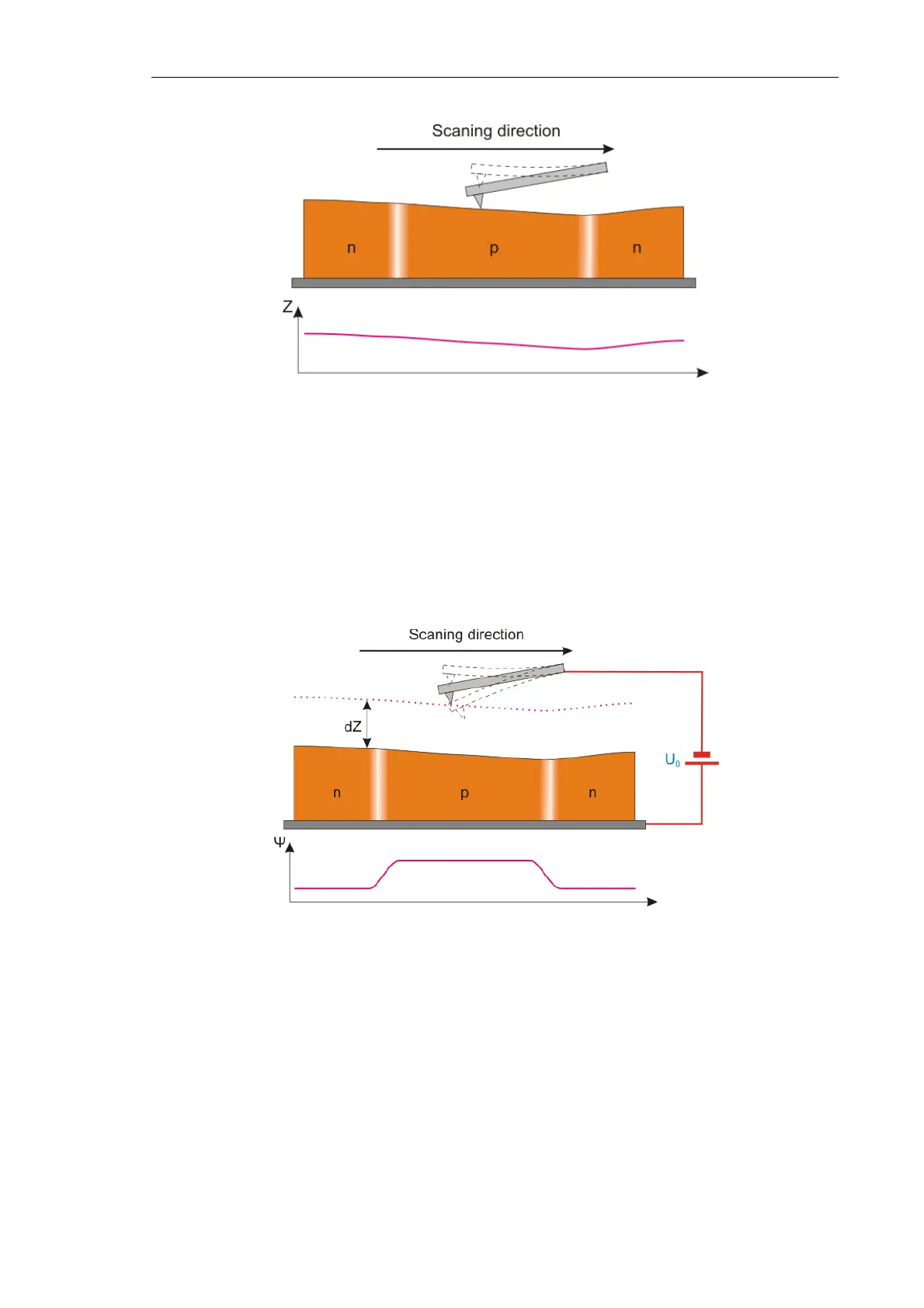
Fig. 7-92. First pass
Surface topography imaging
Then, in the second pass, the probe is lifted above the surface at the height dZ. The
piezodriver induces oscillations of the probe at its resonance frequency and a dc bias
voltage U
0
is set between the probe and surface. During the second pass the probe is
moved over the surface following the surface topography contour (Fig. 7-93). Imaging of
the Z-component of the electric field gradient on the sample surface is performed by means
of reading variations of the probe oscillation phase.
Fig. 7-93. Second pass
Ψ – phase shift
During the second pass the distance between the scanned surface and the probe is kept
constant. This distance should be big enough to eliminate the surface topography influence.
In this case, the probe is only affected by long-range forces whose most prominent yield is
due to electric properties of the sample. On the other hand the value of dZ should not be
too great as that would reduce the measured signal and impair the lateral resolution.


 To Next Page