Solver NEXT SPM. Instruction Manual
80
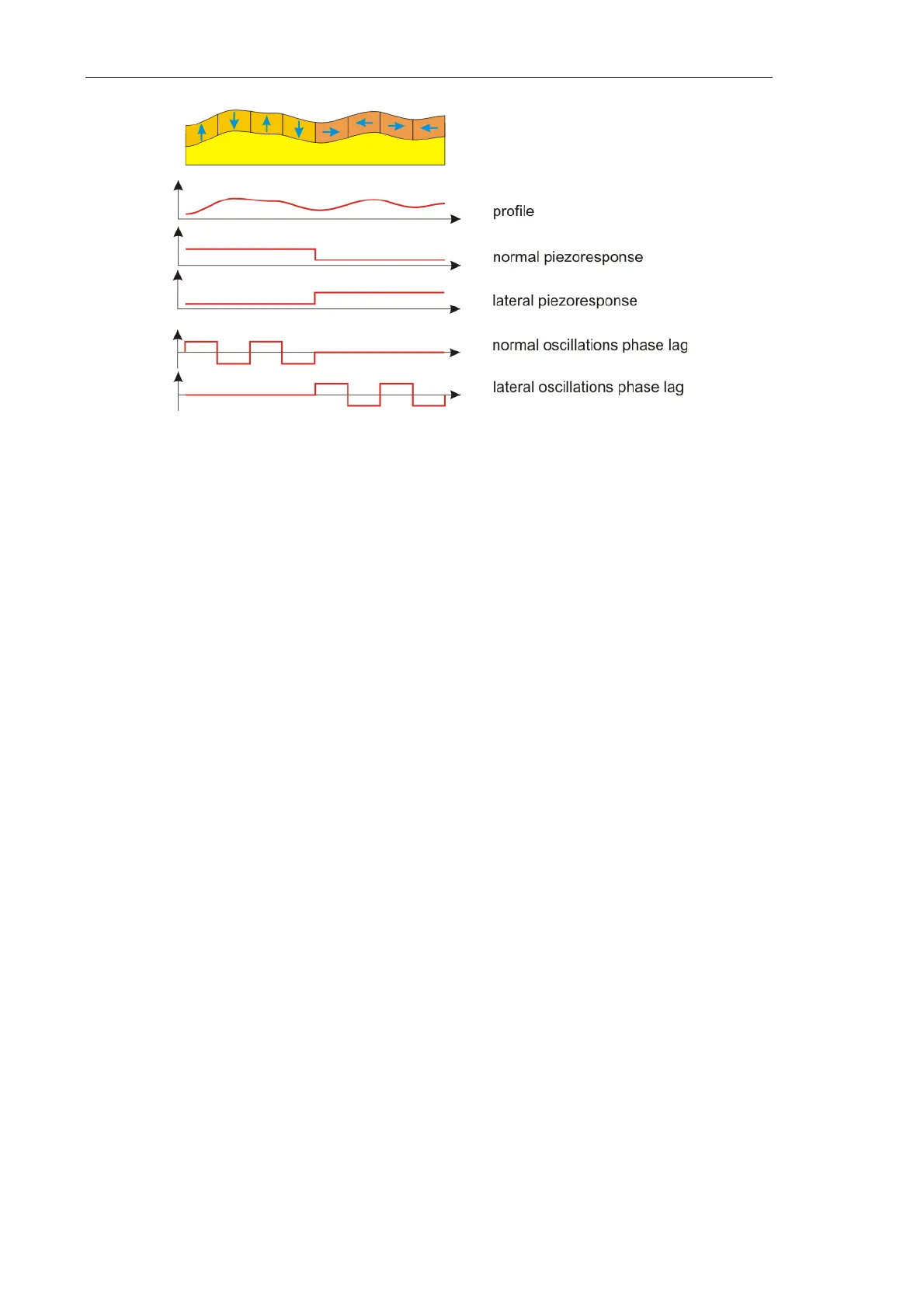
Fig. 7-36
However interpretation of the results obtained is not always simple. It is necessary to
consider a number of factors which can affect or influence images obtained during
measurements.
For better signal (oscillation amplitude), it is desirable to operate on a frequency that is
close to the frequency of the system cantilever-probe-surface (so that oscillations of the
cantilever pressed to the sample would be resonance). This approach is, however, good
only for homogeneous materials. If the sample is inhomogeneous, containing some
inclusions, for example, the resonance oscillation amplitude will reflect the distribution of
surface elasticity in addition to the domain structure. In this case it is recommended to
operate on a frequency that is afar from the resonance.
For inhomogeneous materials, under certain conditions, the oscillation amplitude can
reflect the sample structure even afar from the resonance. This might be due to camber of
the surface induced by electrostatic forces.
7.1.5.2. Preparation for Measurements
To operate in Piezoresponse Force Microscopy a sample should be glued to the substrate
with the conductive glue or mounted on the substrate with a spring contact and it should be
used conductive probes for contact modes.
Before the Piezoresponse Force Microscopy measurements, prepare for the measurements
and perform measurements of surface topography by the Constant Force Mode.
After the completion of preliminary measurements of surface topography by the Constant
Force Mode, perform setting of parameters for operating on Piezoresponse Force
Microscopy.


 To Next Page