Chapter 7. Performing Measurements
143
To provides the total increase of the scanner length when the tip is in contact with the
sample. This value should be negative.
NOTE. For exploratory measurements, recommended values for
From
and
To
are in
the ranges from 200 to 500 nm and from –100 to –10 nm, respectively.
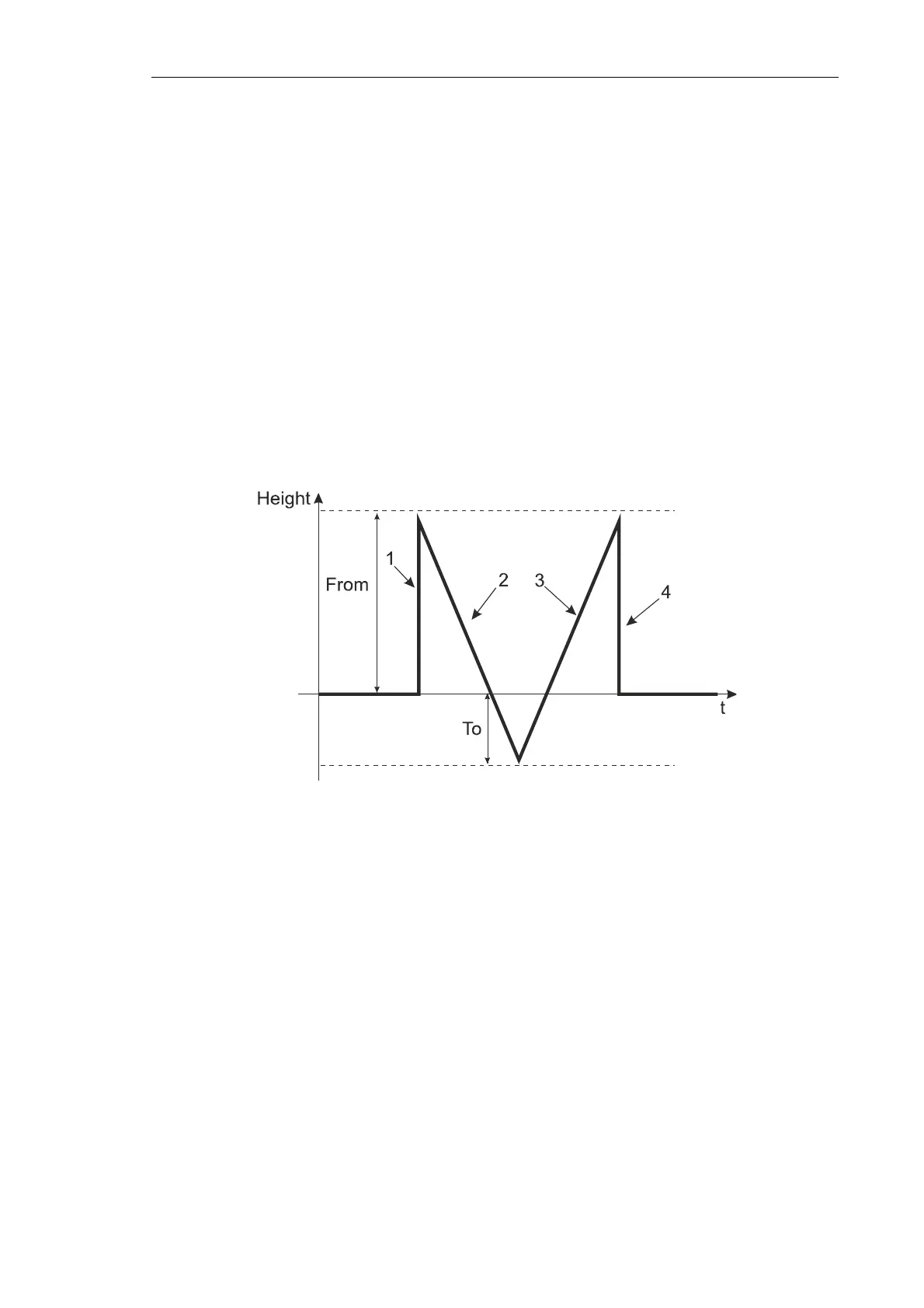
In the course of measurement, the Height value will behave as shown in Fig. 7-126:
1) Part 1 – the scanner brings the sample along the z axis to the point at which the
measurements begin. The Height level increases stepwise by the From value.
2) Part 2 – forward scan measurements. The Height value linearly decreases to its
original level and then to the step defined by To value.
3) Part 3 – backward scan measurements. The Height value linearly increases.
4) Part 4 – the sample returns to the original position. The Height value returns to its
original level.
Fig. 7-126. Height behavior during measurements at a single point
6. Define the desired limits for a signal if necessary. To this purpose, select the Limits
option of the desired signal and in the fields
Min and Max define maximum and
minimum limits of that signal, respectively.
For the force spectroscopy, proper upper limit of
DFL is important.
If the Limits option for the detection signal is not measurements are performed
throughout the whole range of the argument.
7. In the Speed input fields, define either rates of taking 1D relations at forward (Forw
parameter) and backward (Back parameter ) scans in um / sec or times of acquisition at
forward and backward scans in sec.


 To Next Page