Chapter 7. Performing Measurements
151
The adhesion force can be calculated assuming the force is a linear function of the probe
displacement relative to the sample surface along the Z-axis.
By Hooke’s law:
F k Height=×Δ
, (1)
where k – is the cantilever stiffness (see the calibration chart).
For calculating the adhesion force, take the
Δ
Height value. To this purpose, press the
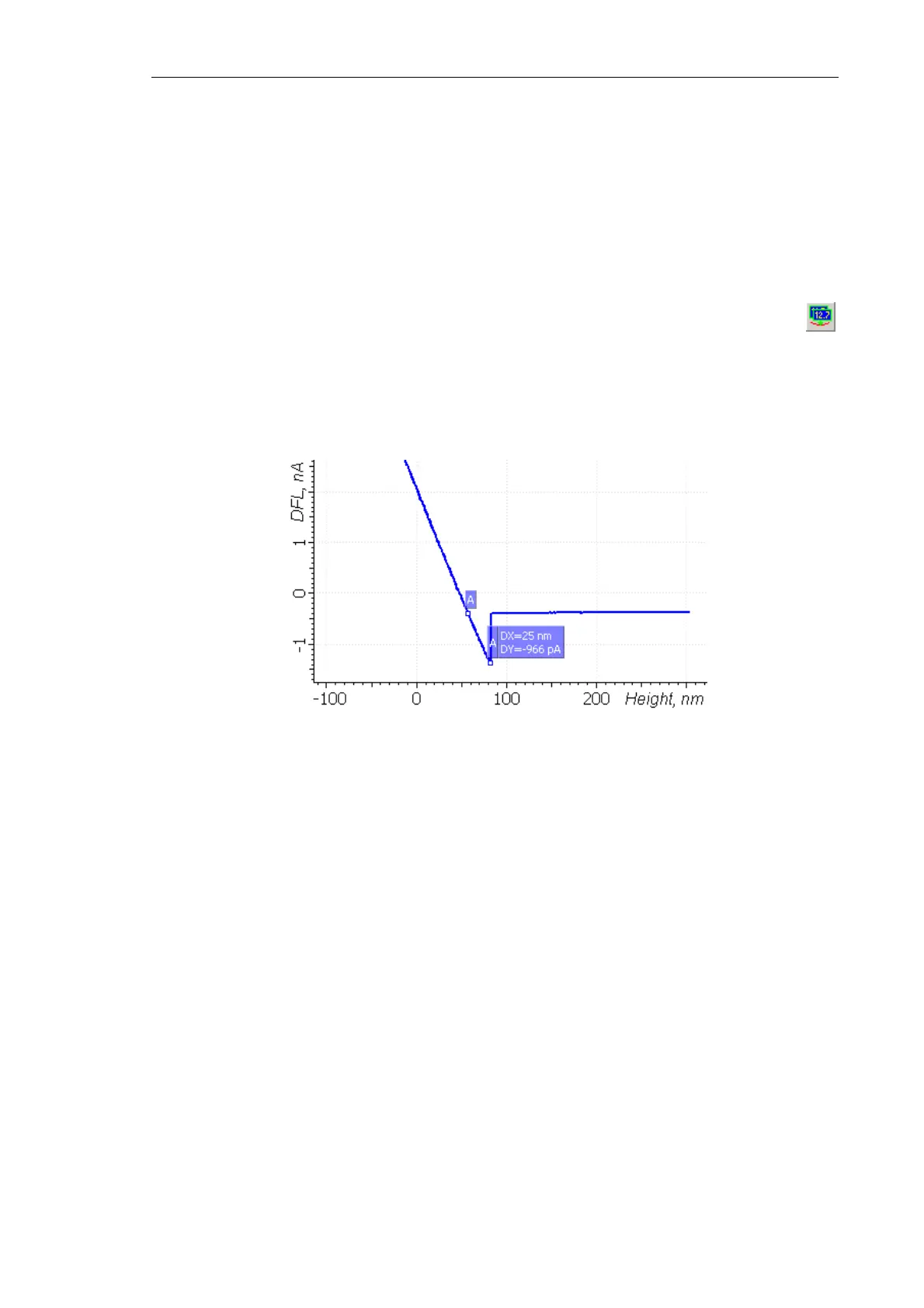
button (Pair Markers) in the 1D Data Viewer and place the two markers on the inclined
portion of the curve as shown in Fig. 7-139.
NOTE. For precise measurement of the adhesion force, take the
Δ
Height value for a point
where the sample does not bend.
Fig. 7-139
The values of DX and DY measured with the markers are Δ Height and Δ DFL, respectively.
In the example
Δ Height = 25 nm.
In our case the cantilever stiffness was ∼0.03 N/m. Thus the adhesion force in the
spectroscopy point is:
0.03 / 25 0.8
N m nm nN=×≈
. (2)
In a similar manner, the force acting on the probe (and the sample) during scan can be
calculated.
As an example, we can calculate the force acting on the probe during scanning using
Constant Force Mode with the parameter Set Point = 2 nA. This force results in the
Δ Height value measured as shown in Fig. 7-140. The position of the first marker
corresponds to the Set Point value, while that for the second marker reflects the level of the
DFL signal immediately before the cantilever detached from the sample surface.


 To Next Page