Chapter 7. Performing Measurements
71
7.1.2. Lateral Force Microscopy
7.1.2.1. Brief Description
The Lateral Force Microscopy facilitates discrimination between areas with different
coefficients of friction as well as reveals specific features of surface topography. This
mode is useful in research of semiconductors, polymers, film coatings, memory media for
physico-chemical properties of the surface (in particular, deterioration), tribology
characteristics etc.
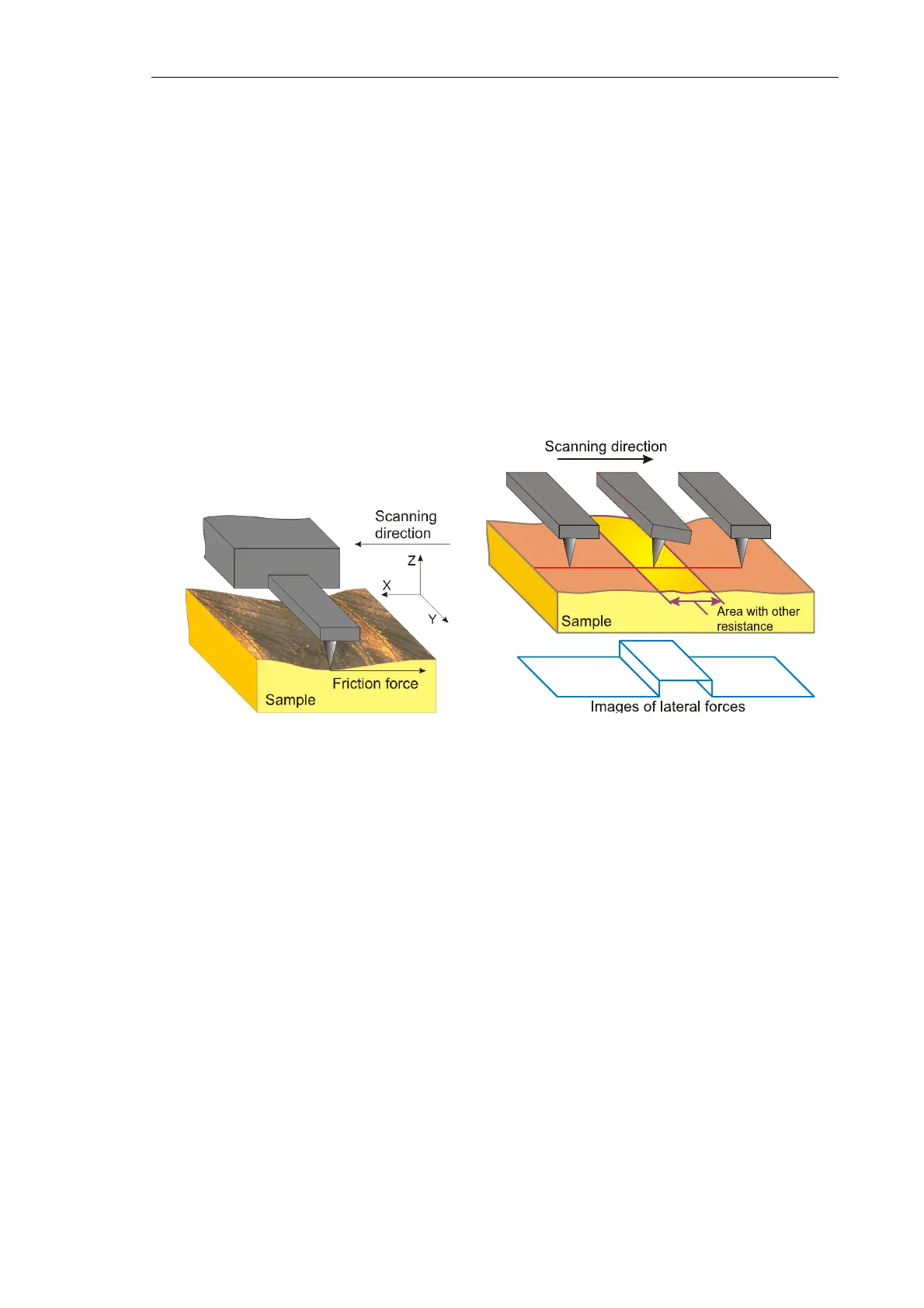
The Lateral Force Microscopy is based on the following physical ground. While scanning
in this mode, a torsion deflection of the probe occurs in the direction perpendicular to the
longitudinal axis of the cantilever additionally to the normal deflection (see Fig. 7-25). It is
caused by moment of the force acting on the tip of the probe.
Fig. 7-25 Fig. 7-26
At small deflections, the twist angle of the probe is proportional to the lateral force. The
magnitude of the twist is measured with the optical detection system of the instrument.
This detection system generates the
LF signal whose variation is proportional to the value
of the torsion deflection of the cantilever. This signal provides imaging of the local friction
along the sample surface.
The twist angle of the probe varies when the probe moves along a flat surface with regions
that differ in their friction coefficients (see Fig. 7-26). This variation provides information
on distribution of local friction properties. Unfortunately, such interpretation becomes
invalid if the landscape is not flat.
Nevertheless, this technique offers good imaging of surface features in small scales. For
example, lateral forces data provided easy determination of the atomic lattice parameters of
mica and other lamellar materials.


 To Next Page