A-108 Appendix – Terms and Denitions
FlexFit – Linkageless Control – Revision 1.0
PREFERRED
UTILITIES MFG CORPORATION
AA
PP
PP
EE
NN
DD
II
XX
Term
Feed Forward When a process value lags a change in effect that causes it, that change in effect is
directed to a control element prior to the process value changing (e.g. the fuel valve posi-
tion could be fed forward to a draft controller to cause a draft damper to pre-position prior
to the ring rate causing a draft change).
Feedback The return of the output of a controlled device to its controller (e.g. VSD feedback at a
certain speed to the VSD controller to let the controller know if it needs to increase or
decrease speed)
FlexFit-BMS
or FlexFit Flame Safeguard
The burner management system (ame safeguard) portion of the FlexFit – mounted inside
the control cabinet.
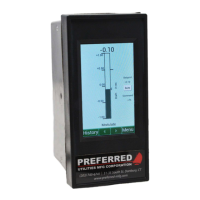
FlexFit-CC The combustion control portion of the FlexFit with the LCD screen – mounted ush on the
control cabinet.
Hysteresis Hysteresis is the dependence of the state of a system on its history (e.g. if one wishes to
maintain a temperature of 20 °C then one might set the thermostat to turn the heater on
when the temperature drops to below 18 °C and off when the temperature exceeds 22 °C).
Interlock A burner control or limit
Linkageless Control System A linkageless control system uses a burner with individual servos to control fuel and air
ratios and provide more savings to the end user.
Lockout A state the causes a burner shutdown or prevents a burner startup
NFPA 85 Boiler and Combustion Systems Hazards Code – NFPA 85 contributes to operating safety
and prevents explosions and implosions in boilers with greater than 12.5 MMBTUh, pulver-
ized fuel systems, and heat recovery steam generators.
Oxygen Trim Oxygen trim maintains the lowest possible burner excess air level from low to high re.
Burners that don’t have oxygen trim must run with extra excess air to allow safe operation
during variations in weather and fuel. Extra fuel is burned to heat the extra excess air and it
leaves the stack as lost energy. Oxygen trim minimizes excess air and saves fuel.
A sensor measures ue gas oxygen and the FlexFit compares the actual oxygen level to
the desired oxygen level. The air (or fuel) ow is trimmed by the controller until the oxygen
level is corrected. The desired oxygen level for each ring rate must be entered into a
characterized setpoint curve. For dual fuel burners, independent curves must be entered.
The control strategy must include variable gain (ratio trimming) and setpoint lead/lag logic
to prevent control oscillation.
Parallel Positioning The fuel control valves are positioned by one servo while the air control damper is posi-
tioned by a second servo. For every ring rate, there is one and only one position for the
fuel valves and a corresponding position for the air damper. For the FlexFit, the fuel/air ratio
is varied by creating a digital curve of fuel position vs. air position.
PID Controller PID stands for Proportional–Integral–Derivative. A PID controller calculates the difference
between a desired setpoint and a measured process variable and applies a correction to
the output signal, based on the P, I, and D terms, until the process matches the setpoint.
Proportional Band The amount of input change that causes a controller to move from one extreme to the other.
Example: In a draft controller with a proportional band of 0.600 and a setpoint of -0.10"
When draft = +0.20", the damper will be opening at full speed.
When draft = 0.00", the damper will be opening at 33% speed.
When draft = -0.10", the damper will not be moving.
When draft = -0.25", the damper will be closing at 50% speed.
When draft = -0.40", the damper will be closing at full speed.
FlexFit State Dened step in the burner management system sequence of operation (See section
"Description of BMS Sates" on page 1-8).
UL 372 The standard for primary safety controls for gas- and oil-red appliances
Table A – 2 Denitions



 To Next Page