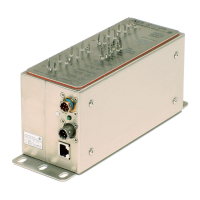
The MPS4232 is a miniature, intelligent, 32-channel piezoresistive pressure scanner designed for various applications including industrial, flight test, educational, and wind tunnel environments. It integrates 32 individual pressure sensors, analog-to-digital (A/D) converters, and a dual-core processor operating system for engineering unit conversion and communication. The device is powered by a single 5-36Vdc input and communicates primarily via Ethernet, with RS-232 available for backup and troubleshooting.
Function Description
The MPS4232's core function is to measure and scan pressure values from its 32 channels. A key feature is the proprietary "Dynamic CALZ" function, which effectively nulls the zero offset of the A/D conversion process with every scan, leading to extremely stable sensor outputs and virtually eliminating zero drift. This significantly reduces the need for traditional pneumatic zero correction. The device operates in a "Measurement Mode" where Px ports are directly routed to discrete sensors, and a common reference cavity exposes the negative side of all 32 sensors to a common reference pressure.
Important Technical Specifications
- Size (WxHxD): 0.5" x 1.62" x 4.13" [12.7mm x 41.15mm x 104.78mm]
- Weight: 0.19lbs [86.2g]
- Inputs (Px): 0.042" [1.067mm] OD (standard), 0.031" [.787mm] OD (optional)
- Inputs (REF): 0.063" [1.600mm] OD
- Standard Full Scale Ranges: ±4 inH2O, ±8 inH2O, ±1psid, ±5psid, ±15psid, 50psid (995.4Pa, 1990.7Pa, 6.89kPa, 34.5kPa, 103.4kPa, 344.7kPa). Modules calibrated at +15PSI F.S. or higher are only calibrated to -15PSI.
- Accuracy (including linearity, hysteresis, and repeatability):
- 4 inH2O: ±0.20% FS
- 8 inH2O: ±0.15% FS
- 1psid, 5psid, 15psid, 50psid: ±0.06% FS
- Overpressure (No damage):
- 4 inH2O, 8 inH2O: 2psi
- 1psid: 10psi
- 5psid: 40psi
- 15psid: 75psi
- 50psid: 200psi
- Maximum Reference Pressure: 50psig (344.7kPa) or overpressure range, whichever is less
- A/D Resolution: 24bit
- Ethernet Connection: 100baseT, MDIX auto-crossing
- Communications: HTTP, Telnet, FTP, UDP, IEEE1588-2008v2 Precision Time Protocol
- Power Requirements: 5-36Vdc, 3.5W
- External Trigger: 5-15Vdc, 6.5mA
- Temperature:
- Operation: 0 to 70°C
- Storage: 0 to 80°C
- Compensated: 0 to 70°C
- Humidity (Non-Condensing):
- Operation: 5 to 95% RH
- Storage: 5 to 95% RH
- Shock & Vibration: MIL-STD-810G, Category 24
- Media: Gasses compatible with Silicon, Silicone, Aluminum and Buna-N
- Environmental Pressure: Maximum 100psia (690kPa absolute), Minimum 0.50psia (3.45kPa absolute)
- Data Output Rate (samples/channel/second): Binary 1000Hz, ASCII 100Hz (maximum data rate depends on network)
- Standards: CE & RoHS v3
Usage Features
- Pneumatic Inputs: Features removable input headers for the 32 individual channel inputs (Px ports) and a single common reference port (REF). This allows for easy plumbing changes, swapping with other modules, or using blanking caps for protection.
- Electrical Connectors: Equipped with TE Connectivity "Mini I/O" series connectors for power and Ethernet, which are polarized to prevent improper connections and latching to prevent loosening due to vibration. The power connector also supports external trigger input and RS-232 serial communication.
- Communication Options:
- Ethernet: Primary communication method, supporting TCP/IP, UDP, HTTP, Telnet, and FTP protocols.
- Serial (RS-232): Available for emergency communication, troubleshooting, and configuring the module if an Ethernet connection cannot be established.
- Web Server: An integral Web Server with a graphical interface accessible via a web browser (Google Chrome, Microsoft Edge). It allows users to configure the MPS, view scan data, and update firmware and coefficient tables.
- Scanning Modes: Supports various scanning options including internal rate (software or hardware triggered), external rate (hardware or software frame triggering), scan-on-startup, and PTP time triggered.
- Data Output Formats: Scan data can be output in ASCII (unformatted, formatted VT100, CSV) or Binary (standard 32-channel or padded 64-channel for MPS4264 compatibility) via TCP, UDP, or FTP.
- Engineering Units: Supports a wide range of pressure engineering units (PSI, Pascals, Bar, etc.) and temperature in degrees Celsius. Raw A/D counts can also be output for troubleshooting.
- Multicast Operations: Allows for controlling multiple MPS units simultaneously (e.g., starting scans, stopping, calibration) by configuring them into "clusters" using a multicast address.
- Precision Time Protocol (PTP): Compliant with IEEE1588v2, enabling synchronization of data collection across multiple MPS units or with other PTP-compatible equipment. Can be configured as a PTP slave or master device.
Maintenance Features
- Firmware Installation: Firmware can be updated via the integrated Web Server or an FTP file server.
- Calibration Coefficient Installation: Calibration coefficients can be installed via the Web Server or an FTP file server.
- Flash Disk Formatting: The internal memory can be erased and formatted using the FDISK command, which is useful for restoring operating files in case of corruption.
- Zero Offset Calibration (CALZ): A quick zero offset correction can be performed internally without additional equipment, ideally in a "wind-off" condition. This is recommended daily to maintain accuracy, especially if the module's temperature changes significantly.
- Calibration & Validation: Supports full and field calibrations and validations, which can be automated using Scanivalve SPC4000 or SPC4050 calibrators and Ethernet controllable thermal chambers. Manual field calibration/validation is also possible.
- Configuration Management: Settings can be saved to flash memory, loaded from files, and listed for review.

 Need help?
 General

 To Next Page