18
2.6.2 Patch Pipettes
Patch pipette programs are generally one line programs with Pull = 0 and Velocity = 15-60
that loop 2-5 times. The number of Loops (cycles) the puller performs is determined by the
velocity setting. The number of Loops to aim for will depend on the glass size and type of
patch experiment.
Patch pipettes used for whole or dissociated cells usually require thick walled glass and a
program that loops 4-6 times.
Patch pipettes used for slice and live tissue usually require thin walled glass and a program
that loops 1-3 times.
To find a Cookbook program to make a patch pipette, press [Menu] or [Home] from the
program screen. When in the Cookbook menu, you will be asked to select the filament and
glass you are using. Then select a “Type A” program, which can then be installed and used to
make a patch pipette.
2.6.3 Microinjection Pipettes and High Resistant Electrodes (30-300 Megohm)
These pipettes are commonly made by using a one-line program that pulls the glass apart in
one stage. Use the Cookbook feature to help establish appropriate settings. Typical Pull and
Velocity settings commonly used are Pull = 35-125 and Velocity = 50-90. To find a program
from within the program screen, press [Menu] or [Home]. Type B and C Cookbook programs
are best for making microinjection pipettes while Type C and D can be used to make high
resistant electrodes.
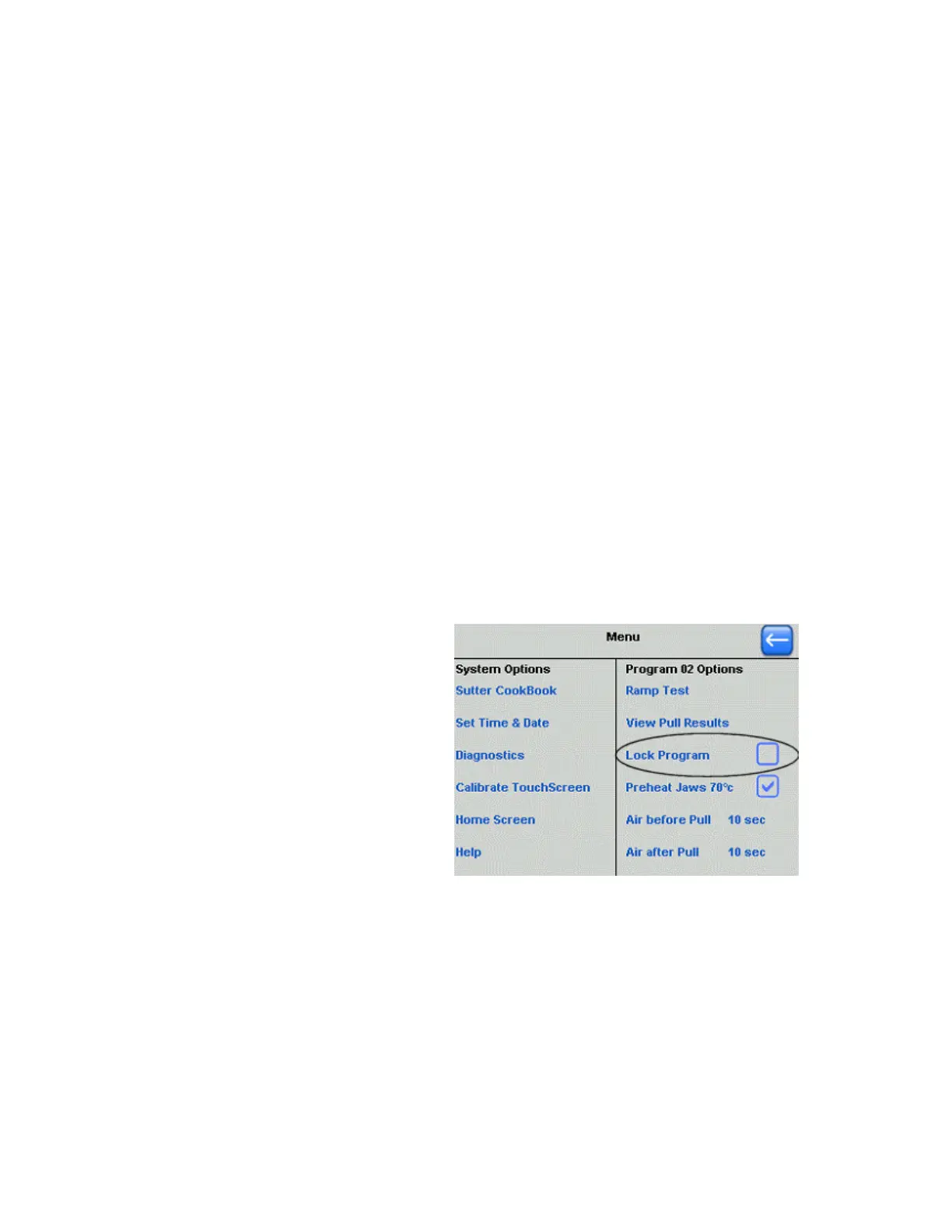
2.6.4 Lock/Unlock Program
The program can be
locked/unlocked in the [Menu]
screen.
Figure 2-14. Locking & unlocking a program (Menu screen).
P-1000 FLAMING/BROWN MICROPIPETTE PULLER SYSTEM OPERATION MANUAL – REV. 3.02 (20161118)


 To Next Page