3
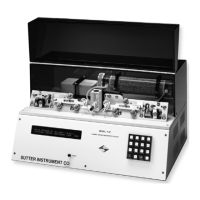
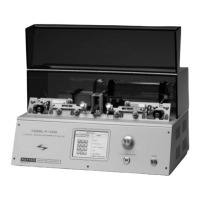
Additionally, more than 100 programs from the Sutter Pipette Cookbook are stored in the P-
1000 any one of which is available can be loaded up into any program.
In describing the operation of the puller, the above configuration is assumed. If the
configuration of your puller differs, the operating instructions still apply but references to
specific program settings may not be accurate. Inappropriate settings will generally only
affect your ability to control the geometry of the glass micropipette you are trying to
fabricate. However, the heating filament can be destroyed by an excessive value for the
HEAT parameter. We recommend you refrain from executing a program until you have read
this section of the manual, have run the Ramp Test described herein, and are using the Safe
Heat Mode.
Program
(0-99)
A program consists of one or more lines or loops that, when executed,
will ‘pull’ the capillary glass inserted in the instrument. A program
can be up to 4 lines. Each line can be repeated up to 4 times with a
maximum of 10 lines including repeats.
Locked/Unlocked
(write protection)
A program that is locked cannot be edited or changed.
No keypad is
displayed when the program is locked. A program’s locked status is
changed in the Menu screen (displayed when pressing the MENU
button).
Safe Heat
(On/Off)
Causes a warning if a Heat value is more than 10% above or below
Ramp value.
Pressure Setting
(Range 0-999)
Shows the programmed value of the air pressure during the active
cooling phase of the pull cycle.
Date/Time Shows the date and time of the last program edit.
HEAT
(Range 0-999)
HEAT controls the level of electrical current supplied to the filament.
The HEAT required to melt a piece of glass is a function of the
filament installed and the particular glass size and composition. It is
important that the HEAT value be set relative to the Ramp Test
value as discussed in the Operation Section. Generally, changes to
HEAT will be made in steps of about 5 units since in most cases
smaller changes will have little effect.
PULL
(Range 0-255)
This parameter controls the force of the hard pull. In general, the
higher the PULL, the smaller the pipette’s tip diameter and the
longer the taper. Useful changes in PULL strength are 10 units or
more to see an effect.
VELOCITY
(Range 0-255)
The velocity of the glass carriage system is measured as the glass
softens and begins to pull apart under a constant load. The
increasing velocity of the initial pull is determined by the viscosity of
P-1000 FLAMING/BROWN MICROPIPETTE PULLER SYSTEM OPERATION MANUAL – REV. 3.02 (20161118)


 To Next Page