Parametric Graphing 4-3
82EB1A~1.DOC TI-83 international English Bob Fedorisko Revised: 10/26/05 1:20 PM Printed: 10/27/05 1:58
PM Page 3 of 8
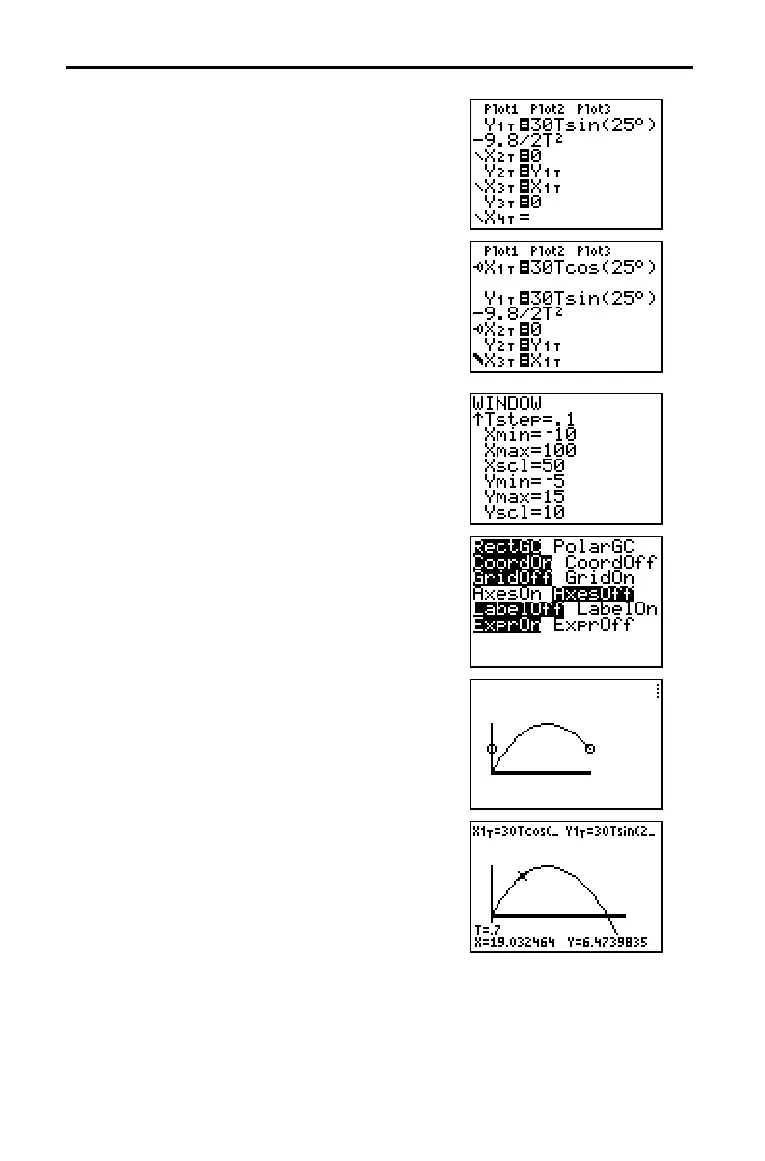
The horizontal component vector is defined by
X3T and Y3T.
6. Press ~ 2, and then press 1 Í to
define
X3T. Press 0 Í to define Y3T.
7. Press | | } Í to change the graph
style to è for
X3T and Y3T. Press } Í
Í to change the graph style to ë for
X2T
and Y2T. Press } Í Í to change the
graph style to ë for
X1T and Y1T. (These
keystrokes assume that all graph styles were
set to ç originally.)
8. Press p. Enter these values for the
window variables.
Tmin=0 Xmin=L10 Ymin=L5
Tmax=5 Xmax=100 Ymax=15
Tstep=.1 Xscl=50 Yscl=10
9. Press y [FORMAT] † † † ~ Í to set
AxesOff, which turns off the axes.
10. Press s. The plotting action
simultaneously shows the ball in flight and the
vertical and horizontal component vectors of
the motion.
Tip: To simulate the ball flying through the air, set
graph style to ì (animate) for
1T and
1T.
11. Press r to obtain numerical results and
answer the questions at the beginning of this
section.
Tracing begins at
Tmin on the first parametric
equation (
X1T and Y1T). As you press ~ to
trace the curve, the cursor follows the path of
the ball over time. The values for
X (distance),
Y (height), and T (time) are displayed at the
bottom of the screen.


 To Next Page
 Loading...