OPERATION
Carl Zeiss Illumination and contrast procedures Axio Examiner
66 M60-2-0003 e 05/2012
4.1.4 Oblique illumination according to DODT
(1) General operating principle
Oblique illumination allows a relief representation of your specimen. This is achieved by a radially
adjustable stop which is located in the optical path, and directs light at an angle to the specimen.
For oblique illumination according to DODT, a special segmented stop is used in combination with a
diffusing screen. The diffusing screen creates an intensity gradient within the diffusing cylinder. Artefacts
in the image are reduced, and hard contrasts are avoided. This procedure is suitable in particular for
highly scattering tissue sections.
(2) Equipment
The equipment of every microscope allows the performance of the oblique illumination procedure.
All condensers available for delivery may be used for oblique illumination.
− Corresponding segmented stop slider for the condenser;
− HAL 100 halogen lamp for transmitted-light illumination
(3) Adjusting oblique illumination
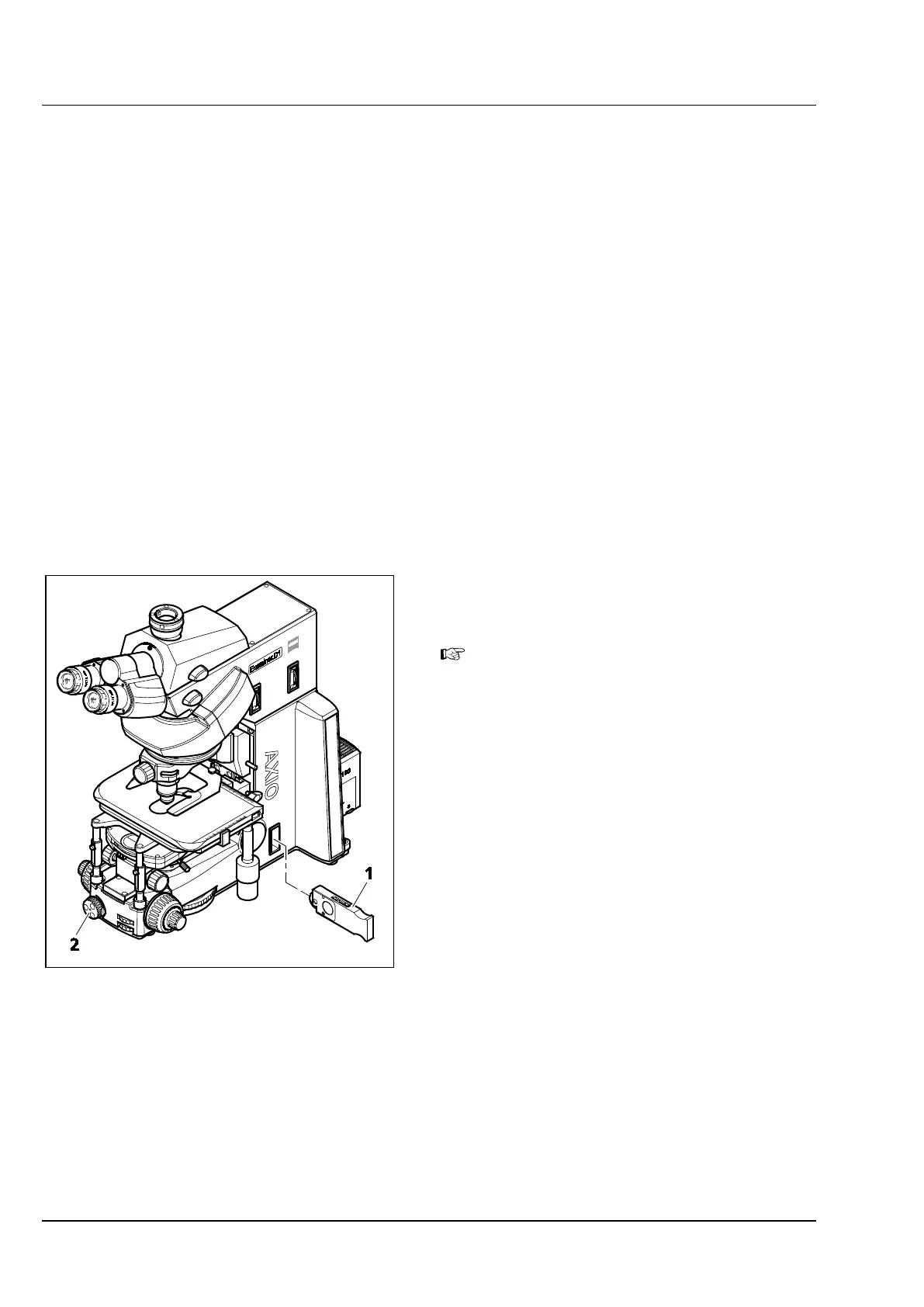
• Insert the segmented stop slider (Figure 4-7/1)
into the lower microscope part until it locks into
place.
When the water condenser 1.2 is used
(424226-9020-000), the diffusing diaphragm
needs to be swiveled into the condenser
since the segmented stop slider has no
diffusing diaphragm of its own.
• Switch on the transmitted-light illumination.
• Use the control wheel (Figure 4-7/2) at the
stand to rotate the slot segment of the stop
into the desired position.
Figure 4-7 Inserting a segmented stop slider



 To Next Page