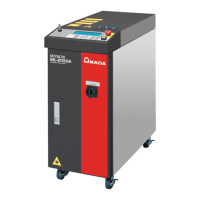
MM-400A
10. Interface
10-6
(Note) About the analog displacement signal
The displacement analog output changes depending on the sensor step.
Based on 1 um of sensor step, perform approx. 5 V output for 2.047 mm (0.0805 inch),
approx. 5 V output for 8.191 mm (0.3224 inch), and approx. 5 V output for 32.767 mm
(1.2900 inch) in a range of ±5 V max.
The displacement analog output is obtained by the following formula: measured value ÷
output range × output maximum voltage (5 V) ÷ sensor step.
Ex. 1)
For output voltage with 2 mm of measured value, 2.047 mm of output range, and 1.0 um of
sensor step, 2 mm ÷ 2.047 mm × 5 V ÷ 1 um = approx. 4.885 V.
Ex. 2)
For output voltage with 1 mm of measured value, 2.047 mm of output range, and 0.5 um of
sensor step, 1 mm ÷ 2.047 mm × 5 V ÷ 0.5 um = approx. 4.885 V.
Ex. 3)
For output voltage with 2 mm of measured value, 2.047 mm of output range, and 00.5 um of
sensor step, 2 mm ÷ 2.047 mm × 5 V ÷ 0.5 um = approx. 9.770 V. However, it is 5 V max.
since the maximum value is ±5 V. (Change the output range to 8.191 mm or more.)
Ex. 4)
For output voltage with 2 mm of measured value, 2.047 mm of output range, and 10.0 um of
sensor step, 2 mm ÷ 2.047 mm × 5 V ÷ 10 um = approx. 0.489 V.
The displacement analog output does not change even when the setting of displacement
polarity is changed.
For the displacement polarity, refer to Chapter 8, “m-3. EXTEND SETUP (3) Screen.”
The force analog output changes depending on the rated output of the sensor
Ex. 1)
When the rated output of the sensor is 1 mV/V, the force analog output is approx. 5 V at the
rated maximum force.
Ex. 2)
When the rated output of the sensor is 2 mV/V, the force analog output is approx. 10 V at
the rated maximum force.


 To Next Page