Chapter 5 Use Examples
5-6
5.3 Testing Jitter Tolerance
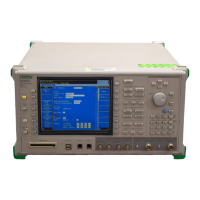
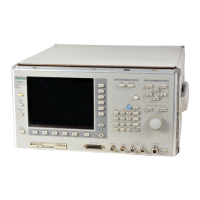
This section describes how to test jitter tolerance by using MP1861A and
MP1862A.
The equipment used in the following example is:
MP1800A-016: 1
MU183020A-x01/x23/x31: 1
MU183040B-x01/x20: 1
MU181000A: 1
MU181500B: 1
MP1861A-x01/x13/x30: 1
MP1862A-x01: 1
1. Place the equipment in the error-free state according to the
procedure in 5.1 “Achieving Error-Free Data Transmission”. Be sure
to use the cables that come with MP1861A and MP1862A.
2. Turn off the output from MP1861A by clicking the
module
function button (
) or pressing the
key on the front panel
of MP1800A.
3. On the
tab of MP1861A, set the data output interface
so that it does not exceed the input voltage range of the DUT.
4. On the
tab of MP1862A, set the data input interface so
that it can detect the signal output from the DUT.
5. Connect the
and
connectors of MP1861A
to the input connectors of the DUT by using coaxial cables.
6. Connect the
and
connectors of MP1862A to
the output connectors of the DUT by using coaxial cables.
7. Adjust the length of the cable used for the
connector
of MP1861A and the
connector of MP1862A so that it
becomes equivalent to the delay between the
connector
of MP1861A and the
connector of MP1862A.
Jitter tolerance may not be tested properly unless the delay length is
set properly.
8. On the
tab of MP1861A, switch the
to
.
9. Turn on the output from MP1861A by clicking the
module
function button (
) or pressing the
key on the front panel
of MP1800A.
10. Click the
module function button ( ).
11. Click
Jitter Noise Tolerance Test Software
.
For how to use the MX181500A Jitter/Noise Tolerance Test Software,





 To Next Page