39
You can then control the computer as you regularly would within the window on the display.
For computers hosting Linux, or Android, or Embedded Operating System, you will need to switch off
“Surfer” feature by using keyboard “Ctrl + Alt + Shift + F8” hotkey or pressing side-key of the mouse
(if applicable) in order to control that computer. The window’s border will turn red, this signifies that
your Sequoia 4K60 is now in Remote mode without “Surfer” feature. Your keyboard and mouse
control will stay within that window and won’t be able to move across the border.
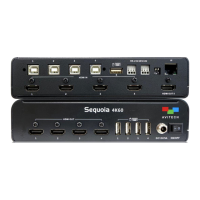
Your Sequoia 4K60 can only enter Remote mode to take control of a computer when the correct USB
Type-B port (marked 1 to 4) on the rear panel of Sequoia 4K60 is properly connected to the USB
Type-A port of that computer (using a standard USB A/B cable). In addition, only windows
corresponding to computer systems (as opposed to pure video systems) can be accessed through
Remote mode.
To switch back to Host mode, use keyboard “Pause/Break” hotkey, or double-click the mouse scroll
button.
When your workstation configuration is composed by two or more monitors and is in "Surfer", the mouse
moving away from quad-view to the neighboring fullscreen will remain the current Remote or Host mode.
3.5 Basic Operation for Projector Configuration
When in Projector (PiP) display mode, four outputs can duplicate two picture-in-picture (PiP) images,
and one output can have a multiview display as shown in below figure. When in Projector (fullscreen)
display mode, the Sequoia 4K60 offers seamless switching of the input sources to any of the single-view
fullscreen outputs. The web-browser based GUI offers easy and intuitive control from computers and
handheld touch devices.
1. The last switched or routed video source is automatically saved after five seconds by the Sequoia 4K60;
until the next change in video routing. This means that if you will be powering off the Sequoia 4K60, but still
wish to retain the last configured video routing, please wait five seconds or more before turning off power to
your Sequoia 4K60 in order to retain the last configured video routing in system memory, and it will be
automatically recalled upon the next power-on.
2. Embedded audio is switched/routed following the video signal (supporting HDMI with up to 8-channel
embedded audio respectively).
3.5.1 Source switching for the Projector (PiP) Display Mode
When in Projector (PiP) display mode, four outputs can duplicate two picture-in-picture (PiP) images.
The web browser-based GUI comprises an input source bar and output displaying ports in subsequent
order. Video switching can be achieved through simple drag- and-drop of input to the target output for
video routing.
Use drag-and-drop to switch a source to destination port, perform the following steps:


 To Next Page