EasyManua.ls Logo

Commodore Amiga - Page 298

Commodore Amiga
321 pages
Print Icon
To Next Page IconTo Next Page
To Previous Page IconTo Previous Page
Loading...
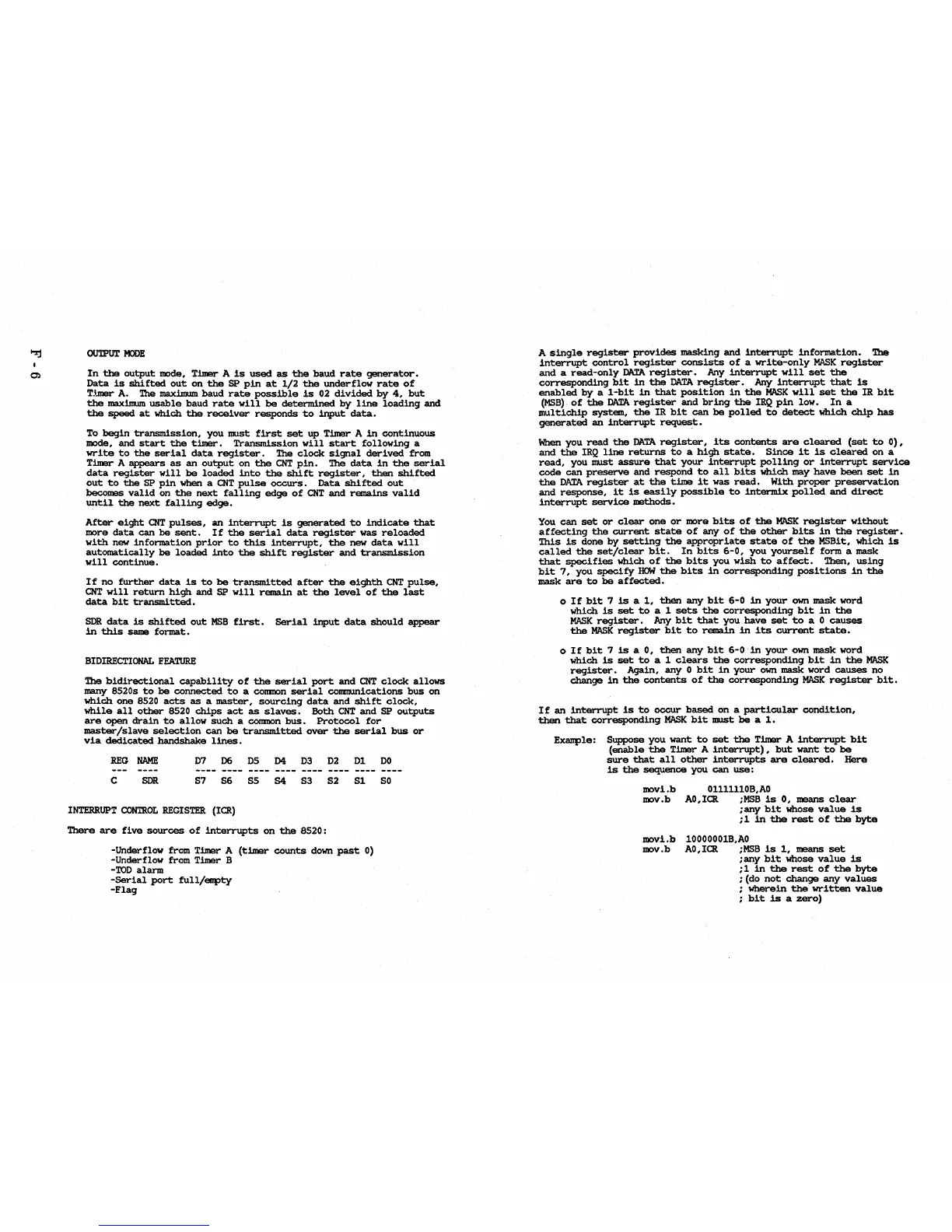
OUTPUT
K>DE
In
the
output
mode,
Timer
A
is
used
as
the
baud
rate
generator.
Data
is
shifted
out
on
the
SP
pin
at
1/2
the
underflow
rate
of
T~.mer
A.
The
maxilrrum
baud
rate
possible
is
02
divided
by
4,
but
the
maxinrum
usable
baud
rate
will
be
detennined
by
line
loading
and
the
speed
at
which
the
receiver
responds
to
input
data.
To
begin
transmission,
you
must
first
set
up
Timer
A
in
continuous
mode,
and
start
the
timer.
Transmission
will
start
following
a
write
to
the
serial
data
register.
The
clock
signal
derived
from
Timer
A
appears
as
an
output
on
the
CNT
pin.
The
data
in
the
serial
data
register
will
be
loaded
into
the
shift
register,
then
shifted
out
to
the
SP
pin
when a
CNT
pulse
occurs.
Data
shifted
out
becomes
valid
on
the
next
falling
edge
of
CNT
and
remains
valid
until
the
next
falling
edge.
After
eight
CNT
pulses,
an
interrupt
is
generated
to
indicate
that
more
data
can
be
sent.
If
the
serial
data
register
was
reloaded
with
new
information
prior
to
this
interrupt,
the
new
data
will
automatically
be
loaded
into
the
shift
register
and
transmission
will
continue.
If
no
further
data
is
to
be
transmitted
after
the
eighth
CNT
pulse,
CNT
will
return
high
and
SP
will
remain
at
the
level
of
the
last
data
bit
transmitted.
SDR
data
is
shifted
out
MSB
first.
Serial
input
data
should
appear
in
this
same
format.
BIDIRECTIONAL
FEA'l'URE
'!be
bidirectional
capability
of
the
serial
port
and
CNT
clock
allows
many
8520s
to
be
connected
to
a conmon
serial
colllllUnications
bus
on
which
one
8520
acts
as
a
master,
sourcing
data
and
shift
clock,
while
all
other
8520
chips
act
as
slaves.
Both
CNT
and
SP
outputs
are
open
drain
to
allow
such
a conmon
bus.
Protocol
for
master/slave
selection
can
be
transmitted
over
the
serial
bus
or
via
dedicated
handshake
lines.
REG
NAME
D7
D6
D5
D4
D3
D2
D1
DO
c
SDR
57
S6
S5
54
S3
S2
S1
SO
INTERRUPT
CONTROL
REGISTER
(ICR)
'lbere
are
five
sources
of
interrupts
on
the
8520:
-Underflow
from
Timer
A
(timer
counts
down
past
0)
-Underflow
from
Timer
B
-TOD
alarm
-Serial
port
full/enpty
-Flag
A
single
register
provides
masking
and
interrupt
information.
'!be
interrupt
control
register
consists
of
a
write-only
MASK
register
and
a
read-only
DATA
register.
Any
interrupt
will
set
the
corresponding
bit
in
the
DATA
register.
Any
interrupt
that
is
enabled
by
a
1-bit
in
that
position
in
the
MASK
will
set
theIR
bit
(MSB)
of
the
DATA
register
and
bring
the
IRQ
pin
low.
In
a
multichip
system,
the
IR
bit
can
be
polled
to
detect
which
chip
has
generated
an
interrupt
request.
When
you
read
the
DATA
register,
its
contents
are
cleared
(set
to
0),
and
the
IRQ
line
returns
to
a
high
state.
Since
it
is
cleared
on
a
read,
you
must
assure
that
your
interrupt
polling
or
interrupt
service
code
can
preserve
and
respond
to
all
bits
which
may
have
been
set
in
the
DATA
register
at
the
time
it
was
read.
With
proper
preservation
and
response,
it
is
easily
possible
to
intermix
polled
and
direct
interrupt
service
methods.
You
can
set
or
clear
one
or
more
bits
of
the
MASK
register
without
affecting
the
current
state
of
any
of
the
other
bits
in
the
register.
This
is
done
by
setting
the
appropriate
state
of
the
MSBit,
which
is
called
the
set/clear
bit.
In
bits
6-0,
you
yourself
form
a mask
that
specifies
which
of
the
bits
you
wish
to
affect.
Then,
using
bit
7,
you
specify
HOW
the
bits
in
corresponding
positions
in
the
mask
are
to
be
affected.
o
If
bit
7
is
a
1,
then
any
bit
6-0
in
your
own
mask
word
which
is
set
to
a 1
sets
the
corresponding
bit
in
the
MASK
register.
Any
bit
that
you
have
set
to
a 0
causes
the
MASK
register
bit
to
remain
in
its
current
state.
o
If
bit
7
is
a
0,
then
any
bit
6-0
in
your
own mask
word
which
is
set
to
a 1
clears
the
corresponding
bit
in
the
MASK
register.
Again,
any
0
bit
in
your
own
mask word
causes
no
change
in
the
contents
of
the
corresponding
MASK
register
bit.
I f
an
interrupt
is
to
occur
based
on
a
particular
condition,
then
that
corresponding
MASK
bit
must
be
a
1.
Exanple:
Suppose
you
want
to
set
the
Timer
A
interrupt
bit
(enable
the
Timer
A
interrupt),
but
want
to
be
sure
that
all
other
interrupts
are
cleared.
Here
is
the
sequence
you
can
use:
movi.b
01111110B,AO
mov.b
AO,ICR
;MSB
is
0,
means
clear
;any
bit
whose
value
is
; 1
in
the
rest
of
the
byte
movi.b
10000001B,AO
mov.b
AO,ICR
;MSB
is
1,
means
set
;any
bit
whose
value
is
; 1
in
the
rest
of
the
byte
; (do
not
change
any
values
;
wherein
the
written
value
;
bit
is
a
zero)

Table of Contents

Other manuals for Commodore Amiga

Related product manuals