EasyManua.ls Logo

Commodore Amiga - Page 297

Commodore Amiga
321 pages
Print Icon
To Next Page IconTo Next Page
To Previous Page IconTo Previous Page
Loading...
One-shot/continuous
A
control
bit
selects
either
timer
mode.
In
one-shot
mode,
the
timer
will
count
down
from
the
latched
value
to
zero,
generate
an
interrupt,
reload
the
latched
value,
then
stop.
In
continuous
mode,
the
timer
will
count
down from
the
latched
value
to
zero,
generate
an
interrupt,
reload
the
latched
value,
and
repeat
the
procedure
continuously.
In
one-shot
mode, a
write
to
timer-high
(register
5
for
timer
A,
register
7
for
Timer
B)
will
transfer
the
timer
latch
to
the
counter
and
initiate
counting
regardless
of
the
start
bit.
Force
load
INPUT
K>DES
A
strobe
bit
allows
the
timer
latch
to
be
loaded
into
the
timer
counter
at
any
time,
whether
the
timer
is
running
or
not.
Control
bits
allow
selection
of
the
clock
used
to
decrement
the
timer.
Timer A
can
count
02
clock
pulses
or
external
pulses
applied
to
the
CNT
pin.
Timer B
can
count
02
pulses,
external
CNT
pulses,
timer
A
underflow
pulses,
or
timer
A
underflow
pulses
while
the
CNT
pin
is
held
high.
The
timer
latch
is
loaded
into
the
timer
on
any
timer
underflow,
on
a
force
load,
or
following
a
write
to
the
high
byte
of
the
pre-
scalar
while
the
timer
is
stopped.
If
the
timer
is
running,
a
write
to
the
high
byte
will
load
the
timer
latch
but
not
the
counter.
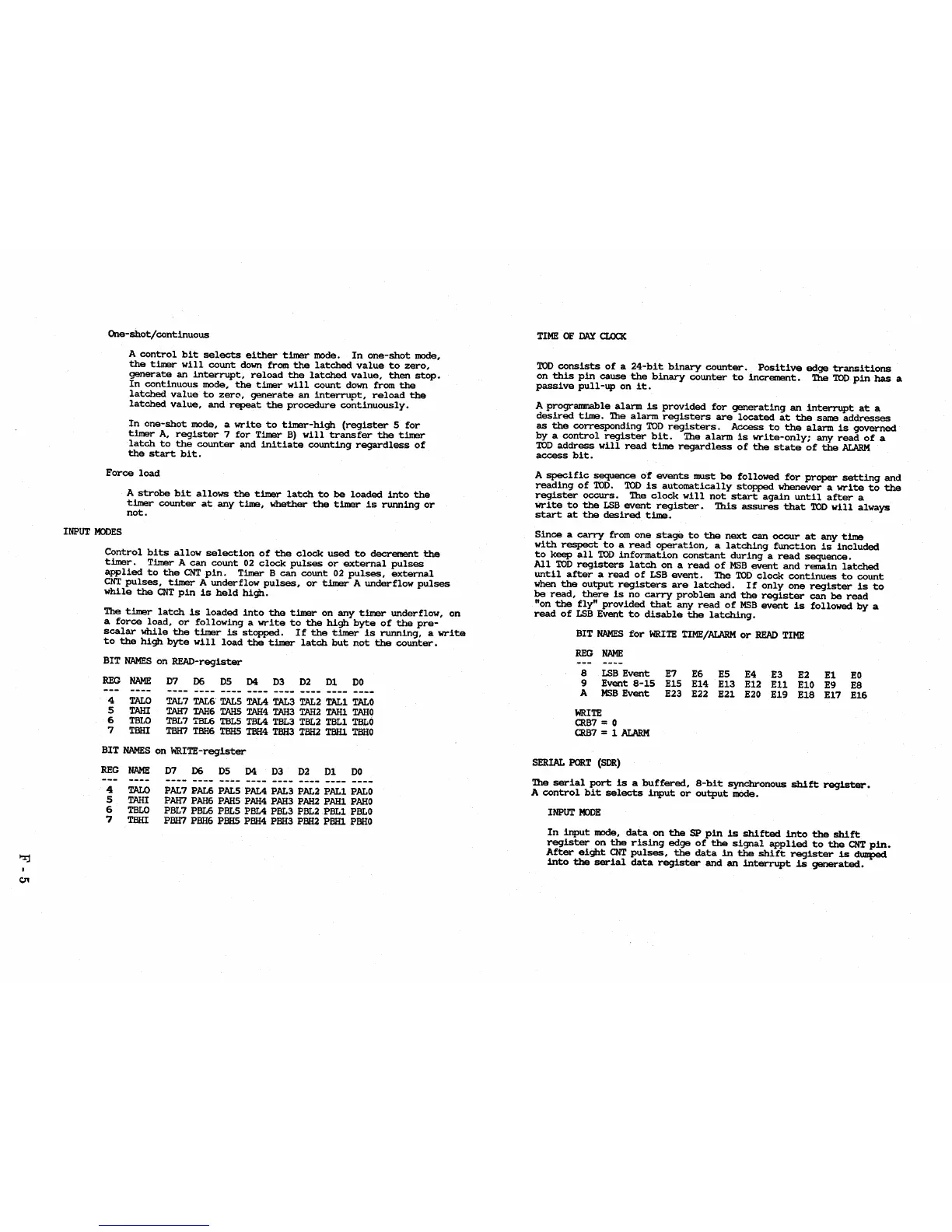
BIT
NAMES
on
READ-register
REG
NAME
07
D6
05
D4
03
02
01
DO
4
5
6
7
TALO
TAHI
TBLO
TBHI
TAL 7 TAL6 TALS TAL4 TAL3 TAL2
TALI
TALO
TAH7 TAR6 TAH5 TAR4 TAR3
TAR2
TAHl
TARO
TBL
7
TBL6
TBLS
TBL4
TBL3
TBL2
TBLI
TBLO
TBH7
TBH6
TBH5
TBH4 TBH3
TBH2
TBHl
TBHO
BIT
NAMES
on
WRITE-register
REG
NAME
07
D6
05
D4
03
02
01
DO
4
5
6
7
TALC
TAHI
TBLO
TBHI
PAL
7
PAL6
PALS
PAL4 PAL3
PAL2
PALl
PALO
PAIr7
PAR6
PARS
PAR4
PAR3
PAH2
PAR1
PARO
PBL
7
PBL6
PBLS
PBL4 PBL3
PBL2
PBL1
PBLO
PBH7
PBH6
PBHS
PBH4
PBH3
PBH2
PBHl
PBHO
TIME
OF
DAY
CLOCK
TOO
consists
of
a
24-bit
binary
counter.
Positive
edge
transitions
on
this
pin
cause
the
binary
counter
to
increment.
The
TOO
pin
has
a
passive
pull-up
on
it.
A programmable
alarm
is
provided
for
generating
an
interrupt
at
a
desired
time.
The
alarm
registers
are
located
at
the
same
addresses
as
the
corresponding
TOO
registers.
Access
to
the
alarm
is
governed
by
a
control
register
bit.
The
alarm
is
write-only;
any
read
of
a
TOO
address
will
read
time
regardless
of
the
state
of
the
ALARM
access
bit.
A
specific
sequence
of
events
nrust
be
followed
for
proper
setting
and
reading
of
TOO.
TOO
is
automatically
stopped
whenever
a
write
to
the
register
occurs.
The
clock
will
not
start
again
until
after
a
write
to
the
LSB
event
register.
This
assures
that
TOO
will
always
start
at
the
desired
time.
Since
a
carry
from
one
stage
to
the
next
can
occur
at
any
time
with
respect
to
a
read
operation,
a
latching
function
is
included
to
keep
all
TOO
information
constant
during
a
read
sequence.
All
TOO
registers
latch
on
a
read
of
MEB
event
and
remain
latched
until
after
a
read
of
LSB
event.
The
TOO
clock
continues
to
count
when
the
output
registers
are
latched.
If
only
one
register
is
to
be
read,
there
is
no
carry
problem
and
the
register
can
be
read
"on
the
fly"
provided
that
any
read
of
MEB
event
is
followed
by
a
read
of
LSB
Event
to
disable
the
latching.
BIT
NAMES
for
WRITE
TIME/ALARM
or
READ
TIME
REG
NAME
8
LSB
Event
E7
E6
ES
E4
E3
E2
9
Event
8-15
E1S
E14
El3
E12
Ell
E10
A
MEB
Event
E23
E22 E21 E20
E19 E18
WRITE
CRB7
= 0
CRB7
= 1
ALARM
SERIAL
PORT
(SDR)
E1
EO
E9 E8
E17
E1G
The
serial
port
is
a
buffered,
8-bit
synchronous
shift
register.
A
control
bit
selects
input
or
output
mode.
INPUT
K>OE
In
input
mode,
data
on
the
SP
pin
is
shifted
into
the
shift
register
on
the
rising
edge
of
the
signal
applied
to
the
CNT
pin.
After
eight
CNT
pulses,
the
data
in
the
shift
register
is
dUllped
into
the
serial
data
register
and
an
interrupt
is
generated.

Table of Contents

Other manuals for Commodore Amiga

Related product manuals