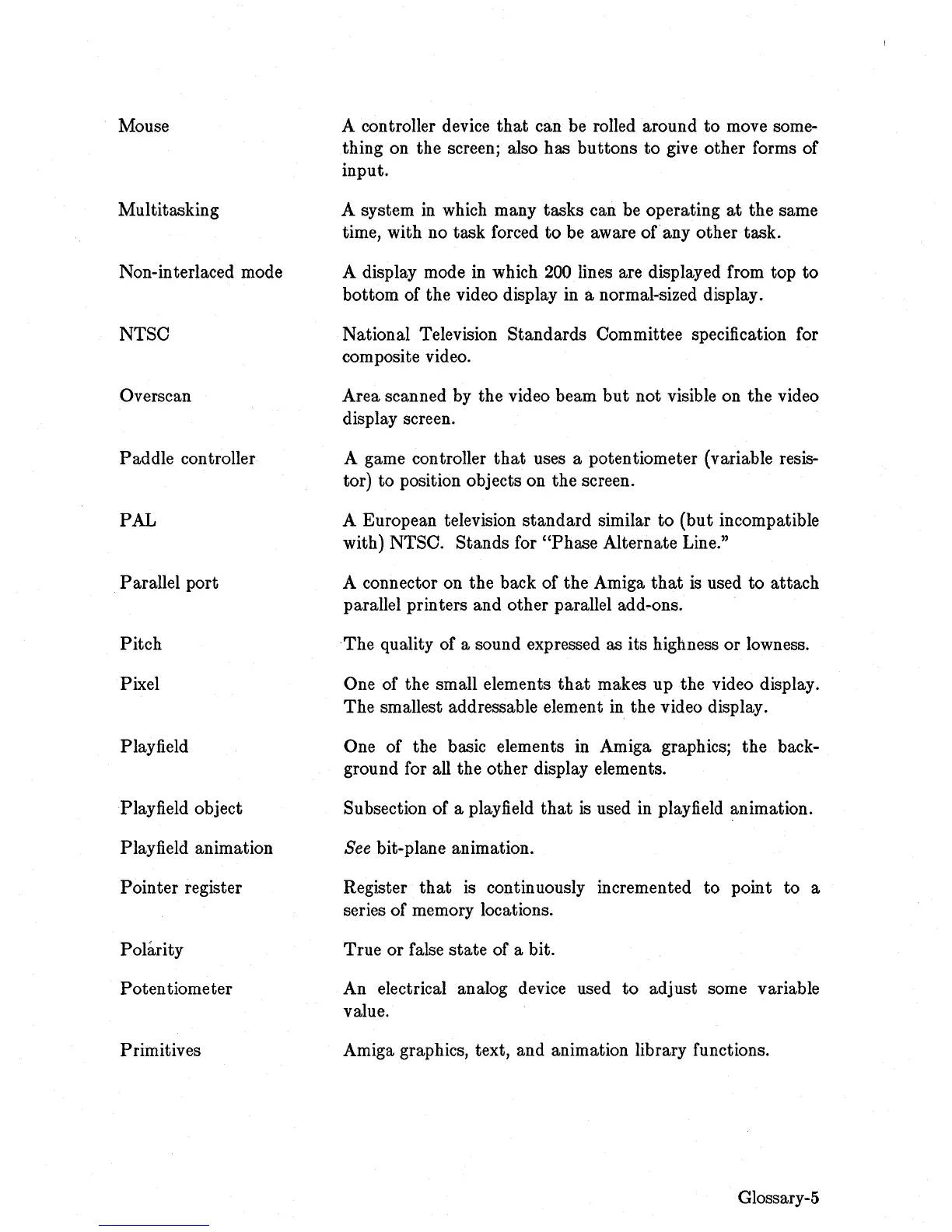
Mouse
Multitasking
Non-interlaced mode
NTSC
Overscan
Paddle controller
PAL
Parallel port
Pitch
Pixel
Play
field
Play
field
object
Play
field
animation
Pointer register
Polarity
Poten tiometer
Primitives
A controller device
that
can be rolled around
to
move some-
thing on the screen; also has buttons
to
give other forms of
input.
A system
in
which many tasks can be operating
at
the same
time, with no task forced to be aware
of
any other task.
A display mode
in
which
200
lines are displayed from top
to
bottom of the video display
in
a normal-sized display.
National Television Standards Committee specification for
composite video.
Area scanned by the video beam
but
not visible on the video
display screen.
A game controller
that
uses a potentiometer (variable resis-
tor)
to
position objects on the screen.
A European television standard similar to (but incompatible
with) NTSC. Stands for "Phase Alternate Line."
A connector on the back of the Amiga
that
is used to attach
parallel printers and other parallel add-ons.
The
quality of a sound expressed as its highness or lowness.
One of the small elements
that
makes up the video display.
The smallest addressable element in the video display.
One of the basic elements in Amiga graphics; the back-
ground for all the other display elements.
Subsection of a playfield
that
is used in playfield animation.
See bit-plane animation.
Register
that
is continuously incremented
to
point to a
series of memory locations.
True or false
state
of a bit.
An electrical analog device used
to
adjust some variable
value.
Amiga graphics, text, and animation library functions.
Glossary-5





 To Next Page