95-8533
2-1
18.2
Section 2
Introduction
SYSTEM DESCRIPTION
The EQP system is a combined fire and gas
safety system that is globally approved for
hazardous locations. It is a distributed releasing
system and is certified for annunciation and
releasing.
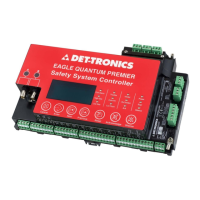
The system consists of a Controller and a
number of addressable microprocessor based
field devices. The Controller coordinates
system device configuration, monitoring,
annunciation, and control, while the field
devices communicate their status and alarm
conditions to the Controller.
The EQP controller can be arranged in a
redundant configuration, thereby increasing
the availability of the system. The controllers
work in “Master” and “Hot Standby” mode.
Various combinations of field devices can be
configured as part of the system. The actual
selection depends on the requirements of the
application and the regulations that cover the
type of protection required. See Figure 2-1 for
a block diagram of the Eagle Quantum Premier
system.
All field devices are tied into a communication
loop that starts and ends at the Controller.
Each device connected to the communication
loop is assigned a unique identity by setting
its address switches. All other device operation
parameters are configured through Det-Tronics
“Safety System Software.” These selections
define the type of device and how it is to
operate. This system configuration data is then
downloaded into the Controller.
A programmed Controller is configured to
automatically download the configuration
data into the individual devices when they first
communicate with the Controller.
In addition to Det-Tronics advanced flame
and gas detectors, Eagle Quantum Premier
offers the capability of incorporating third party
fire and gas protection equipment into the
system. These can be either input or output
devices. Typical input devices include manual
fire alarm "call boxes," heat detectors, and
analog combustible or toxic gas measurement
instruments. Typical output equipment includes
solenoids, strobes, and horns. All equipment is
monitored for wiring fault conditions.
For complete system integration, the Controller
has the capability to communicate with other
systems such as PLCs and DCSs. Different
communication protocols are supported,
allowing the Controller to communicate with
other systems either directly or through
communication gateways.
NOTE
For specific information relating to the
SIL 2 rated EQP system, refer to manual
number 95-8599.
COMMUNICATIONS LOOP
Eagle Quantum Premier utilizes a Det-Tronics
Signaling Line Circuit (SLC), a version of
Echelon’s Local Operation Network (LON)
customized specifically for Eagle Quantum
Premier. This network provides several key
advantages:
• ANSI/NFPA Class X performance of SLC
• Peer-to-peer communications
• Short message formats
• Expandability
The Controller utilizes several mechanisms
to continuously check the LON loop for fault
conditions, thereby providing the highest level
of reliable communication.
Every device on the LON loop has the ability
to communicate with the Controller at any
time. This design allows immediate alarm
messages to be sent from the field devices to
the Controller.
All messages are kept short in order to
maximize network performance. This minimizes
network bottlenecks.
The Eagle Quantum Premier system is easily
modified to accommodate design changes
or plant expansions. This can involve adding
LON sections, repositioning LON sections, or
removing LON sections from the loop. There
are LON communication implementation
details that affect and limit how the LON loop
is changed.


 To Next Page