95-8533
4-19
18.2
START-UP PROCEDURE FOR
CONTROLLER
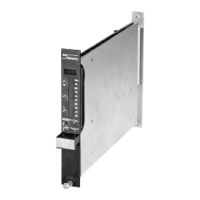
The Controller is powered-up when the Power
Supply is turned on. When the Power Supply has
been powered-up, verify power at the Controller by
verifying that the Green LED indicator is on. This
indicator is located on the front of the Controller.
To verify that the Controller is powered-up and
operating properly, ensure that:
1. When power is first applied, all LEDs are on.
The ACK LED flashes while the memory test
is running. When initialization is complete, only
the green power LED remains lit.
2. The Ethernet/Serial communication indicators
continuously flash (if active).
NOTE
For the Ethernet Interface Board, the blue
LEDs associated with ports 3 and 4 will
remain on when the ports are ready for
communication. Flashing green and amber
LEDs indicate active transmit and receive.
The amber indicator on the front of the
RJ45 connector indicates a 10 Mb/s link
is established. The green indicator on the
front of the RJ45 connector indicates a 100
Mb/s link is established.
3. The Text display runs an initialization routine.
When initialization is complete and if all alarms
and trouble conditions are cleared, the text
display shows the current time and date. If
the controller has been unpowered for more
than 12 hours, the time and date may have
to be set. If an alarm or trouble condition
exists, it will be displayed until the condition
is corrected and the Reset button is pressed.
If the controller has not been software
configured, unconfigured devices will be
displayed. Configuration must be done using S³
Safety System Software before proceeding.
4. The LEDs on the front panel provide an
indication of the system status.
5. Ensure configuration was performed
properly.
6. After any modifications have been made either
to the installation or to configuration software,
always check the entire system for proper
operation in order to ensure that the changes
were performed properly.
STARTUP PROCEDURE FOR EDIO
MODULE
Conguration
The EDIO Module is an eight-channel device.
Each channel is capable of being configured
as an input or output, independent of any other
channel.
NOTE
The module is congured using Det-Tronics
Safety System Software.
Activation Time
Timers are made available for output circuits
only. Timers are used primarily to set the timing
of output release in a suppression system. Timers
provide a pulse timed output for the time period
specified in the configuration of the channel. The
channel output goes active when commanded by
the system logic and remains on until the timer
expires.
Static Logic Mode
Each input channel can be configured as a
Fire Alarm, Trouble, Low Gas Alarm, High Gas
Alarm, Supervisory, or Other type of channel,
independent of any other channel configuration.
The type selected determines the logic the
system uses to configure Indicators, Alarms and
Messages.
For example: When an input is selected as Fire
type, the Fire LED on the Controller and Audible
alarm will automatically actuate when that input
channel is active.


 To Next Page