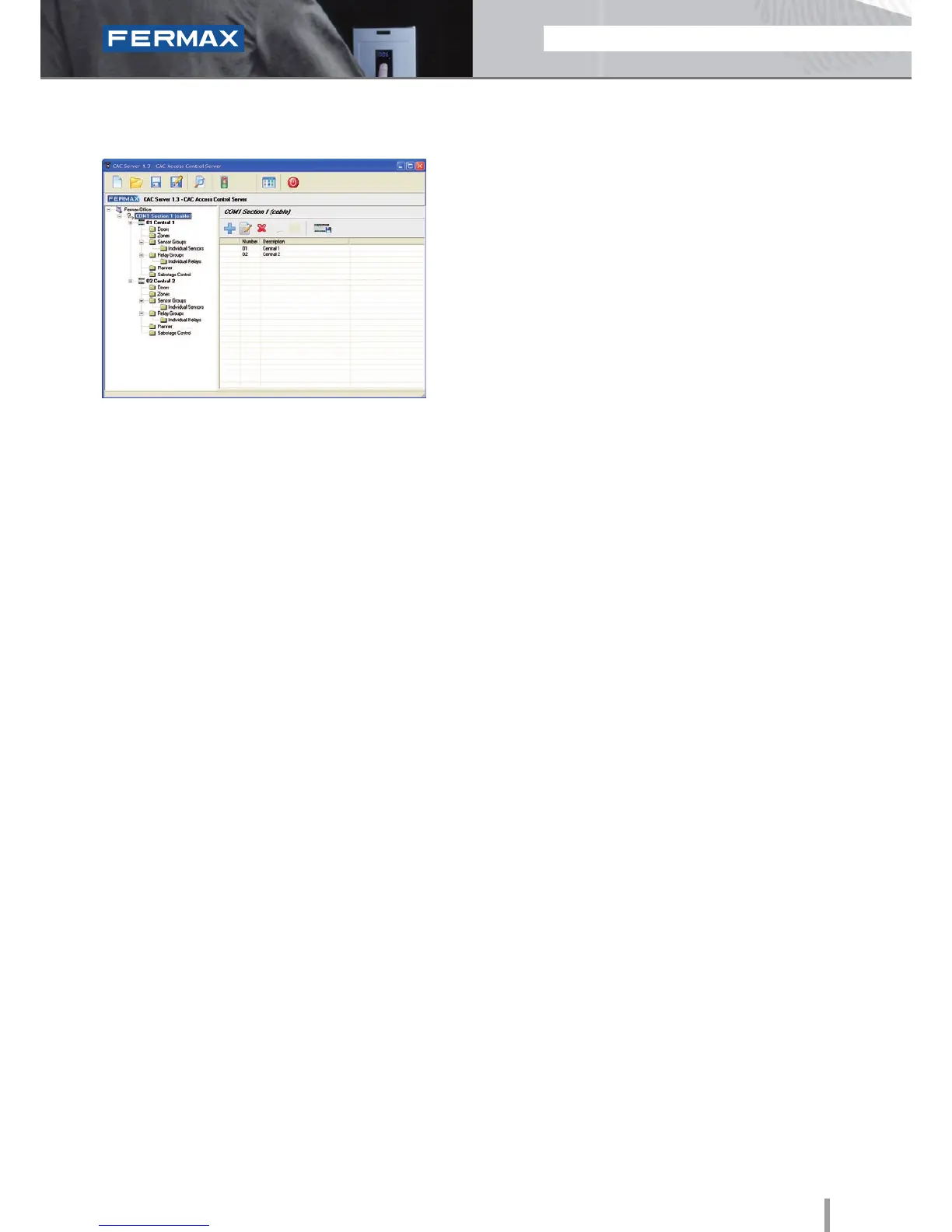
CAC Central Unit CAC Server Software
and Database Server
Server Applications
Server Applications: these are applications developed for the
installer.
· CAC Database Server: this is the application that manages the
database where all information pertaining to the systems (users,
incidents, etc..) is stored, and which manages the rest of the user
applications and the CAC Server itself.
· CAC Server: this is the application where the installer defines
the system's hardware elements which, in turn, act as the server
for the remaining CAC architecture client applications and as a
communication server with the CAC system.
The PC where the CAC Server is installed should be connected
directly to the system through an appropriate interface.
The whole CAC system must have a single CAC Server
application and CAC Database.
• Sections: The CAC Control Server application, allows the system to be organised into sections (up to 4 different sections).
In systems with a high number of central units or central units which are very far from others, the creation of sections allows to
manage all the central units from the same PC without needing to connect all the central units by way of a FXL network, creating
one single system.
• CAC Central Unit: A CAC access control system will use between 1 and 64 CAC central units. Each central unit is inserted into
the CAC Control Server application, in its corresponding section. It is also assigned a description and central unit number.
• Doors: A door corresponds to each one of the readers or door controllers (DC) of the installation. Each DC may manage up to 2
readers (Entrance/Exit) from the same door.
In the CAC Server application, for each central unit, the same number of doors and readers or DCs are added, and these can be
connected to the the central units in the system (from 1 to 32 readers or door controllers per central unit).
• Areas: Areas only need to be defined where limits on capacity are required (capacity control).
• Antipassback: The anti-passpack function prevents a user who has accessed the building by means of an entrance door to
re-enter the building (via any entrance door) without having previously exited the building. Two levels of antipassback: pedestrian
and vehicular.
• Sensor Groups - Individual Sensors (Capacity to manage 1.000 sensors): You only need to dene groups of sensors or
individual sensors where there are sensor decoders in the building.
• Relay Groups - Individual Relays (Capacity to manage 1.000 relays): You only need to dene groups of relays or individual
relays where there are relay decoders in the building.
• Planner: Allows the user to dene up to 32 automation plans to control various devices.
• Sabotage Control: Allows you to activate the sabotage detection function on the decoder bus (where relay decoders, sensor
decoders or panel decoders are set up for intercommunication).
• Automatic switch to winter/summer daylight saving time.
TECHNICAL FEATURES
CENTRALISED



 To Next Page