Coordinated Motion - Mathematical Analysis
The terms of coordinated motion are best explained in terms of the vector motion. The vector velocity, Vs, which is
also known as the feed rate, is the vector sum of the velocities along the X and Y axes, Vx and Vy.
The vector distance is the integral of Vs, or the total distance traveled along the path. To illustrate this further,
suppose that a string was placed along the path in the X-Y plane. The length of that string represents the distance
traveled by the vector motion.
The vector velocity is specified independently of the path to allow continuous motion. The path is specified as a
collection of segments. For the purpose of specifying the path, define a special X-Y coordinate system whose origin
is the starting point of the sequence. Each linear segment is specified by the X-Y coordinate of the final point
expressed in units of resolution, and each circular arc is defined by the arc radius, the starting angle, and the angular
width of the arc. The zero angle corresponds to the positive direction of the X-axis and the CCW direction of
rotation is positive. Angles are expressed in degrees, and the resolution is 1/256th of a degree. For example, the
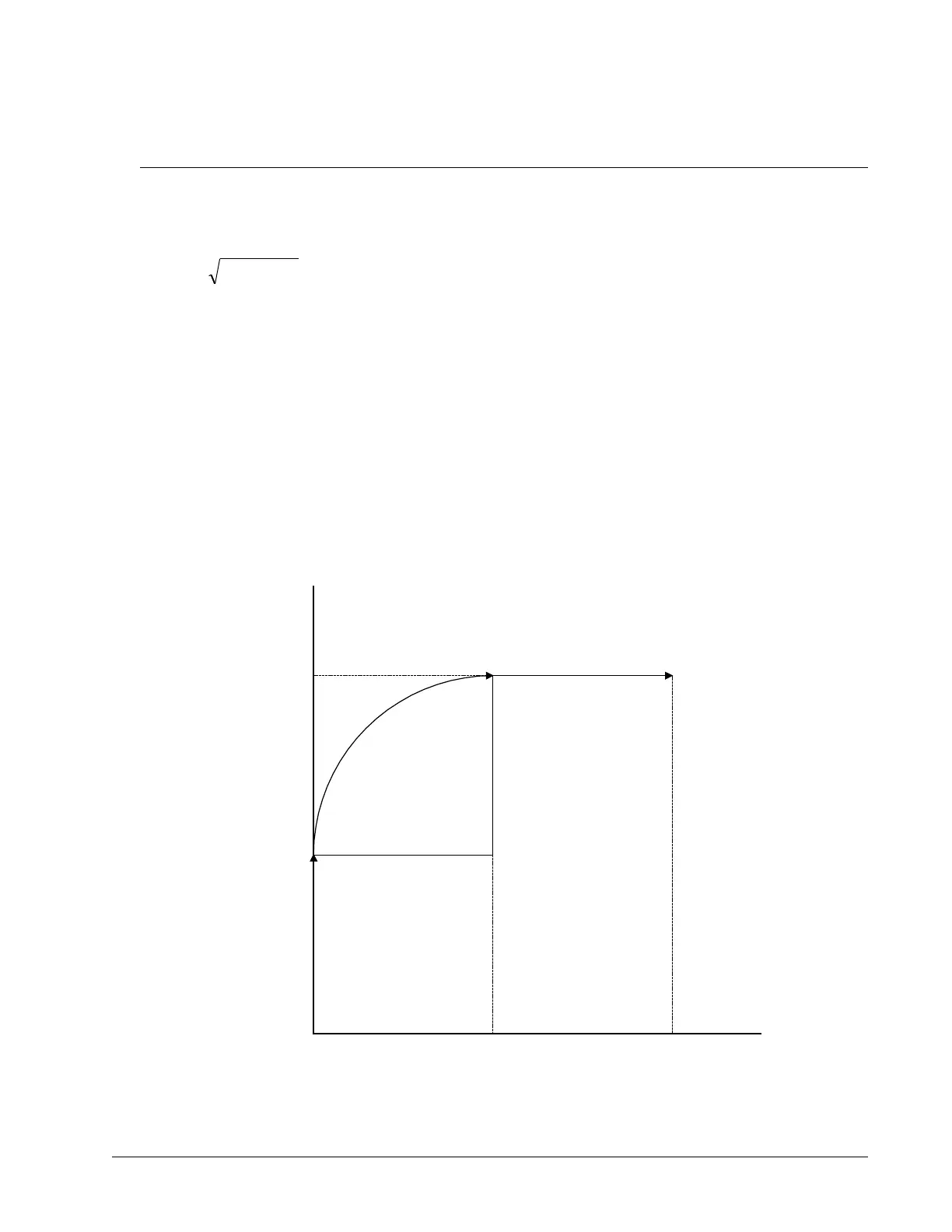
path shown in Fig. A.1 is specified by the instructions:
VP 0,10000
CR 10000, 180, -90
VP 20000, 20000
10000 20000
20000
10000
Y
C D
B
A
X
Figure A..1 - X-Y Motion Path
Appendices • 225 DMC-40x0 User Manual


 To Next Page