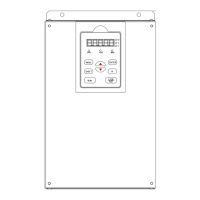
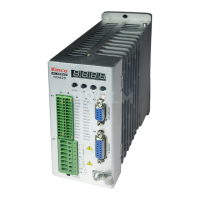
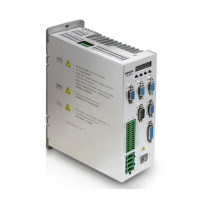
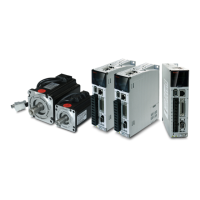
Kinco FD5 AC series servo driver user manual
Chatper 10 Communication
04——Data length is 4 Byte(2 WORD);
4E 82 00 1B——write data hexadecimal 001B4E82,decimal 1789570,convert to 100RPM;
ED 56——Check code;
10.2.4 Communication troubleshooting measures
When the communication connection between the driver and the Kinco Servo+ cannot be performed, please refer to Chapter 10.2
to check the communication parameters and wiring of the driver. When the communication of the drive is easy to drop, read only
but not write or only write but not read, etc., you can troubleshoot through the following aspects:
1. Terminating resistor. When the 485 communication rate is high and the communication distance is long, the signal will be
reflected at the end of the transmission line. Therefore, it is necessary to connect a 120Ω terminal resistor in parallel at the
beginning and end of the communication network. Since the FD servo drive has its own terminal resistance, it is only necessary
to dial the dial code of the first and last drives to the ON position.
2. Cable size. The recommended wire diameter of the 485 signal cable is 24AWG, and shielded twisted pair cables should be used.
The shielding layers of the cables should be grounded together and the grounding resistance should not be greater than 1
Ω
. The
use of twisted pairs can effectively eliminate antagonistic interference, and cables with good shielding can effectively reduce
the impact of external interference sources
。
3. Reasonable wiring. The communication cables should be routed in separate troughs from the power cables, and the distance
should be ≥ 20cm. If the cables can be tucked into a metal tube, the anti-interference ability will be better. During the wiring
process, the signal line and the power supply line intersect vertically, and parallel laying should be avoided as much as possible.
4. Good grounding. The motor power cable must use a cable with a shielded net, the motor PE is connected to the ground terminal
of the driver, and the driver shell must be well grounded. For the grounding diagram, please refer to Figure 3.6 in Chapter 3.
5. Power disturbance. The unstable power supply of the grid will also directly affect the normal use of the servo. For the external
circuit of the driver, please refer to Chapter 3.2 for connection.
10.3 CANopen Bus communication
CANopen is the most famous and successful of the open fieldbus standards, which has been widely recognized and widely used in
Europe and the United States. In 1992, the Association of Automation CAN Users and Manufacturers (CiA) was established in
Germany and began to develop CANopen, an application layer protocol for automation CAN. Since then, the members of the
Association have developed a series of CANopen products, which are widely used in machinery manufacturing, pharmaceuticals,
food processing and other fields.
The FD5 series servo is A standard CAN slave device, which strictly follows the CANOpen 2.0A/B protocol, and any host
computer that supports the protocol can communicate with it. The servo uses a strictly defined list of objects, we call it the object
dictionary, this object dictionary is designed based on the CANopen international standard, all objects have a clear function
definition. The Objects mentioned here are similar to the memory address we often say, some objects such as speed and position
can be modified by the external controller, and some objects can only be modified by the drive itself, such as status and error
messages. Table 10-5 lists these objects.
Table 10-5 Object dictionary example list
Device status control word
The properties of an object are as follows:
1. RW(Read and write) : Objects can be read or written;
2. RO(read-only) : The object can only be read;
3. WO(Write only) : Write only;
4. M(Mappable) : Objects can be mapped, similar to indirect addressing;
5. S(Storable) : Objects can be stored in the Flash-ROM area and are not lost when powered off.

 To Next Page
 Loading...