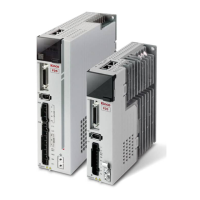
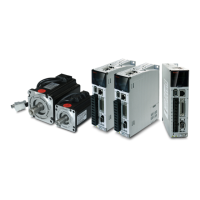
Kinco FD5 AC series servo driver user manual
Chatper 10 Communication
10.3.1 CANopen bus communication hardware description
Table 10-6 Pin name and function
CAN_H bus(high dominant )
CAN_L bus cable(low dominant )
The CAN communication protocol mainly describes the information transfer method between devices. The definition of the CAN
layer is consistent with the open system interconnection model (OSI). Each layer communicates with the same layer on another
device, the actual communication takes place on two adjacent layers on each device and the devices are interconnected only
through the physical medium of the model physical layer, The specification of CAN defines the bottom two layers of the model,
the data link layer and the physical layer. The physical layer of the CAN bus is not strictly regulated, and can use a variety of
physical media such as twisted pair optical fibers, etc. The most commonly used is twisted pair signals, using differential voltage
transmission (commonly used bus transceivers). The two signal lines are called CAN_H and CAN_L, and they are both about
2.5V in static state. At this time, the state is expressed as logic 1, which can also be called recessive bit. CAN_H is higher than
CAN_L to represent logic 0, which is called display bit. At this time, the usual voltage value is CAN_H=3.5V and
CAN_L=1.5V,Epiphany first in conflict. The names and functions of the CAN communication interface pins are shown in Table
10-6.
Figure 10-3 CAN Signal Identification
Note:
1
、
All CAN_L and CAN_H pins of the slave station can be directly connected and connected in series.
2、The master station and the last slave station need to be connected to 120 ohms of terminal resistance, FD5 drive with
terminal resistance dip SW1, set to ON to turn on terminal resistance. Restart the drive after changing the terminal resistance dip
status.
3
、
Use shielded twisted pair cables for communication, and ground them properly. (The 3-pin ground cable can be
disconnected for short-distance communication, but it is recommended to ground the 3-pin for long-distance, high-baud
communication.)
4、Table 10-7 lists the theoretical maximum communication distances of various baud rates.
5、The FD5 series servo drive does not require an external 24V power supply to power the CAN.
Table10-7 The longest distance table that can theoretically communicate with each baud rate
Communication speed
(
bit/s
)
Communication distance (M)


 To Next Page
 Loading...