Stratos Multi E401N
100
6.2.1 Calibration Methods
One-Point Calibration
The sensor is calibrated with just one buffer solution. A one-point calibration is useful and permissible
if the measured values are close to the sensor zero point, such that the change in sensor slope is of
negligible significance. The sensor’s zero point is subsequently adjusted, while the slope remains
unchanged.
Two-Point Calibration
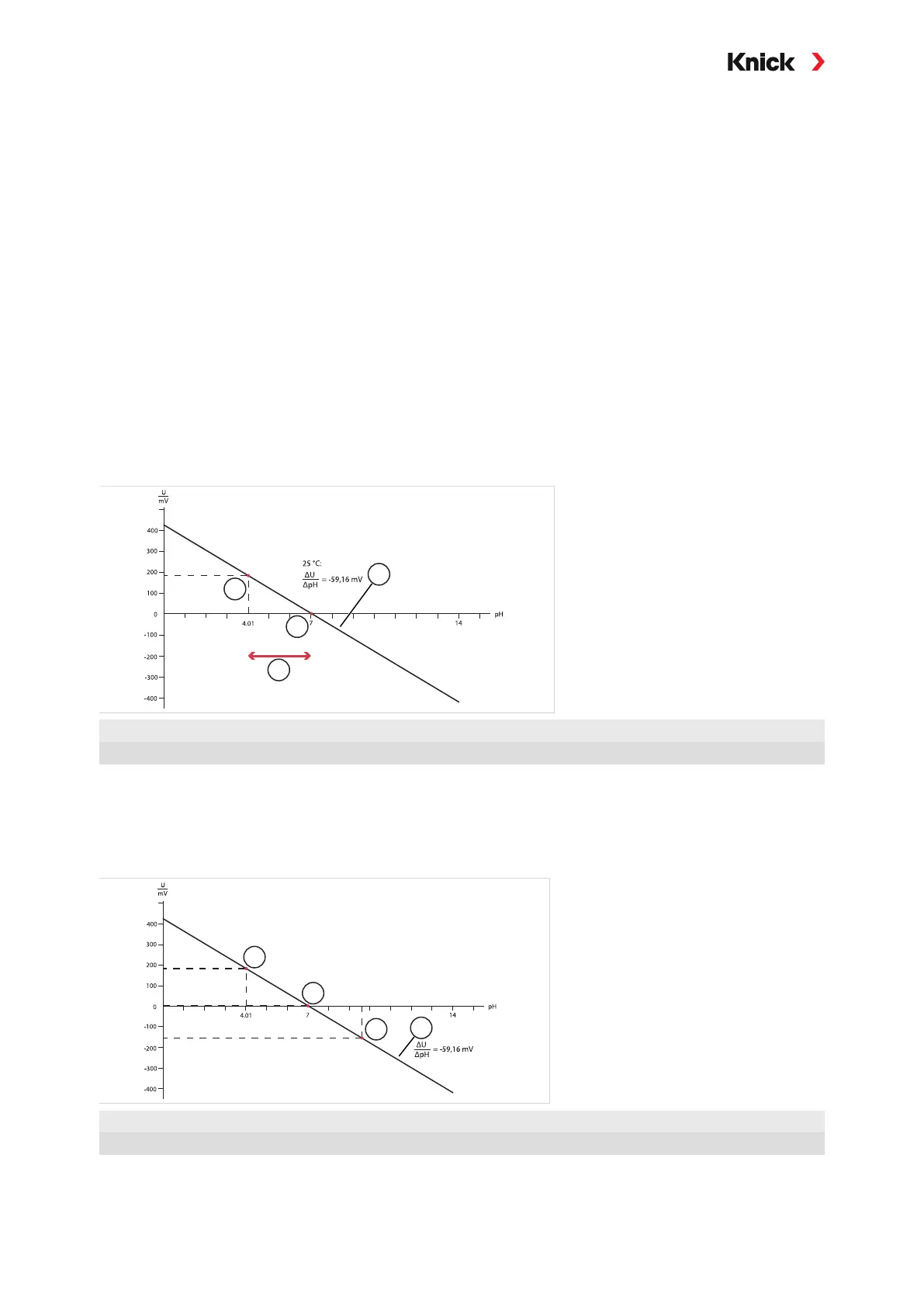
The sensor is calibrated with two buffer solutions. This makes it possible to calculate the sensor’s zero
point and slope. The sensor’s zero point and slope are subsequently adjusted. A two-point calibration
is required in the following cases, for example:
• The sensor has been replaced
• The pH measured value covers a large range
• The pH measured value is far from the sensor zero point
• The pH value needs to be determined with high precision
• The sensor is subject to heavy wear
1
First point of first buffer solution
3
Recommended measuring range
2
Second point of second buffer solution
4
Result of ideal calibration at 25°C/77°F
Three-Point Calibration
The sensor is calibrated with three buffer solutions.
The zero point and slope are calculated using a line of best fit in accordance with DIN 19268. The sen-
sor’s zero point and slope are subsequently adjusted.
1
First point of first buffer solution
3
Third point of third buffer solution
2
Second point of second buffer solution
4
Rise


 To Next Page