Stratos Multi E401N
208
When calculating Cond/Cond, it is possible to determine a pH value from the measured conductivity
values. Settings can be changed in the
pH Value submenu:
Adjustable parameters for pH value calculation
Parameter Setting
[CI/II] Cond/Cond Calculation
pH Value
Usage Off, pH-VGB-S-006, pH variable
If you select pH-VGB-S-006:
Alkalizing Agent NaOH: 11 + log((COND A – COND B / 3) / 243)
NH
3
: 11 + log((COND A – COND B / 3) / 273)
LiOH: 11 + log((COND A – COND B / 3) / 228)
Alkalizing Off, on
Ion Exchanger Off, on
Filter Volume Enter filter volume in l
Resin Capacity Enter resin capacity
Capacity Factor Enter capacity factor in %
If you select pH variable:
Enter coefficient C, factor 1 … 3
Typical Application
Calculating the pH Value from Dual Conductivity Measurement
When monitoring boiler feedwater in power plants, dual conductivity measurement can be used to
calculate the pH value. For that purpose, the boiler feedwater conductance is measured before and
after the cation exchanger. This commonly used method of indirect pH value measurement does not
require much maintenance and has the following advantage:
Normal pH measurement in ultrapure water is very critical. Boiler feedwater does not contain many
ions. This requires the use of a special electrode, which must be calibrated constantly and the service
life of which is generally rather short.
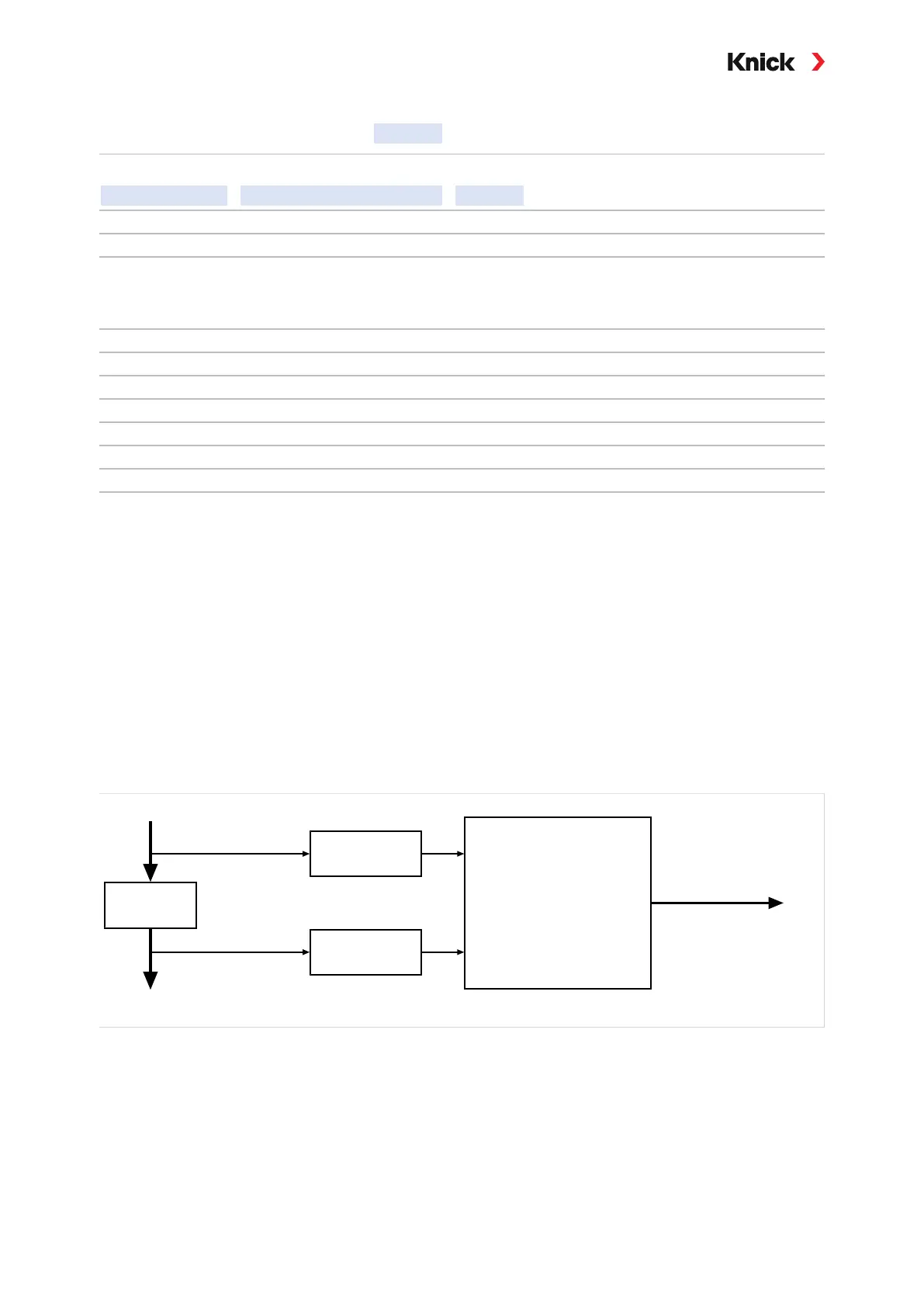
Two sensors are used to measure the conductivity before and after the cation exchanger. The pH value
is inferred from these two conductivity values.
pH Value Measurement of Boiler Feedwater in Power Plant Technology
Cation
exchanger
Sensor A
Sensor B
pH
Cond meas. point
1
Cond meas. point
2
Calculation block


 To Next Page