9HUVD3XOVH3RZHU6XLWH6HULHV6HUYLFH0DQXDO 7+(25<2)23(5$7,21
5(9%
powers without requiring the extreme rod cooling as would be required in a single rod system at the same
operating point.
The use of multiple heads results in a number of advantages over previous surgical solid state lasers:
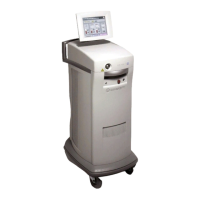
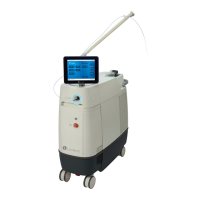
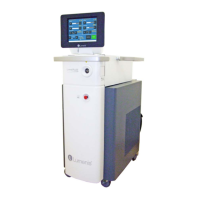
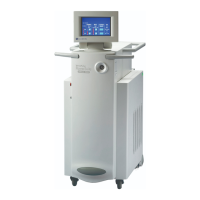
VersaPulse PowerSuite is smaller and lighter; it has a much simpler and more reliable cooling system; and it
can operate at much higher pulse rates, resulting in higher average powers. Also, different rods and optics can
be installed enabling a multiwavelength laser is one package.
While the use of multiple heads provides all the above mentioned user advantages, it also results in several
design challenges:
• Flash lamp supply switching - The VersaPulse PowerSuite uses a combination of capacitor
storage and rectified AC voltage to supply the current required to turn on the flash lamps.
The lamp current, pulse width, and voltage level of the charge on the capacitor determines
the amount of light energy out of the lamp, and therefore, the pulse energy out of the rod.
Using four heads requires a method of switching the reservoir capacitor bank voltage
between the four flash lamps. The VersaPulse PowerSuite uses Insulated Gated Bipolar
Transistors (IGBT) to switch the reservoir capacitor bank voltage between the four heads.
• Multiplexing the beams - Merging the four YAG beam paths requires a more complicated
optical scheme. The VersaPulse PowerSuite Holmium and the VersaPulse PowerSuite Ho/
Nd:YAG use a servo positioned rotating mirror to assemble the four YAG beams into a sin-
gle beam. The servo system must reposition the mirror between pulses, pointing the mirror
towards the head that will be flashed.
• Control - In general, the microprocessing demands of the VersaPulse PowerSuite are greater
than that of a single head system. The VersaPulse PowerSuite uses a Motorola 68000 micro-
processor.
For the purposes of this discussion, the VersaPulse PowerSuite laser is divided into the following functional
subsystems. The remaining topics in this section provide a detailed description of each subsystem.
Power Switching, Conditioning, Distribution (4.2) - Provides switching and conditioning of the pri-
mary power input, converts the AC line voltage to DC voltages used within the system and distributes
the various voltages throughout. It includes the turn-on and turn-off circuitry. It does not include the
high voltage power supply.
Cooling (4.3) - The cooling system removes heat from the YAG cavities and two beam dumps. It is a
closed loop distilled water system including a pump, reservoir tank, fill tank, heat exchanger, variable
speed fan, D/I filter, particle filter, flow switch, temperature sensor and resistivity sensor.
Control Electronics (4.4) - The control electronics executes the software instructions to provide overall
control to the VersaPulse PowerSuite laser. It includes a microprocessor, Eraseable Programmable
Logic and its associated circuits (DIO, ADC, DAC), LCD color display, and a number of electronic and
electro-mechanical devices.


 To Next Page