9HUVD3XOVH3RZHU6XLWH6HULHV6HUYLFH0DQXDO 7+(25<2)23(5$7,21
5(9%
The HVPS provides a V-FFEEDBACK signal to the Controller through RECV9, and U23. The signal is 4 to 8
VDC for a capacitor charge level of 400 to 800 Volts. The microprocessor ADC circuits read this voltage.
TURNING ON A LAMP - Turning on a lamp consists of selecting the appropriate lamp for discharge, then
providing a trigger to cause the discharge at the appropriate time to provide the selected pulse interval.
Each flash lamp has an IGBT in series with it. The four sets of flash lamps and IGBT’s are connected in parallel
(as shown in the block diagram). Each IGBT gate is connected to a IGBT driver circuit (located on the IGBT
Driver PCB). When triggered, the IGBT driver circuit gates its associated IGBT on, establishing a current path
for discharge of the capacitor bank through the associated lamp. The lamp current or lamp energy is
controlled via the LAMPMODULATE signal, which establishes the "on" time of the IGBT.
Prior to firing, the following series of steps occur:
• The microprocessor, by way of U40, determines which head is to be fired and asserts the
appropriate digital output signal (L1_LAMP_DRIVE, L2_LAMP_DRIVE, L3_LAMP_DRIVE
and L4_LAMP_DRIVE). These four lines are asserted into the inputs of the Fiber Optic
Driver U19. The U19 outputs are attached to a red transmitter (XMIT1 through 4). Optical
fibers carry the signal from the XMIT's to receivers (RECV 1 through 4) on the Mother
Board.
• The microprocessor then by way of U40, outputs the appropriate LAMP CURRENT
SELECT signal from the analog multiplexer U2 on the Power Supply Controller PCB. The
signal is then sent to the appropriate IGBT driver circuit, resulting in the output of an IGB-
TON signal to the IGBT Driver PCB. This enables the IGBT Driver PCB turning on the base
of the IGBT.
4.4.6 Energy Monitor Circuits
Refer to the Energy Monitor Circuits Simplified Diagram (Figure 4.5) and to the associated schematics in
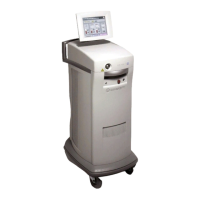
Section 8. The VersaPulse PowerSuite measures the energy of each YAG pulse. Two separate channels
measure the energy. These two channels are required to provide safety redundancy.
• MAIN_ENERGY - Laser energy feedback loop signal (light regulation).
• SAFETY_ENERGY - Provides a second laser energy feedback loop for safety (redundancy).
The measurement is accomplished by directing a percentage of the pulse to strike a pyrodetector. The detector
outputs a current, which is proportional to the energy in the pulse. The current signal is converted to a
voltage, integrated and then the result of the integration is held for reading by the microprocessor ADC
circuits (the microprocessor reads the energy monitor circuit output after each pulse). After the energy
monitor outputs are read, the circuits are reset until the next pulse. Each circuit is calibrated by adjusting a
potentiometer.


 To Next Page