TriStar II 3020 Appendix E
302-42828-01 - Dec 2012 E-1
E. FREE SPACE CORRECTION
Free space is that volume of the sample tube which is unoccupied by the sample. The quantity of gas
dosed into the sample tube is calculated from the difference in pressures in the manifold before and
after the dose is delivered. The quantity of gas adsorbed by the sample is calculated by subtracting the
quantity of gas remaining in the free space of the sample tube after equilibrium is established from the
quantity of gas originally dosed into the sample tube. Free space must be determined accurately to
obtain a precise value for quantity adsorbed.
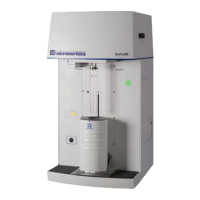
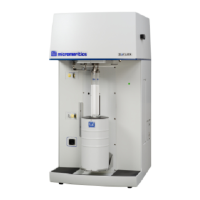
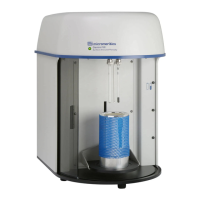
Static-volumetric systems such as the TriStar consist basically of a gas manifold joined to a sample
tube by an isolation valve. The manifold section has connections for an absolute pressure transducer, a
temperature gauge, and a vacuum system. It also has inlets for the adsorptive gas and helium. A Dewar
flask containing a cryogenic liquid (usually LN
2
at approximately 77 K) is situated so that it can be
raised to immerse most of the sample tube. Two temperature zones exist within the sample tube when
immersed in the cryogenic bath: a warm zone (the volume above the liquid level and near ambient
temperature) and a cold zone (the volume below the liquid level at cryogenic temperature). Not only
must the total free space volume be determined, but it also is necessary to determine the quantity of gas
residing within the “cold” zone since a nonideality correction must be applied to only that quantity of
gas.
The total quantity of gas in the partly immersed sample holder cannot simply be determined using n =
PV/RT because temperature is not constant over the total volume, but instead is distributed as two tem-
perature zones with a steep temperature gradient between them. A convenient method for resolving
this problem is to derive two factors which, for the existing temperature profile, can be multiplied by
the prevailing pressure to reveal the molar volume of gas contained in the cold zone and the total quan-
tity residing in the free volume of the immersed sample holder (the cold free space).
The TriStar system provides the following methods for free space determination:
• Measure
• Calculate
•Enter
Measure
Generally, this method, although requiring a little more time (approximately 10 minutes), is the most
preferred one for determining free space. It is simple, automatic, requires very little information, and
essentially is error-proof. With this method, the instrument first evacuates the manifold and sample
tube (containing sample), then isolates the sample tube by closing the valve. Then the manifold is
charged with helium, the pressure measured, and the valve opened allowing the helium to expand into
the sample tube at ambient temperature. Again the pressure is measured.
The Dewar is raised and the sample tube is cooled to cryogenic temperature. Again pressure drops;
when pressure has equilibrated, the value is recorded. Warm and cold free spaces are calculated from
(1) system volume, (2) system, ambient, and bath temperatures, and (3) measured pressures. From
these, the value of the portion of cold free space at cryogenic temperature which requires correction for
nonideality can be determined.



 To Next Page
 Loading...