4.21 Turning the Output On or Off Rapidly
DP Series/DP Series Type R
203
3.
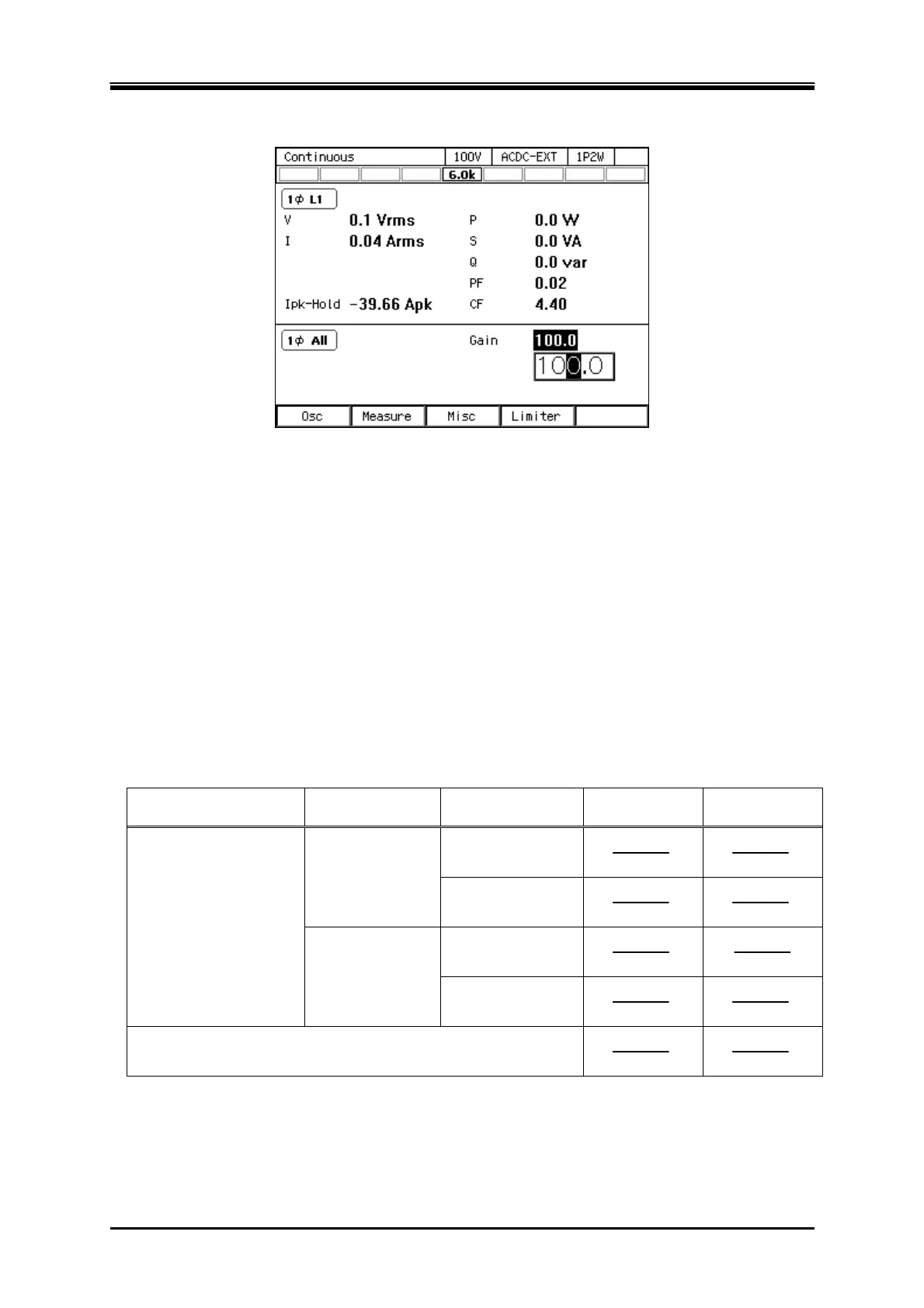
Set the gain in the [Gain] item.
4.21 Turning the Output On or Off Rapidly
In the factory default settings, the internal output relay of this product is activated linking to the
output on/off. In the output off state, the internal circuit, output terminal, and the outlet of this
product are physically separated. On the other hand, if the output relay chattering causes any
problem, or if you want to turn the output on or off rapidly, you can disable the activation of the
output relay. In that case, the output relay is fixed to the on state and the operation to turn the output
on/off is performed by the semiconductor device. The output off state means the state of high
impedance. Table 4-15 shows the list of the output terminal impedance (reference values in the rear
output terminal) in the output off state when the output relay control is disabled.
Table 4-15 The Output Terminal Impedance in the Output Off State when
the Activation of the Output Relay is Disabled
Single-phase/Polyphase
Model
Outlet
Type
AC/DC mode 100 V range 200 V range
Single-phase model
(Hi to Lo)
For Japan/North
America
NEMA 5-15
AC and ACDC
modes
200 kΩ
4N + 3
200 kΩ
4N + 3
200 kΩ
2N + 1
200 kΩ
2N + 1
DC mode
200 kΩ
4N + 1
200 kΩ
4N + 1
200 kΩ
2N + 1
200 kΩ
2N + 1
For Europe
CEE 7
AC and ACDC
modes
200 kΩ
4N + 3
200 kΩ
4N + 3
200 kΩ
2N + 3
200 kΩ
2N + 3
DC mode
200 kΩ
4N + 1
200 kΩ
4N + 1
200 kΩ
2N + 1
200 kΩ
2N + 1
Polyphase model (L1 to N, L2 to N, L3 to N)
200 kΩ
4N + 1
200 kΩ
4N + 1
200 kΩ
2N + 1
200 kΩ
2N + 1
Note 1: The reference value of output terminal at rear panel.
Note 2: N indicates the number of the power units energized.



 To Next Page