4.1 Burst oscillation
WF1946B 4-9
• To simultaneously generate a trigger signal for both channels manually or via remote control
(GPIB or USB), set Type for both channels to Trigger and set OPER-COMMON to on.
If the BOTH lamp is on, behavior is the same even though OPER-COMMON is off.
OFF
ON
TRIG:
3
STOP-LEVEL OPER-COMMON
• Burst oscillation (type: trigger) setting items (BURST menu)
TYPE: TRIG
SOURCE (trigger source) CH1: [EXT
, EXT , INT [s], INT [s]]
CH2: [EXT CH2
, EXT CH2 , EXT CH1 ,
EXT CH1
, INT [s], INT [s]]
DELAY (trigger delay) [s]
MARK (oscillation cycle) [cycle]
STOP-LEVEL [OFF, ON[%]]
OPER-COMMON (trigger in both channels) [OFF, ON]
PHASE (phase when oscillation starts) [deg] * ENTRY menu
Burst oscillation (Type: Gate) (
MODE
→
BURST
→ TYPE : GATE)
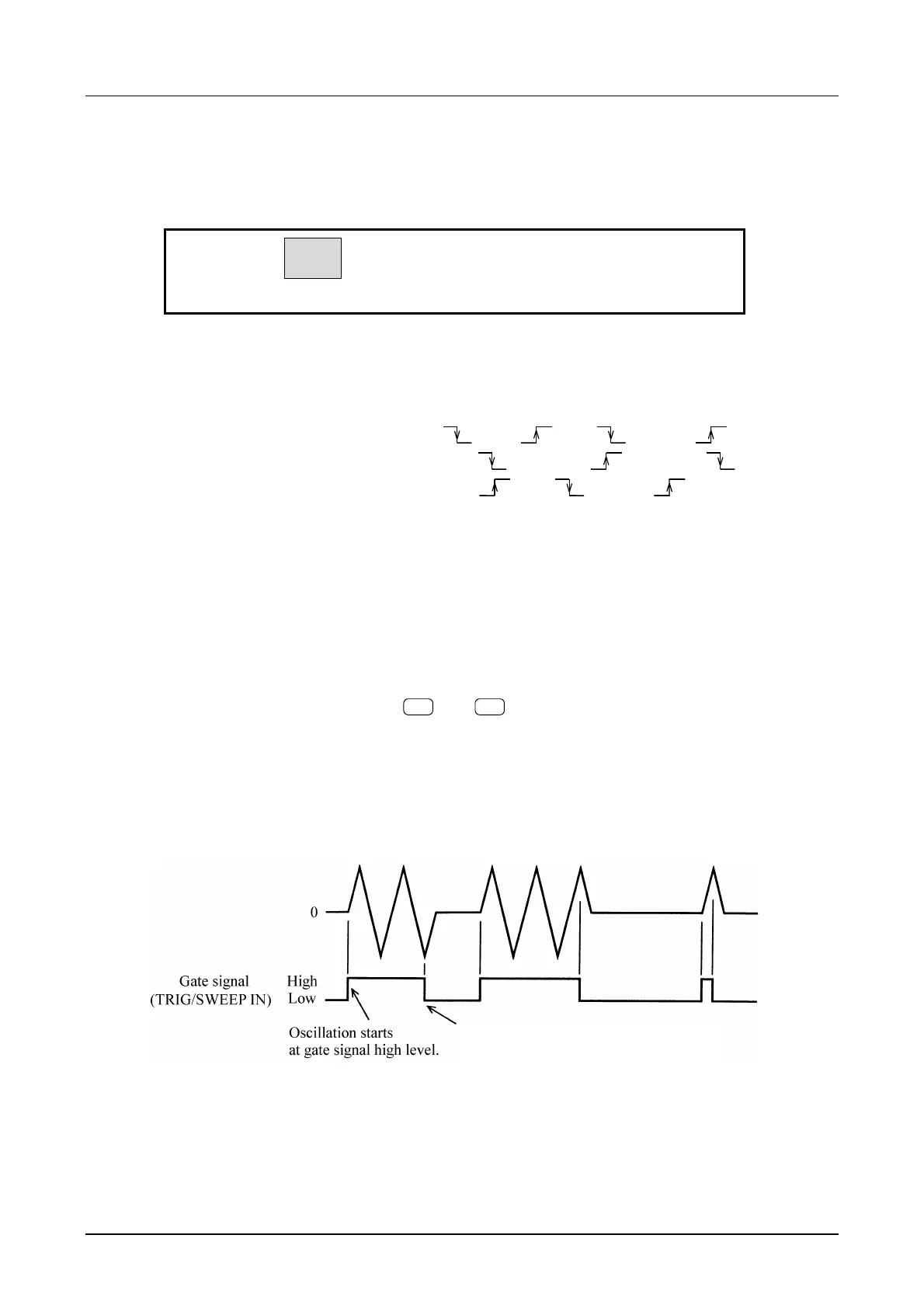
Burst oscillation (Type: Gate) is intermittent with start and stop according to the trigger signal level.
Operation is described with reference to an example of producing a waveform output such as indicated in
the figure in response to an external gate signal.
The example is a triangular waveform, DC offset 0 V, oscillation start phase 0 degrees, frequency and
amplitude arbitrary.
Oscillation stops at end of a half cycle,
when gate signals low level


 To Next Page