Itala | INSTRUCTION MANUAL
Table 16: Acquisition Control Features
6.3.1 Trigger overlap
Exposure Time and Frame Readout relationship
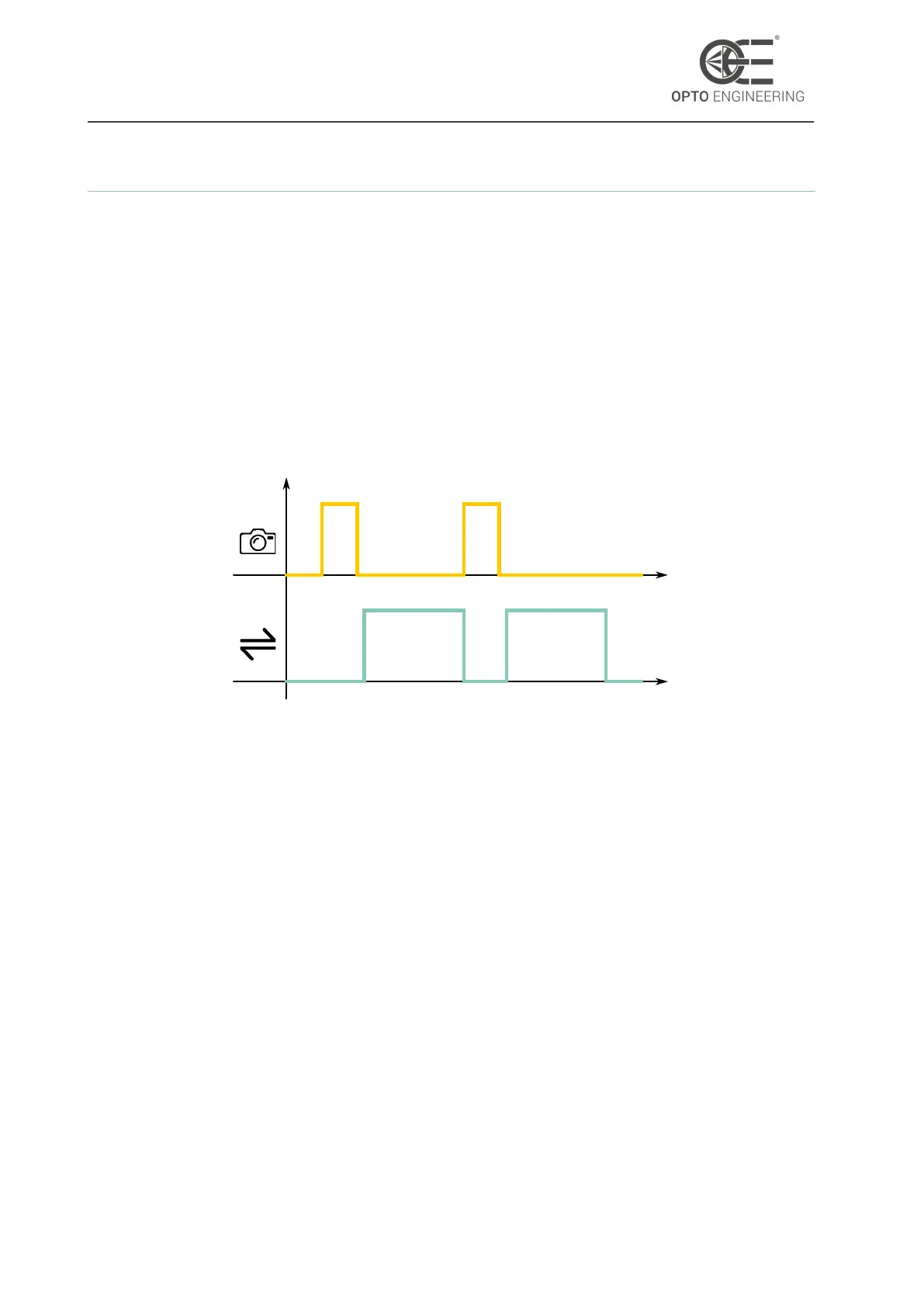
By default, the feature TriggerOverlap is set to OFF: in this case, as shown in Fig.44, the following
exposure time period is not allowed until the end of the current frame transfer, i.e. exposure time
and frame transfer cannot be overlapped. In this configuration, however, latency between expo-
sure time and frame transfer is highly repeatable.
In conclusion, a higher determinism can be achieved at the cost of a lower effective camera frame
rate.
Figure 44: When TriggerOverlap is set to OFF, the latency is
highly repeatable, but the following exposure time cannot
be accepted until the current frame has been transfered
to the internal memory. From top to bottom, the sensor
exposure and readout signals are depicted.
When TriggerOverlap is set to Readout, the latency between exposure time and frame transfer is
affected by a higher uncertainty, but the following exposure can happen during the actual transfer
between sensor and memory buffer. As shown in Fig.45, the only limitation in this mode is the
overlapping of two following transfer periods.
In conclusion, a higher camera frame rate can be achieved (in accordance with the ethernet band-
width limitation) at the cost of a lower frame transfer determinism.
How Readout mode affects Exposure Time
ExposureTime value is bounded by:
• ExposureTimeMin: minimum exposure time that can be set by the user.
• ExposureTimeMax: maximum exposure time that can be set by the user.
v1.12 - eng 65


 To Next Page