Itala | INSTRUCTION MANUAL
Table 17: Analog Control Features
6.4.1 Gain
Gain is a multiplying factor applied to pixel values in order to increase the image brightness also
in low-light conditions.
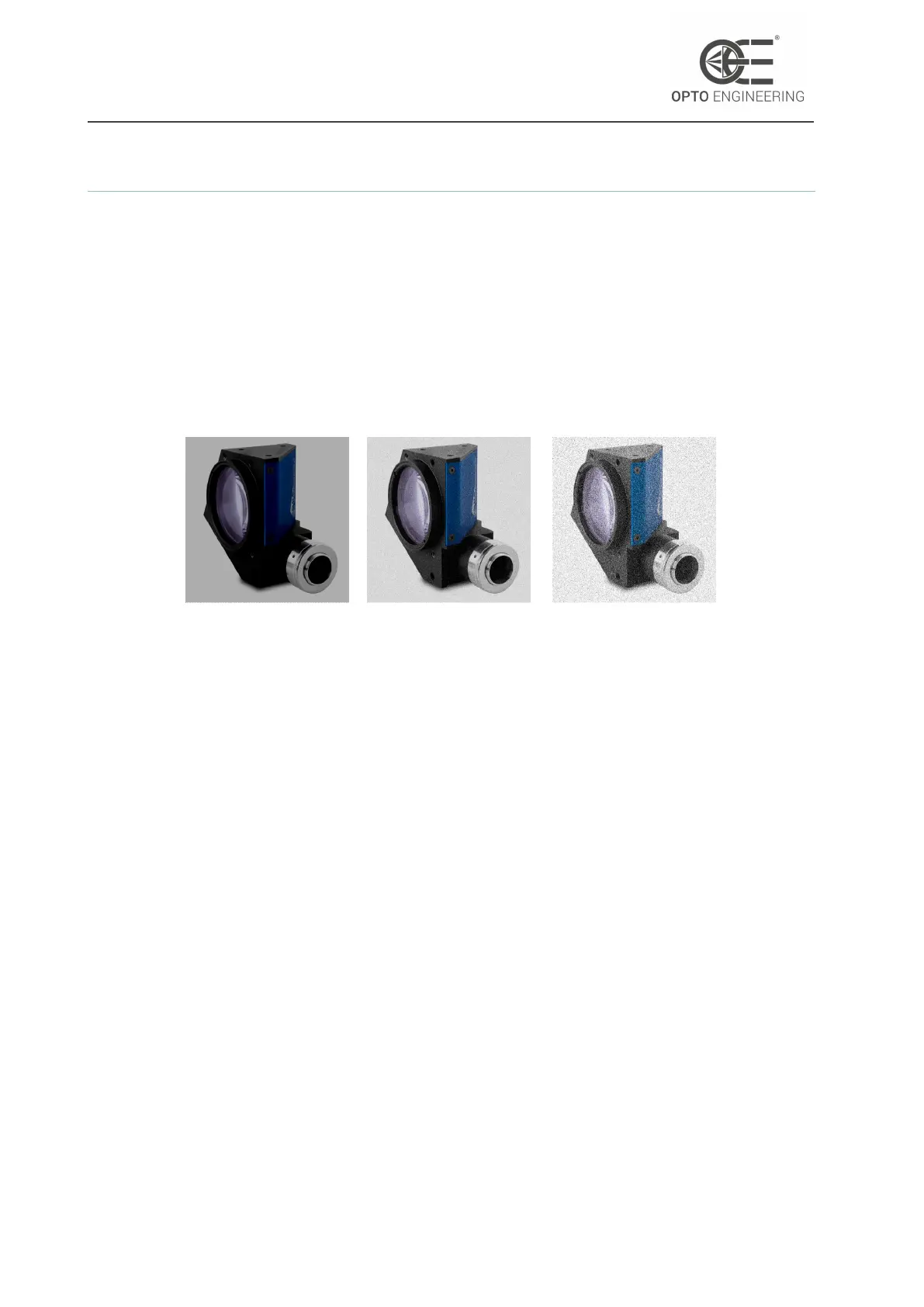
Sensor gain, however, affects indiscriminately useful signal and undesired noise: as can be seen in
Fig.49, image brightness increases proportionally to the gain, however image quality can decrease
in case of high gain values due to excessive noise.
Figure 49: Different gain images
6.4.2 White balance
The white balance feature allows the adjustment of the response of the three color channels (R,
G, B) of color cameras.
Typically color sensors have different sensitivities for the three color coordinates: this is mainly
due to the different response of the Bayer filter present on top of the image sensor.
In Fig.50 (left figure) is shown a typical characteristic of a color sensor: even in case of perfectly uni-
form external light (i.e. flat spectrum), the pixel responses are not uniform (different mean values
of grey levels), therefore green pixels will result brighter than red and blue ones.
To solve this inhomogeneity a scaling factor can be applied to the three color channels:
R
out
= K
red
∗ R
in
(4)
G
out
= K
green
∗ G
in
(5)
B
out
= K
blue
∗ B
in
(6)
To further simplify this operation a color channel may be kept constant (typically the green one,
since it’s the dominant Bayer tile color). The white balance coefficient for the red and blue channels
can be therefore written as:
R
out
= K
red
∗ R
in
(7)
G
out
= G
in
(8)
v1.12 - eng 71


 To Next Page