6-60
PFC-6006 • 5403559 • REV D • 11/17
Section 6: IP Communication
The system's built-in, on-board IP Communicator provides notication to a remote monitoring company when alarms, troubles,
and supervisory conditions occur. The IP Communicator is used with an IP capable Sur-Guard receiver by means of the Fibro
protocol.
Programming options allow you to select accounts for test events and alarm, trouble, and supervisory conditions. You may
set up IP parameters, such as when and where to send reports by specifying IP addresses and other report output options. An
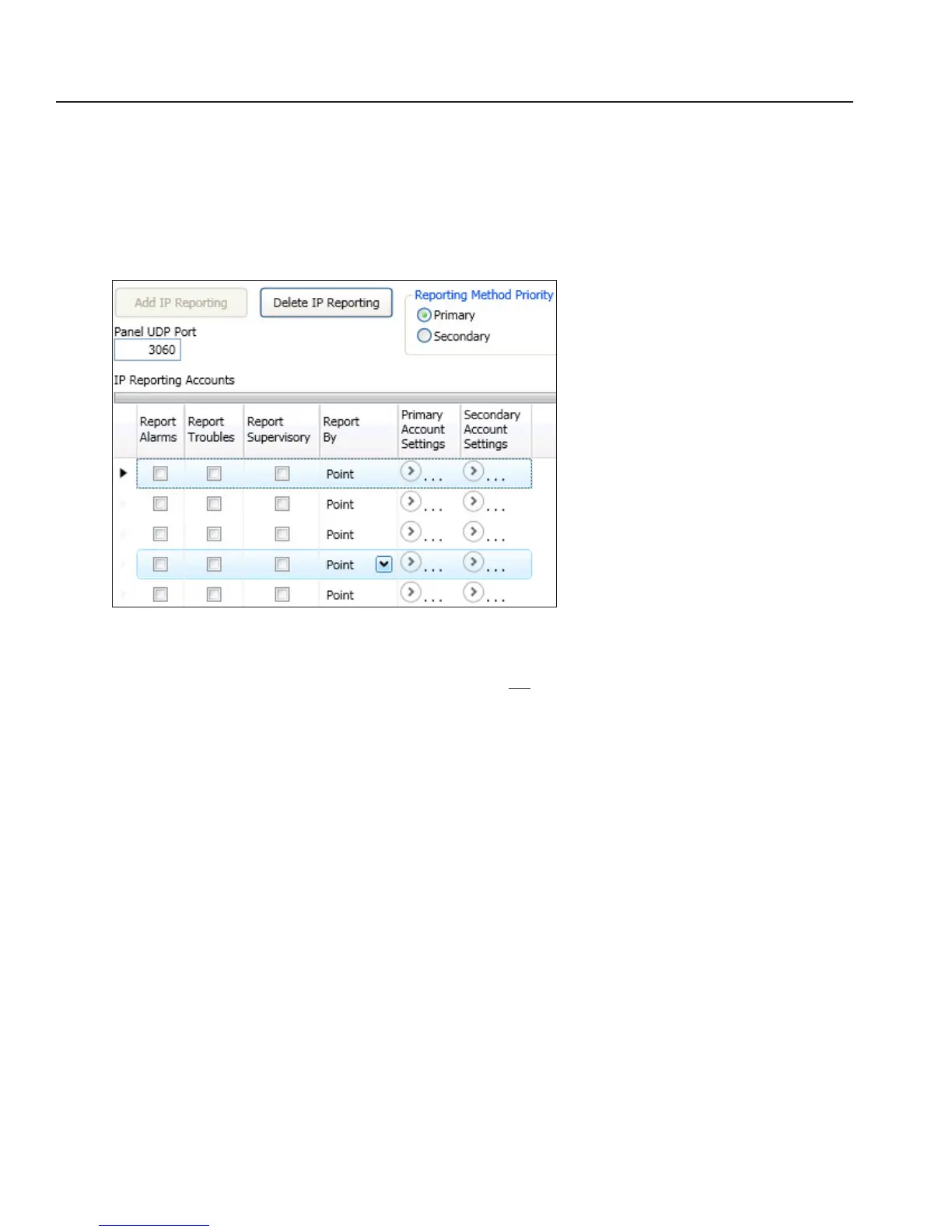
example of the Add – IP Communicator window is shown below.
Figure 71. Example of the IP Reporting Window
Notes:
1. A daily test can automatically be sent to a remote monitoring location; the test time may be programmed through the
General Options program window – “Time to Send Autotest” eld.
2. If the system has been programmed to use the IP Communicator and the on-board DACT, the daily test call can be sent
to both reporting accounts.
3. If the IP Communicator is not programmed and the on-board DACT is not enabled, the system will operate as a local
panel.
4. Where the re alarm transmitter is sharing on-premises communications equipment, the shared equipment shall be
UL listed.
5. Secondary power shall be provided for all equipment necessary for the transmission and reception of alarm, supervisory
and trouble signals at the protected premises.
6. Secondary power shall be provided for all equipment necessary for the transmission and reception of alarm, supervisory
and trouble signals at the supervising station.



 To Next Page