SECTION 17: DUCT C ONSIDERATIONS
69 of 154
SECTION 17: DUCT CONSIDERATIONS
The air handler has been designed to operate at the
specific air volume and external static pressure that
was originally specified. Static pressure is increased
by any additional components that are added to the
air handler (i.e. inlet hood, filter section, dampers,
ductwork, discharge heads, etc) Additional static
pressure beyond original intention (or time of order)
will affect the performance of the air handler and
reduce the air volume that can be delivered.
Proper engineering methods need to be employed
when calculating duct and component static pressure
(i.e. 2009 ASHRAE Handbook - Fundamentals,
Chapter 21).
The system ductwork must comply with Sheet Metal
and Air Conditioning Contractors Nationals
Association (SMACNA) or any other recognized
standards.
As a general rule, all ducting should have a straight
run of at least 3 duct diameters immediately before
and after the air handlers mechanical accessories.
No duct fittings, elbows or transitions with restrictions
can be placed within 3 duct diameters.
Duct diameter for round ducts (in inches):
Dh = d
Dh:diameter
d:round duct inside diameter
Duct diameter for rectangular d
ucts (in inches):
Dh = (2*H*W)/(H+W)
Dh:diameter
H:rectangular duct inside height
W:rectangular duct inside width
The air handler is not designed to support the weight
of ductwork. Ductwork must be constructed in a
fashion that is self-supporting. Ductwork should be
straight, elbows should be minimal and any
transitions should be gradual.
Depending on the options ordered with the air
handler, flanges (either external or internal) may be
provided to facilitate connection of ductwork. In
cases where flanges are not provided, flat surfaces
on the exterior skin of the air handler are provided to
facilitate connection of ductwork.
Neither the flanges nor exterior skin of the air handler
are capable of supporting the load of the ductwork.
Ductwork support must come from the structure itself
that the air handler is serv
icing. On horizontal runs, it
is recommended that ductwork be supported every 6
ft (1.8 m) for ductwork that has a cross section of 10 ft
(3 m) or less and every 4 ft (1.2 m) for ductwork
which has a cross section of greater than 10 ft (3 m).
On vertical runs, it is recommended that ductwork be
supported every 10 ft (3.0 m). On both cases,
supporting members should be sized to carry the
weight load.
17.1 Inlet Air Duct
Inlet duct work height and width must be no smaller
than the air handler inlet height and width and supply
only uncontaminated air to the air handler. (See
Page 10, Section 5 for return air dimensions).
17.2 Return Air Duct
Return air duct work height and width must be no
smaller than the air handler return air opening height
and width. (See Page 10, Section 5 for return air
dimensions).
17.3 Supply Air Duct Work
Supply air duct work sizes sho
uld be determined by
the application requirements of the system. Supply
air ductwork must be smaller than supply air
opening. See Page 10, Section 5 for dimensions.
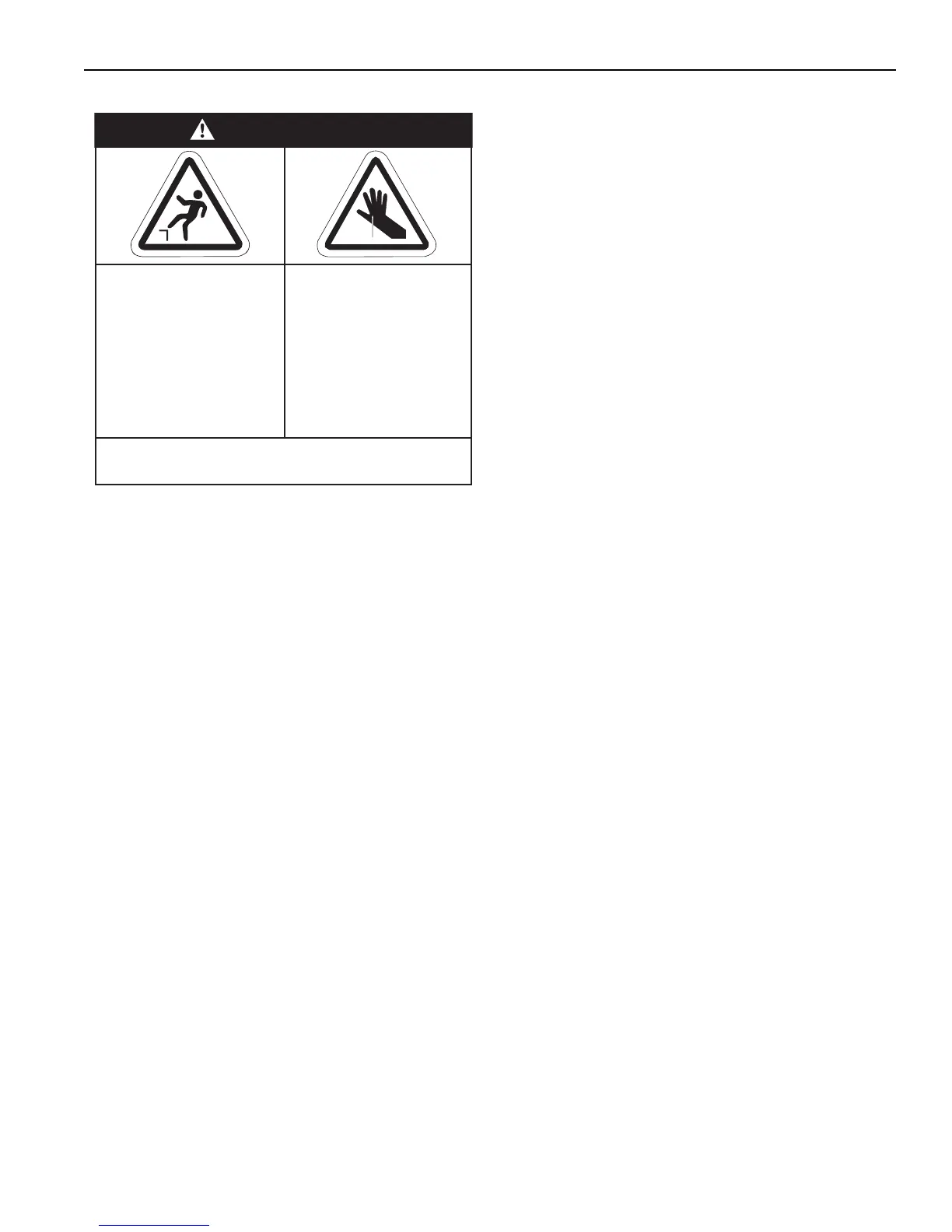
Cut/Pinch Hazard
Wear protective gear
during installation,
operation and
service.
Edges are sharp.
Falling Hazard
Use proper safety
equipment and prac-
tices to avoid falling.
WARNING
Failure to follow these instructions can result
in death, injury or property damage.


 To Next Page