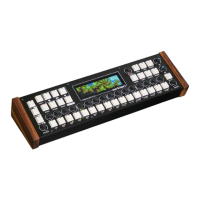
Playlist Edit
In simple terms, playlists tell P3 which patterns to play on each of the 8 tracks.
There is always a playlist at work on each track, but the default playlists are created so that if you
don’t need to work with patterns any longer than the basic 16 steps, then you don’t need to know
much about playlists at all.
It will still be useful to understand what they do.
Why Playlists?
You already saw how to chain a number of patterns together across all the tracks, using a part chain .
Let’s say that you want to chain four patterns together on one track, but only need single patterns on
the other tracks.
With a part chain , you would need to copy the single patterns to three other locations used by the
other parts – time consuming and wasteful of space.
Or you may want to transpose the same pattern to a number of different pitches over several bars, but
don’t want to waste all your parts copying the same pattern multiple times, and part transposing it.
And part transpose will not be any use if you want some patterns to stay at the same pitch while others
are transposed.
This is the sort of thing playlists are for:
• A playlist lets you define a sequence of patterns to be played on a track.
• Each pattern can be used as often as you like in the playlist, up to the limit of 8 steps.
• The pattern on each step can be transposed over a wide range, and can be repeated up to 8
times.
• Playlists can also let you synchronise patterns to the global bar – so you can keep patterns with
uneven lengths in step.



 To Next Page