October 2017 RiverPro and RioPro ADCP Guide
Page 40
EAR-Controlled Technology Subject to Restrictions Contained on the Cover Page.
Maintenance Schedule
To ensure continuous optimal results from the RiverPro/RioPro, TRDI recommends that every
RiverPro/RioPro be returned to our factory for an inspection every two to three years. TRDI’s customer
service will provide the unit with a thorough multi-point inspection and any refurbishment services
needed to properly maintain the unit. To learn more about this service, please contact TRDI.
Calibration Items
Use the following calibration schedule:
Item TRDI Recommended Period
Transducer Beam Angle TRDI recommends return every two to three years for verification of velocity accuracy
Pitch & Roll (Tilt)
TRDI recommends return every two to three years for factory calibration Temperature (Factory)
Heading (Factory)
Heading (Field Pre-Deploy) Field Compass Calibration performed prior to each deployment (see Compass Calibration)
Heading (Field Post-Deploy) Field Compass Verification performed post each deployment
Compass drift effects will accumulate over time. TRDI recommends a factory calibration be
done every two to three years. Expect to have more error (due to drift) if a longer period is
between factory calibrations.
Maintenance Items
Inspect the RiverPro/RioPro to spot problems:
Item TRDI Recommended Period
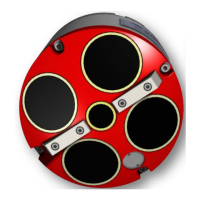
Transducer Beams
The urethane coating is important to RiverPro/RioPro watertight integrity. Many users are not familiar with the
early signs of urethane failure. The primary damage to the urethane is from bio-fouling and long exposure to the
water and sun. Damage occurs on the surface of the urethane and at the edge where the urethane bonds to the
cups. Mishandling, chemicals, abrasive cleaners and excessive depth pressures can also damage the transducer
ceramics or urethane coating.
Before each deployment, check the urethane coating on the transducer faces for dents, chipping, peeling, ure-
thane shrinkage, hairline cracks and damage that may affect watertight integrity or transducer operation.
Based on experience, TRDI knows that most systems need to have the urethane in-
spected after three to five years of field use
; shorter periods may be required depending on marine
growth.
O-rings
O-rings should be replaced whenever the system is opened and BEFORE they are showing any signs of wear and
tear. Replace the end-cap O-ring each time the end-cap is removed.
All O-rings should be replaced
every one to two years maximum.
Housing and End Cap
Inspect for damage and remove biofouling
before each deployment.
Hardware (bolts, etc.)
Check all bolts, washers and split washers for signs of corrosion before each deployment.
TRDI recommends
replacement every one to two years maximum.
Damaged hardware should never be used.
Cables and Connectors
Check the end-cap I/O connector for cracks or bent pins (see Figure 12 and Figure 13) before each deployment.
Check the cable connectors for cracks or bent pins. Inspect the full length of the cable for cuts, nicks in the insula-
tion, and exposed conductors before each deployment.
The I/O cable connectors must be lubricated before every connection.


 To Next Page