October 2017 RiverPro and RioPro ADCP Guide
Page 28
EAR-Controlled Technology Subject to Restrictions Contained on the Cover Page.
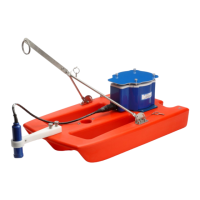
Over-the-Side Mounting
The over-the-side mount is common if you want the ability to move the RiverPro/RioPro from one plat-
form to another. Make the mount as rigid as possible to limit the amount of pitch and roll applied to the
RiverPro/RioPro. Although the tilt sensor can measure a ±70° influence, anything beyond 15° will cause
bias to the data that cannot be removed. No matter what mounting style is used, the RiverPro/RioPro
must be below the bubble layer. Bubbles will cling to the urethane faces of the RiverPro/RioPro and re-
duce the range to almost nothing. Usually a mount somewhere aft of amidship is used. A stern mount will
cause all sorts of problems due to propeller wake, bubbles, and turbulent water conditions.
The most common over-the-side mounting method for RiverPro/RioPro ADCPs uses a Kentucky Mount
style. For more information, see the following:
• http://hydroacoustics.usgs.gov/movingboat/pdfs/KYMount.pdf
• http://hydroacoustics.usgs.gov/movingboat/mbd_deployments.shtml
Our transducer assembly is sturdy, but TRDI did not design it to withstand collisions with all
boating objects. TRDI strongly suggests protecting the RiverPro/RioPro if this is a possibility.
Avoid using ferro-magnetic materials in the mounting fixtures or near the RiverPro/RioPro.
They affect the compass. Use 316 stainless steel hardware.
See the Outline Installation Drawings for dimensions and weights.
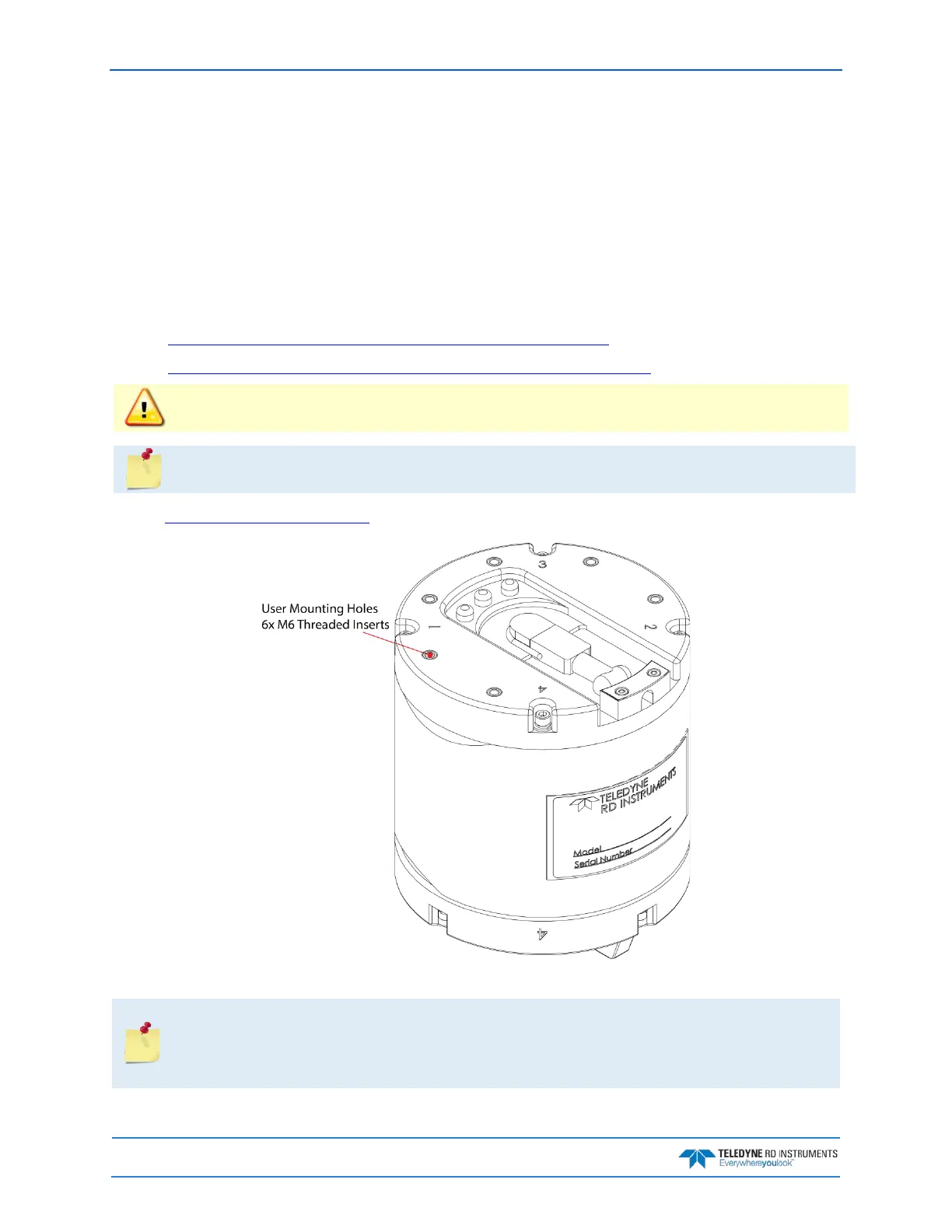
Figure 11. End-Cap User Mounting Holes
Only use M6x1.0 stainless steel hardware.
The maximum thru-hole diameter in the mounting plate is 6.85 mm (0.270 inch). Using a
larger thru-hole could result in the threaded metal inserts on the end-cap being pulled out of
the plastic end-cap.


 To Next Page