TSAT 3000 - Telemetry and data transfer via SATellite
TSAT 3000 Configuration Parameter Description, January 2013 Page 78 of 124
3.11.10 PHL_SLOT_PHASE_MODE
Ver <= 30.2.0: Default 0, Range 0…0xFFFF
Ver >= 30.3.0: Default 0, Range 0…0x00FF.FFFF
Ver <= 30.2.0
Not Used.
Note: DSP will be reprogrammed 10 seconds after you’ve changed CURRENT value.
Ver >= 30.3.0 + DSP >= 2.0.1
You may enable the “Pulse Position Reservation (PPR) Facility” when DSP Ver >= D2.0.0.
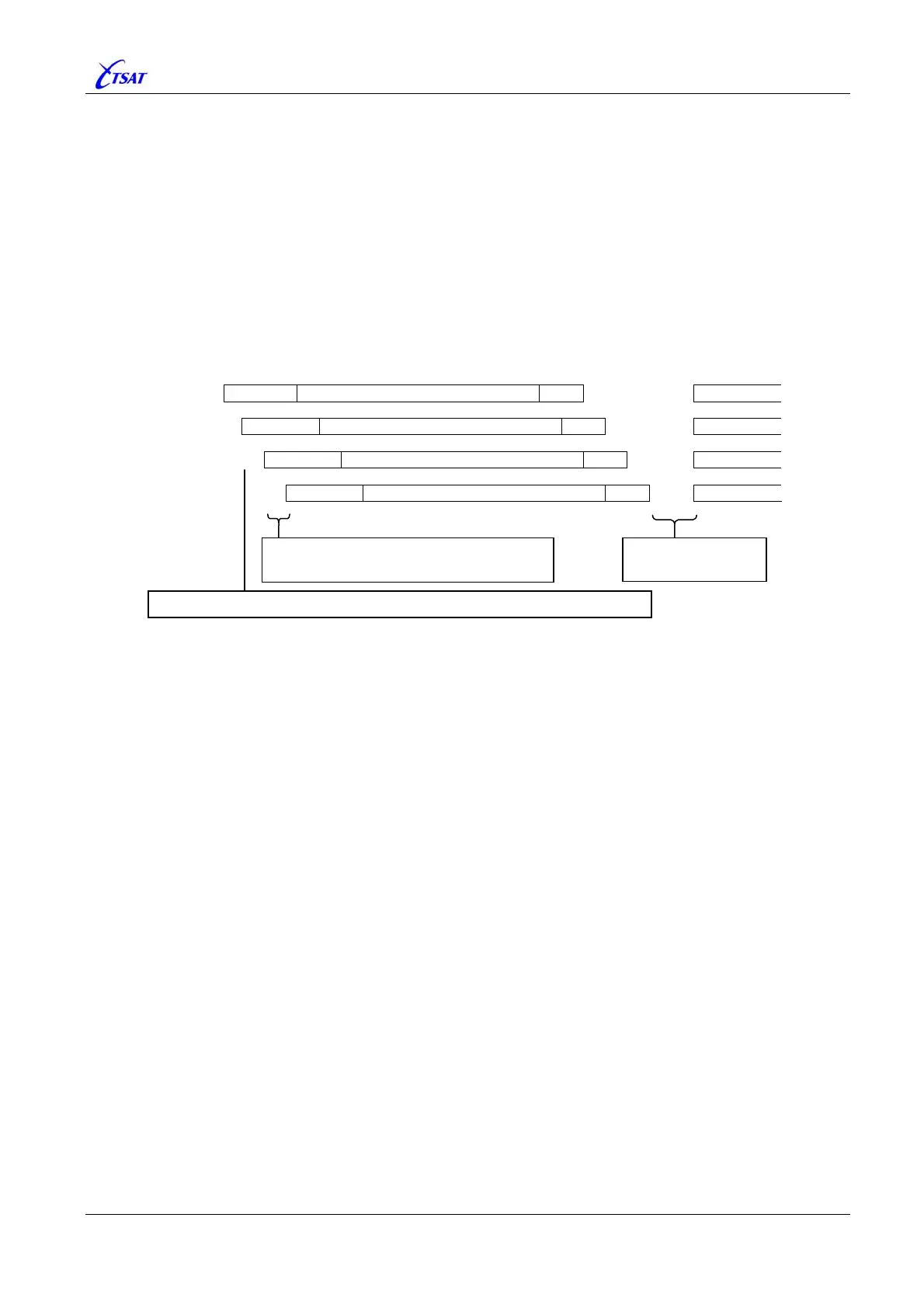
When the “Pulse Position Reservation Facility” is enabled (PULSES >= 2), all packets from the
RTs to HUB are sent at different positions of time within the slot, as shown in the figure below.
Send in Pos 0 Preamble
PKT_INBOUND_SIZE number of bytes CRC Next Slot
Send in Pos 1 Preamble PKT_INBOUND_SIZE number of bytes CRC Next Slot
Send in Pos 2 Preamble PKT_INBOUND_SIZE number of bytes CRC Next Slot
Send in Pos 3 Preamble PKT_INBOUND_SIZE number of bytes CRC Next Slot
When received at the HUB, it will detect in which position the packet was sent, but this
information is not used when a single OK packet is received. When two or more RTs are
sending packets to the HUB in the same slot, the packets will collide. Normally this will result
in a CRC error (sometimes one of them will be decoded OK). The HUB is still able to detect at
which positions the packets were sent. This information is signalled back to all RTs, inbound
slots will be reserved, and the RTs (that know they have sent a packet in the specified position
and slot) will retransmit the packets.
In addition to increasing the available Inbound throughput in a Slotted-ALOHA network, this
facility will also make it easier for the RT to log into the TSAT network after a restart. The RT
will try to log into the network by sending a
LINK_RESET packet to the HUB. When other RTs
are sending a lot of data to the HUB, the packets may collide, and the RT will retransmit the
LINK_RESET after LCC_{MIN | MAX}_RESET_RETRANS_DELAY (normally 10 … 20 seconds).
The RT will reset itself if it hasn’t got a reply (
LINK_ACK) after LCC_MAX_LINK_RETRIES
(normally 5). With the "Pulse Position Reservation Facility" enabled, slots will be reserved
when packets collide, and the
LINK_RESET packet will be retransmitted by the PPR
retransmission mechanism.
The “Pulse Position Reservation (PPR) Facility” is primarily intended to be used in networks
configured for Slotted-ALOHA access to the Inbound channel. The following benefits are
offered:
• Increased application Inbound throughput. In normal Slotted-ALOHA systems, network
saturation is reached at less than 37 % of the maximal Inbound throughput. With the PPR
protocol, you can expect the point of saturation to be greater than 60 %.
• Decreased response time, as nearly all collided packets will be retransmitted immediately.
There is no need to wait for the retransmission timer to expire.
• Make it easier for the RT to log into the TSAT network after a restart (when there is a lot of
Inbound traffic from the other RTs).
SEPARATION is the space between pulses,
measured in number of s
mbols.
PULSES is in this exam
le 4. I.e. it is
ossible to send in 4 different
osition
.
Approx 4 symbols
between
ackets.



 To Next Page